 Go Back

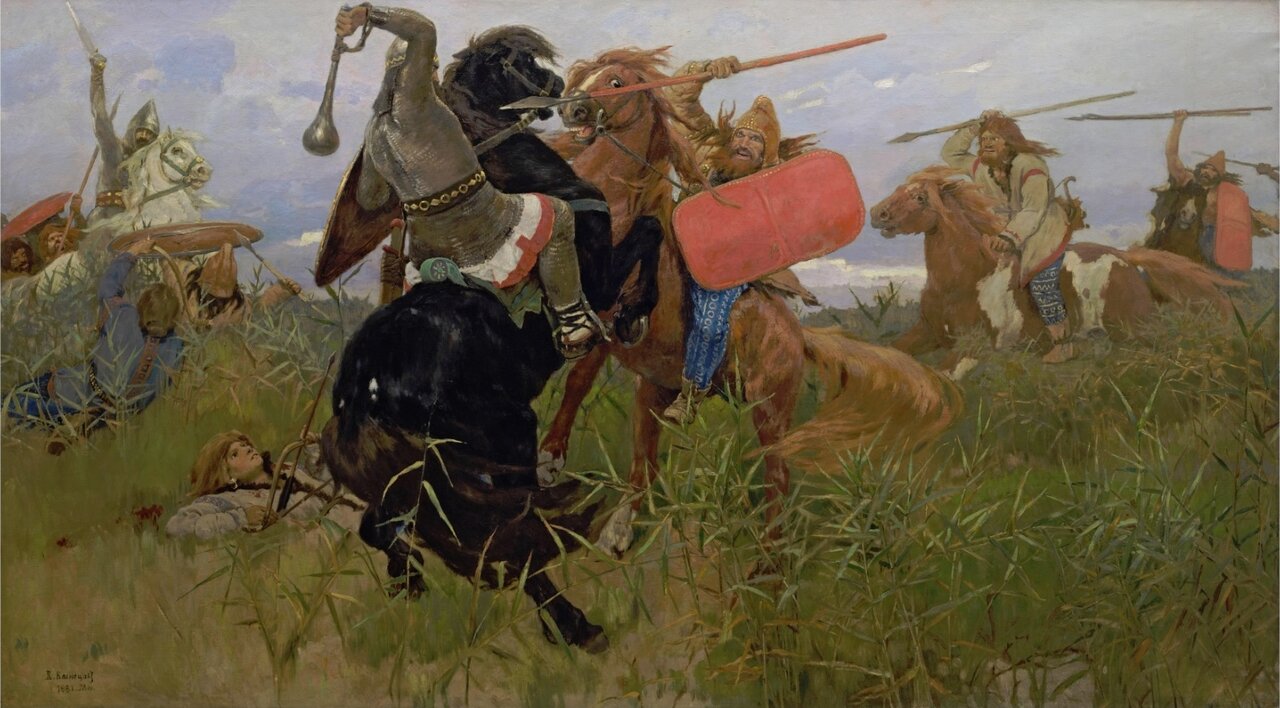
The Early Slavs (c. 500-1000 CE) emerge into written history in the 6th century, when Byzantine authors such as Procopius and Jordanes describe peoples called Sclaveni and Antes raiding across the Danube. Their earlier homeland is placed by most scholars between the Vistula and the Dnieper, in the forest and marsh country of present-day Poland, Ukraine and Belarus. They lived in small villages, farmed with simple plows, kept livestock, and organized themselves in kin groups and tribal assemblies without kings. Archaeologists associate them with modest handmade pottery and sunken-floor huts, material so plain that early Slavic settlements are hard to trace.
From the later 6th century Slavic groups expanded in every direction, often in the shadow of the Avar khaganate, whose horsemen dominated the Danube plain. They flooded into the Balkans, besieging Thessalonica and settling permanently in Greece; they spread west to the Elbe and the Baltic, and east into the Russian forests, where they mixed with Baltic and Finnic peoples. By the 7th century Slavs formed the majority population over most of eastern and central Europe. New polities soon appeared: the Samo realm (c. 623-658), the first known Slavic 'kingdom', resisted both Avars and Franks, and Carantania and Great Moravia followed.
Slavic religion was polytheistic, centered on gods of sky, storm and fertility such as Perun and Veles, with sacred groves, springs and carved idols rather than temples. Conversion came gradually. In 863 the brothers Cyril and Methodius from Thessalonica began preaching to Great Moravia in the Slavic vernacular, devising the Glagolitic alphabet, ancestor of Cyrillic, to translate scripture and law. Their mission, welcomed in Moravia but opposed by Frankish clergy, planted Slavic literacy that later flourished in Bulgaria, Serbia and Rus'. Political Christianization followed: the Bohemian and Polish dukes accepted Latin Christianity in the 10th century, Bulgaria in 864, and the Rus' of Kiev under Vladimir in 988.
The early Slavs left a deep mark on Europe's map and languages. Their descendants form the largest European language family group, from Polish, Czech and Croatian to Bulgarian, Ukrainian and Russian. Slavic settlement redrew the ethnic geography of the Balkans and the east European plain, and the first Slavic states, Moravia, Bohemia, Poland, Bulgaria and Kievan Rus', became the enduring political nations of eastern Europe. Villages, open-field farming and a strong oral tradition of epic and song characterized their culture, while their adoption of Christianity in both its Latin and Byzantine forms tied different Slavic peoples to Europe's two Christian worlds.
 Britannica: Slav
 World History Encyclopedia: Slavs