 Go Back

Monastic Ireland. Christianity reached Ireland in the fifth century, traditionally with the mission of Patrick in 432, and it took root in a society without cities or Roman institutions. The Irish Church grew around monasteries rather than bishops' seats, and the monastery became the island's town, school, workshop and sanctuary all at once. Great houses like Clonmacnoise on the Shannon, Glendalough in the Wicklow hills, Kells, Armagh and Durrow gathered hundreds of monks, students, farmers and craftsmen around a saint's grave and a abbot's rule.
These monasteries made Ireland, in the phrase of the age, an island of saints and scholars. Irish scribes copied the Gospels and the Latin classics in a distinctive hand, decorating them with knotwork, spirals and interlaced beasts drawn from older Celtic metalwork. The masterpieces of this art - the Book of Kells, the Book of Durrow, the Lindisfarne Gospels made by Irish-trained monks - are among the supreme achievements of medieval Europe. Irish scholars kept Greek learning alive when it had faded in the West, and the monks of Bangor and Clonard taught students from Britain and the continent.
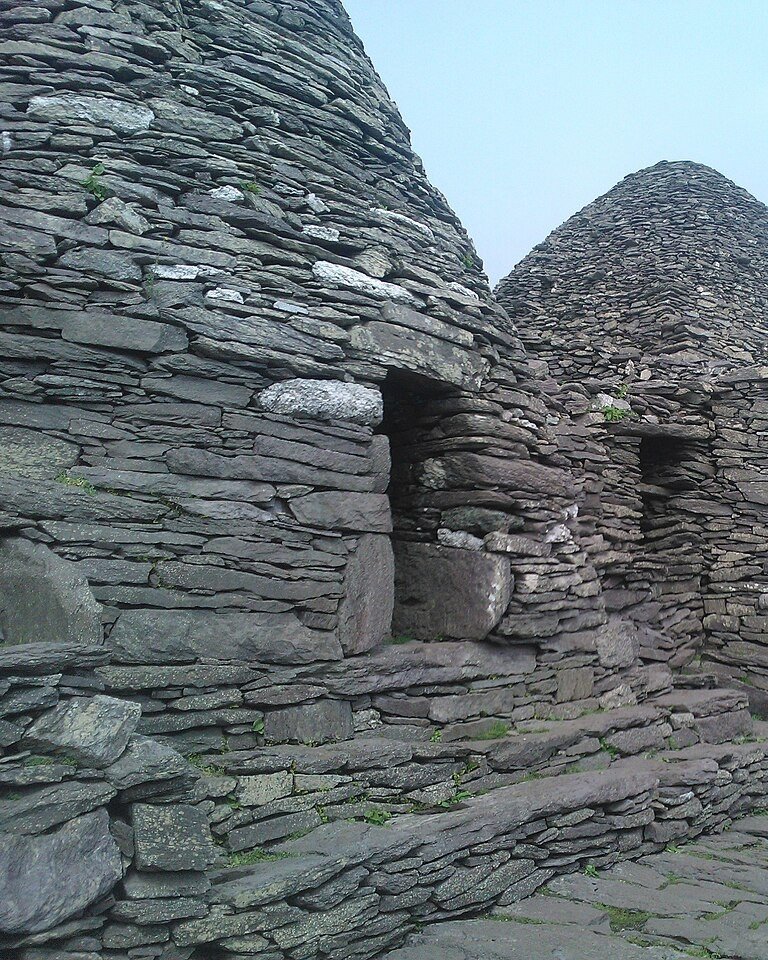
Irish monks also went out as pilgrims and missionaries. Columba founded Iona off Scotland in 563, from which much of northern Britain was converted; Columbanus carried the Irish rule to Gaul and Italy, founding Luxeuil and Bobbio. The austere hermitage of Skellig Michael, perched on a sea-rock off Kerry, shows the other pole of the movement: withdrawal into the Atlantic wilderness. It was Irish monks, too, who taught the Anglo-Saxons at Lindisfarne, seeding the Northumbrian golden age.
The Viking raids of the ninth and tenth centuries burned many great houses and scattered their treasures, and the twelfth-century reform of the Irish Church, capped by the Synod of Kells in 1152, brought Ireland into line with the diocesan structure of continental Christendom. The old monasteries gave way to continental orders, but their legacy endured: a manuscript art without equal, and a memory of learning that became central to Irish identity.
 Britannica: Early Christian Ireland
 World History Encyclopedia: Book of Kells
 UNESCO: Skellig Michael