 Go Back

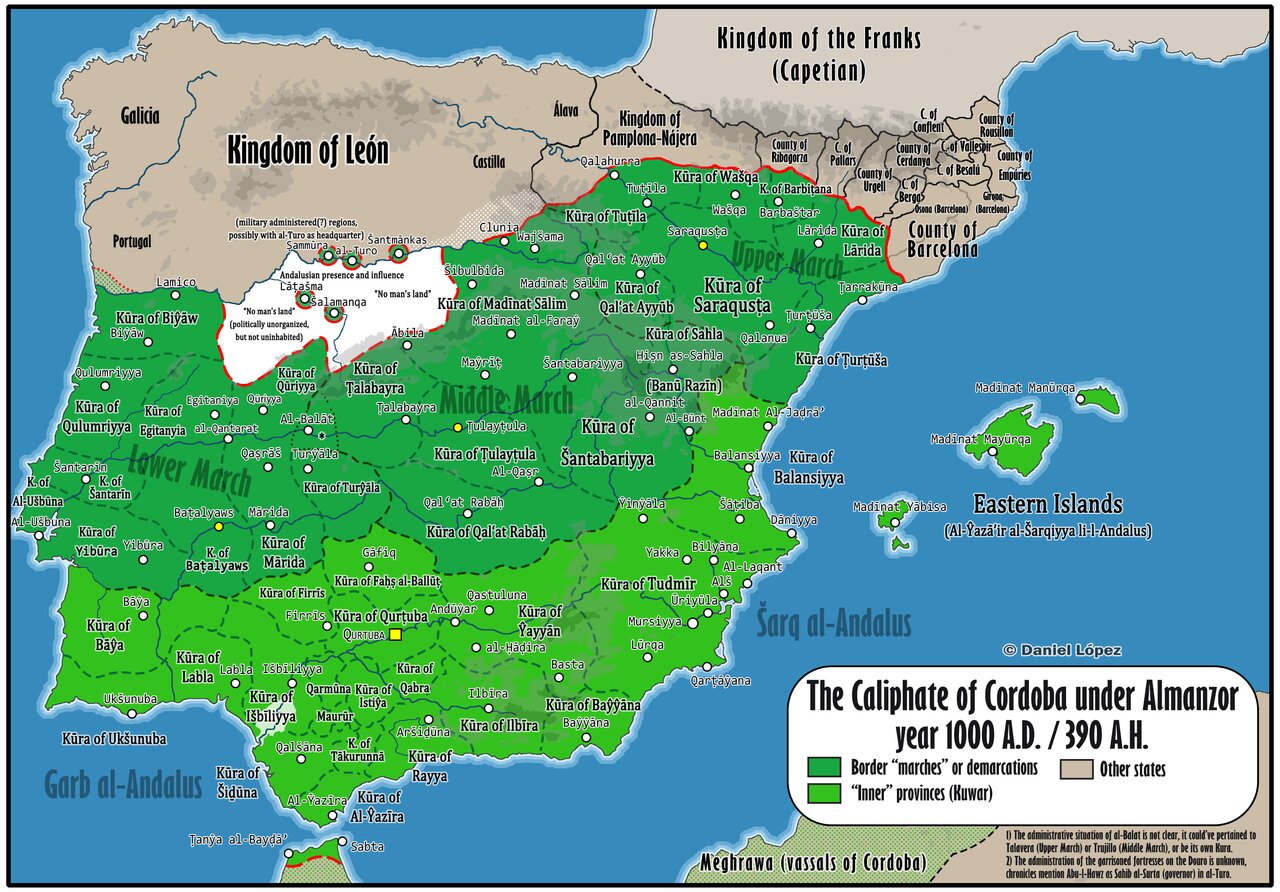
The Caliphate of Cordoba (929-1031) was the zenith of Muslim al-Andalus, the Iberian lands ruled from 711 by conquerors from North Africa. After the Umayyad caliphate fell in the east, the refugee prince Abd al-Rahman I crossed to Spain in 750, overthrew its governors and founded the Emirate of Cordoba (756). For two centuries his descendants gradually subdued the fractious Arab and Berber elites, defended the frontier against the Christian north and the Fatimids in Africa, and built a centralized administration on Islamic and Persianate lines.
In 929 Abd al-Rahman III took the title of caliph, commander of the faithful, directly challenging the Fatimids in Ifriqiya and the Abbasids in Baghdad. His reign, and that of his son al-Hakam II, marked the caliphate's golden age. Cordoba became the largest and most splendid city in western Europe, with paved streets, markets, hospitals and a famous library of hundreds of thousands of volumes. A school of translators and scholars, physicians, astronomers and poets made it a meeting point of Arabic, Latin, Greek, Jewish and Berber learning. Royal workshops produced ivories and silks prized from France to Egypt, and the caliphs began the palace-city of Madinat al-Zahra outside the capital, a monument of Islamic art and power.
The caliphate's strength rested on a professional army increasingly built on Berber recruits and on purchased slave-soldiers, the saqaliba, whose commanders grew into kingmakers. Al-Hakam II's death in 976 left a child caliph, Hisham II, and real power passed to the brilliant and ruthless chamberlain al-Mansur (Almanzor), who won more than fifty campaigns, sacked Barcelona (985), Leon (988) and even Santiago de Compostela (997). But Almanzor and his sons ruled through the army, and after their deaths (1002, 1008) the system tore itself apart: Berber and saqaliba factions, rival Umayyad claimants and the great cities plunged al-Andalus into the civil war known as the Fitna.
In 1031 the leading families of Cordoba abolished the caliphate altogether, and al-Andalus shattered into the taifa kingdoms. Politically fragmented, Muslim Spain lost Toledo to Alfonso VI of Castile in 1085 and survived only through North African intervention, first by the Almoravids, then the Almohads. Yet the caliphate's cultural legacy outlasted its politics: through Cordoba's scholars, Arabic science, philosophy, medicine and poetry passed into Latin Europe, and the Great Mosque the caliphs enlarged, with its forest of columns and horseshoe arches, still stands as the emblem of al-Andalus.
 Britannica: Al-Andalus
 World History Encyclopedia: Umayyad Dynasty
Britannica: Córdoba
World History Encyclopedia: Reconquista