 Go Back

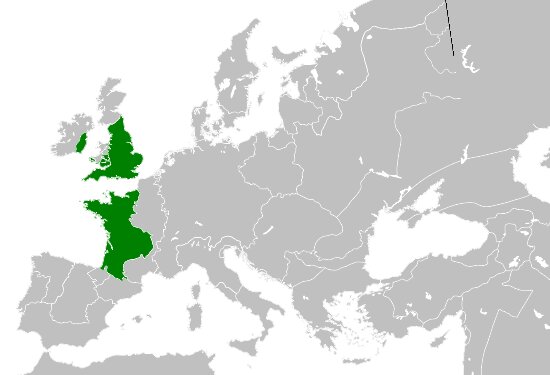
The Angevin Empire (1154-1214) is the name historians give to the collection of lands ruled by the first Plantagenet king, Henry II, and his sons. Its core was the county of Anjou, whose counts built power by war and marriage; Geoffrey Plantagenet of Anjou married Matilda, daughter of Henry I of England, and their son Henry inherited England in 1154 after the civil wars of Stephen's reign. To England, Normandy and Anjou, Henry added by marriage to Eleanor of Aquitaine the vast duchy of Aquitaine stretching to the Pyrenees, and overlordship over Brittany, Wales, Scotland and, later, much of Ireland. At its height this 'empire' controlled half of France and the whole of England, making Henry richer in land than his nominal overlord, the king of France.
The empire was a patchwork, not a state: each land kept its own law, coinage, language and institutions, and the king ruled by constant travel between them, from Newcastle to the Pyrenees. Henry II's great work was administrative. In England he developed royal justice, itinerant judges, juries of presentment and the writ system that became the common law, and he reformed finances after the anarchy. His attempt to extend royal jurisdiction over the church led to his famous quarrel with Archbishop Thomas Becket, whose murder in Canterbury Cathedral in 1170, by knights taking the king's angry words literally, shocked Christendom and forced Henry to compromise and do penance.
Henry's empire was also a family firm that turned on itself. Eleanor and her sons resented his control, and in 1173-1174 the Young King Henry, Richard and Geoffrey, backed by the kings of France and Scotland, rose in a great rebellion that Henry defeated. Imprisoned for fifteen years, Eleanor outlived the struggle; the Young King and Geoffrey died rebelling. Richard I 'the Lionheart', king from 1189, spent barely six months of his reign in England: he led the Third Crusade to victory at Arsuf and the walls of Jerusalem, was captured on his way home and ransomed for a crippling sum, then died campaigning in France in 1199, leaving the inheritance to his brother John.
John's reign undid the empire. Philip II of France, a patient and ruthless rival, used John's feudal failures, his quarrel with the Lusignans, and the mysterious death of his nephew Arthur of Brittany to declare his French lands forfeit, then conquered Normandy in 1204 and Anjou, Maine and Touraine soon after. John's attempt to win them back ended with his allies' crushing defeat at Bouvines in 1214, and his overtaxed English barons forced Magna Carta on him in 1215. What remained to the Plantagenets was England and Gascony, and a lasting French-English enmity. The Angevin experiment still mattered: England's common law and administration were forged in it, and the dream of recovering the lost lands helped drive the Hundred Years' War.
 Britannica: Angevin empire
 Encyclopedia.com: Angevin Empire