 Go Back

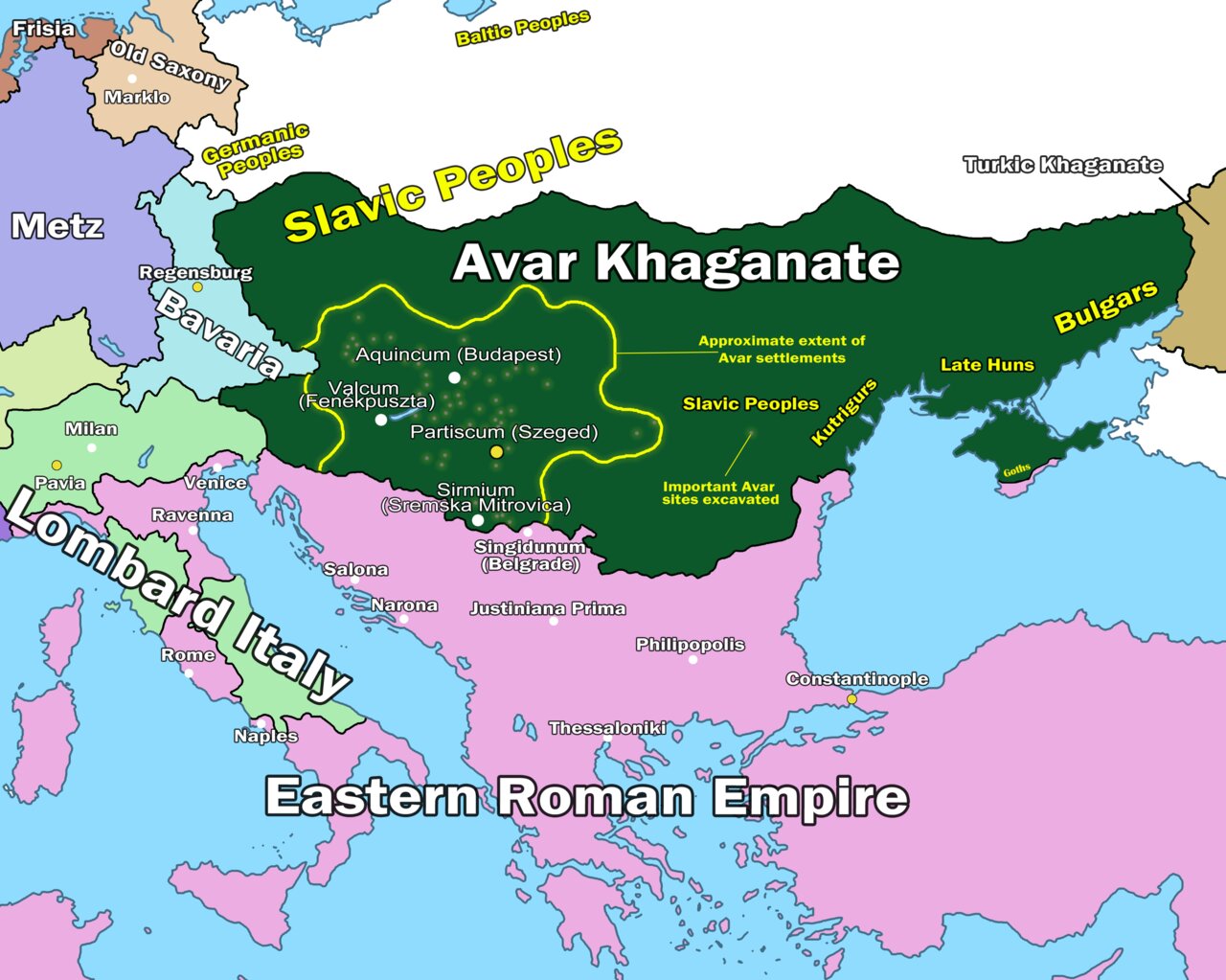
The Avar Khaganate (567-822) was a steppe empire in Central Europe created by the Avars, a nomadic people who appeared on Rome's Danube frontier in 558, fleeing the expansion of the Turks in Central Asia. Byzantine diplomats employed them as allies and mercenaries, but the Avars soon moved west, and in 567, allied with the Lombards, they destroyed the Gepid kingdom; when the Lombards departed for Italy in 568, the Avars took over the whole Carpathian Basin. From the Hungarian plain, rich grazing for their herds, the khagans ruled a multi-ethnic empire of Slavic, Germanic and Romance-speaking subjects stretching from the Alps to the Black Sea.
Under their long-ruling khagan Bayan I, the Avars fought the Byzantine Empire for control of the Balkans. They captured the fortress of Sirmium in 582 after a long blockade, raided deep into Thrace and Greece, and pushed Slavic settlers ahead of their armies into imperial lands. Tribute extracted from Constantinople funded a court famous for goldwork, and Avar archaeology is rich in gold and silver belt fittings, weapons and jewelry showing steppe, Byzantine and Persian influences. Avar power also reorganized the peoples of the north: the first Slavic 'kingdom' of Samo (c. 623-658) was born from a revolt against Avar overlords, and the Bulgars on the lower Danube slipped from Avar control in the 630s.
The khaganate's greatest bid came in 626, when the Avars, allied with the Persian Empire, besieged Constantinople itself. The failure of the assault, broken by the city's walls and fleet, damaged the khagan's prestige across the steppe, and subject peoples began to defect. Civil war among rival Avar factions followed in the 630s, and the empire settled into a smaller but still formidable power centered on the fortified 'ring' encampments of the Hungarian plain, exacting tribute and service from the Slavs of the Carpathians.
The end came from the west. Charlemagne's Franks, allied with dissident Avars and Bulgars, smashed the khaganate in campaigns between 791 and 796, storming the great ring and carrying off its accumulated treasure, which, contemporaries said, enriched the Frankish kingdom for years. Avar power collapsed so completely that a later proverb asked, 'where are the Avars now?', and by 822 the last khagan had accepted Frankish overlordship and baptism before disappearing from history. The khaganate left no written language of its own, but it reshaped eastern Europe: it accelerated Slavic settlement across the Balkans and central Europe and left a legacy of horse gear, warfare and goldsmithing adopted by its successor peoples.
 Britannica: Avar
 World History Encyclopedia: Avars