 Go Back

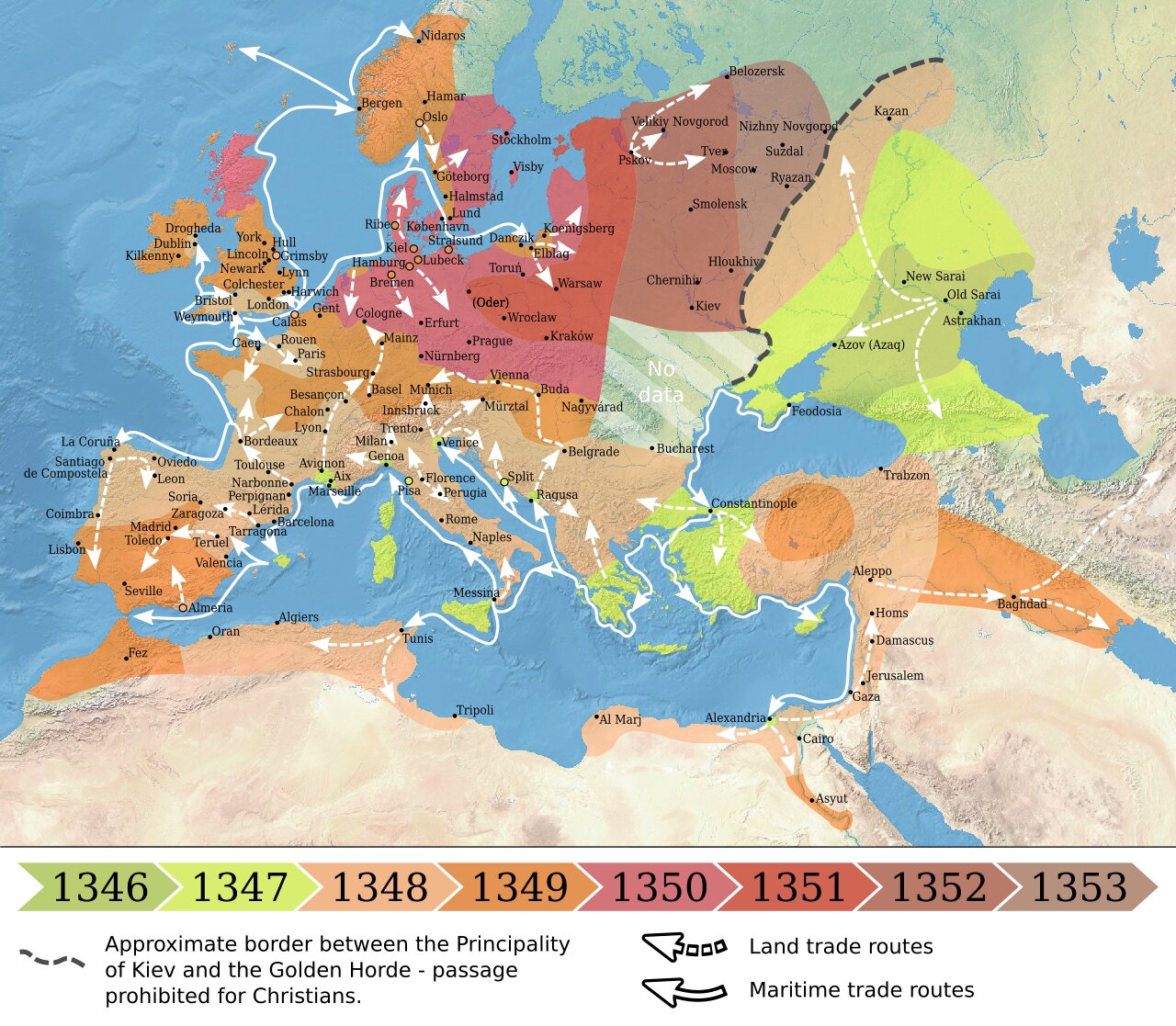
The Black Death (1347-1353) was the deadliest pandemic in recorded history, killing perhaps a third to a half of Europe's people in five years. The disease was plague, caused by the bacterium Yersinia pestis, carried by fleas living on rodents and spread along trade routes from Central Asia. It reached the Black Sea port of Caffa in 1346-1347, during its siege by the Mongols, and Genoese ships carried it to Sicily in October 1347. Within months it was in Italy, France and Spain; by 1348 in England and the Balkans; by 1350 in Germany, Scandinavia and Russia. It returned in repeated waves for four centuries.
Contemporaries described buboes, swollen lymph nodes in groin and armpit, black blotches, spitting blood and death within days; the pneumonic form killed even faster. No remedy worked. Cities lost half their populations; some villages were emptied entirely. Chroniclers like Boccaccio, who watched Florence die and framed the Decameron around it, wrote of parents abandoning children and bodies buried in trenches. Medicine of the day blamed corrupted air, and authorities responded with flight, prayer, quarantines, Ragusa (Dubrovnik) enforced isolation in 1377, and, in some regions, violence: Jewish communities were accused of poisoning wells and massacred in cities from the Rhineland to Spain despite papal condemnation.
The economic consequences reshaped Europe. With a third of the workforce gone, survivors' labor became valuable: wages rose, rents and grain prices fell, and serfs bargained for freedom or fled to towns, accelerating the end of serfdom in western Europe. Landlords answered with repression, England's Statute of Labourers (1351) tried to freeze wages, and the tension exploded in the English Peasants' Revolt (1381), the French Jacquerie (1358) and urban risings in Flanders and Italy. Whole villages were abandoned to pasture, marginal lands reverted to forest, and sheep farming expanded where fields no longer paid.
The cultural and religious effects were as deep. The flagellant movement marched from town to town seeking to avert God's wrath; the church, whose clergy died at high rates tending the sick, lost moral authority; art turned morbid, the danse macabre and memento mori became common motifs. Scholars have long debated links between the plague and the loosening of medieval certainties that fed the Renaissance and, later, calls for church reform. The Black Death did not create the late medieval world, but by thinning population, raising the value of labor and shaking institutions, it hastened the end of the medieval order and the birth of the early modern one.
 Britannica: Black Death
 World History Encyclopedia: Black Death
World History Encyclopedia: Effects of the Black Death on Europe
World History Encyclopedia: Boccaccio on the Black Death