 Go Back

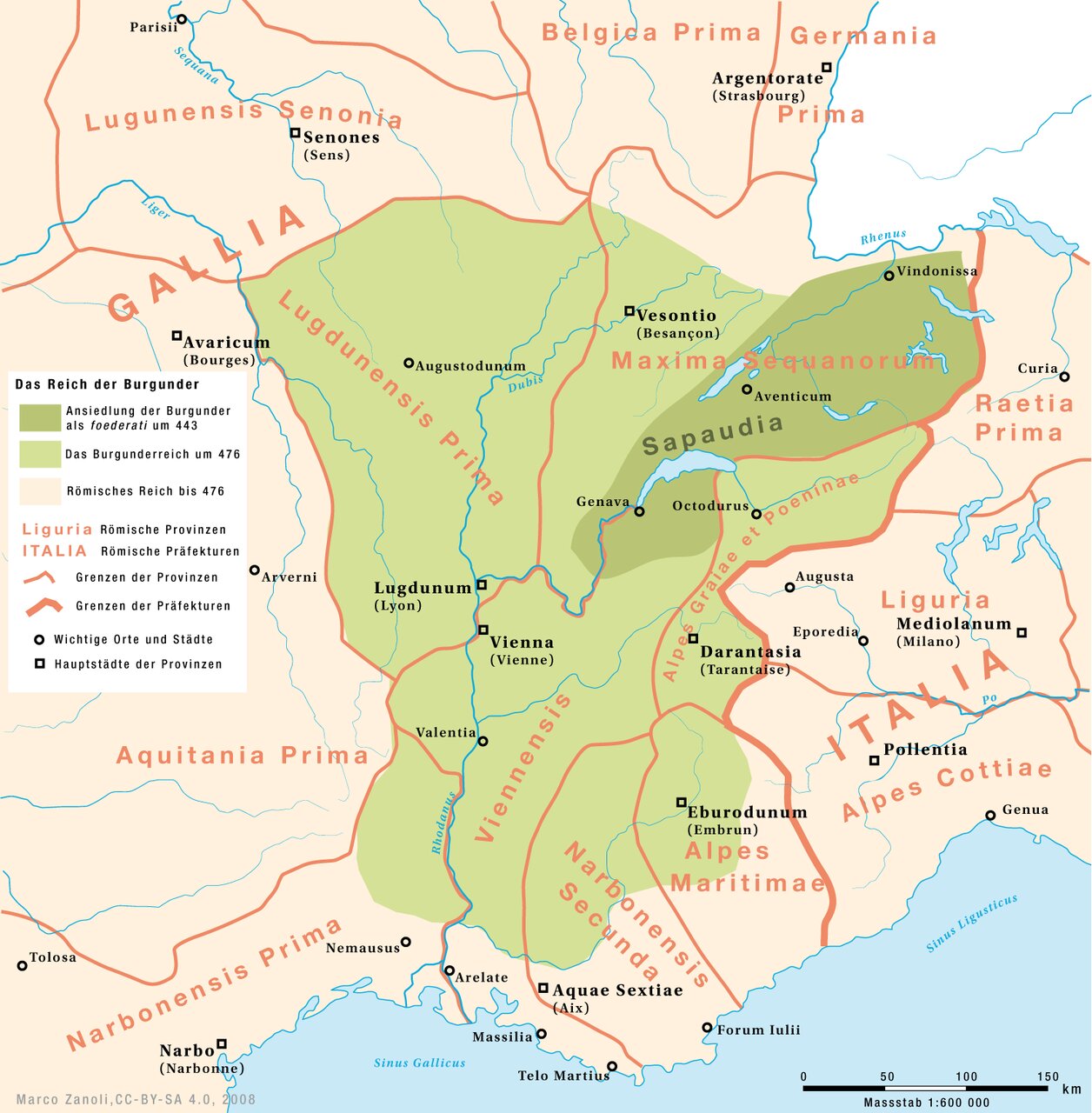
The First Kingdom of Burgundy (413-534) was founded by the Burgundians, an East Germanic people who had migrated from the Baltic across central Europe and settled on the middle Rhine. In 413 their king Gundahar, the Gunther of later legend, established a kingdom at Worms with Roman agreement, serving as federate allies. The kingdom did not last: in 436 Roman magister Aetius unleashed Hunnic auxiliaries against it, destroyed Gundahar and much of his people in a catastrophe later remembered in the Nibelungenlied, and the survivors were resettled in Sapaudia, the region of Lake Geneva and the upper Rhone, in 443.
From Sapaudia the Burgundians expanded into the vacuum left by collapsing Roman power in Gaul. Under King Gundobad (c. 474-516), who had begun his career as a Roman patrician in Italy, the kingdom reached from Lyon down the Rhone to the Mediterranean. The Burgundians ruled as a small warrior minority over a large Gallo-Roman population, sharing lands with them by the customary hospitalitas system, and the two peoples gradually merged. Burgundian kings patronized the church, though they were long Arian Christians among Catholic subjects, and the monasteries of the Rhone valley flourished.
Gundobad is remembered above all as a lawgiver. His Lex Burgundionum, issued around the turn of the 6th century, codified the customs of both Burgundians and Romans in his realm, and a parallel Roman law book served his Gallo-Roman subjects, making the kingdom a leader among the successor states in written law. His court at Lyon and Geneva also produced the first major historian of the Franks' neighbors, and his letters show a king trying to balance Roman tradition with Germanic kingship.
After Gundobad's death the kingdom weakened under his son Sigismund, who converted to Catholicism and founded the great abbey of Saint-Maurice d'Agaune, and his brother Godomar. The Frankish kings, sons of Clovis, saw their chance: in 523 they invaded, captured and executed Sigismund, and after Godomar's resistance, annexed the whole kingdom in 534. Burgundy survived as a name and an idea, first as a Frankish sub-kingdom, later as the middle kingdom of Lotharingia's partition, then as the Kingdom of Arles and the famous French duchy, but the independent Burgundian people dissolved into the populations of Gaul, leaving their name on the map of France and their law code in its legal tradition.
 Britannica: Burgundian
Britannica: Burgundy