 Go Back

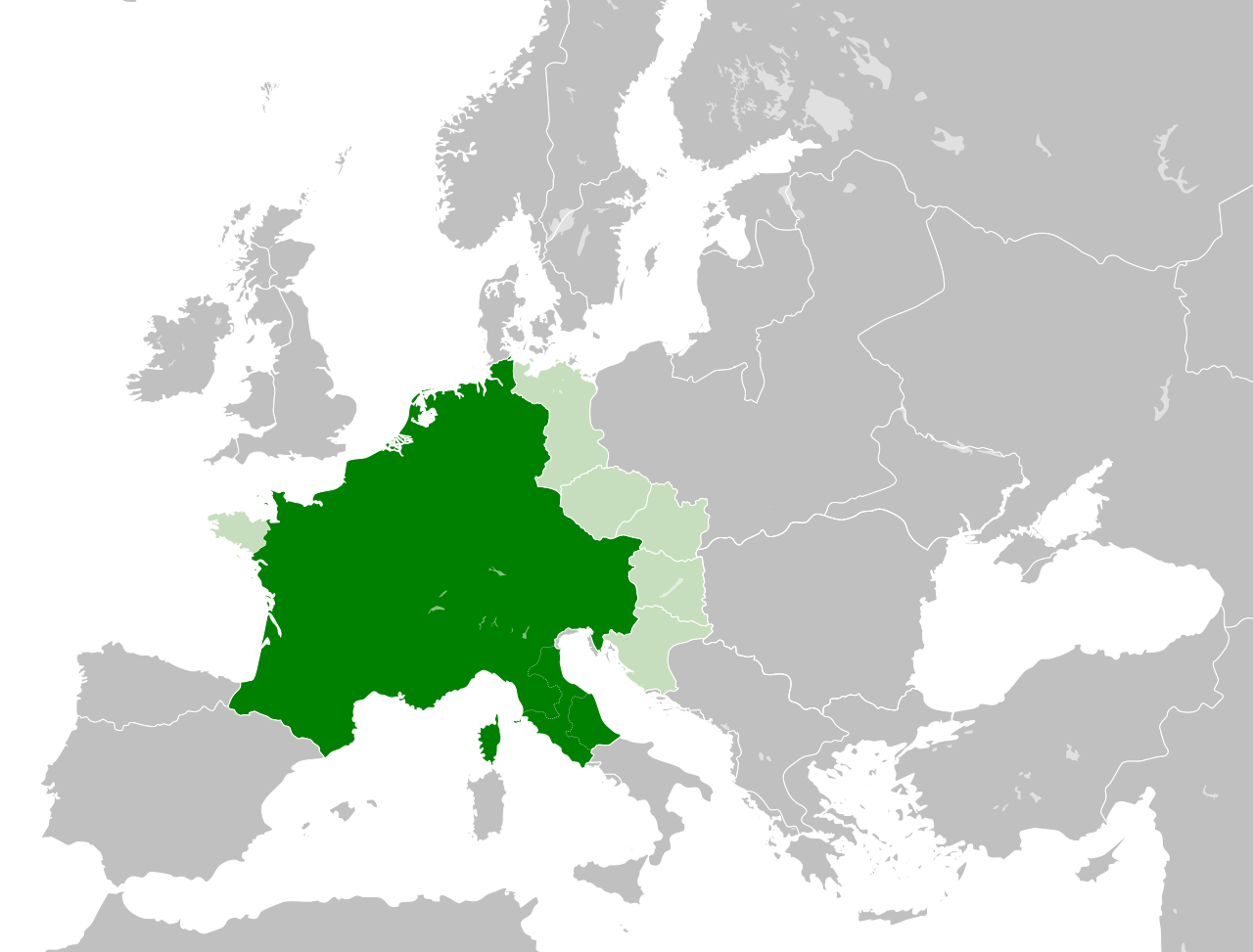
The Carolingian Empire. The Carolingian Empire (800-888) was medieval Europe's first attempt to rebuild the Roman Empire in the West - the realm of Charlemagne, the most important European ruler between Rome's fall and the modern age. The Carolingian family had risen as mayors of the palace under the Merovingian kings; Pepin the Short took the crown itself in 751, and his son Charles - Charlemagne, 'Charles the Great' - spent a forty-six-year reign (768-814) conquering: the Lombards of Italy, the Saxons in wars and rebellions that ran from 772 to 804, the Avars, and the Spanish March - with his one great defeat coming at Roncevaux Pass in 778.
On Christmas Day 800, in Rome, Pope Leo III crowned Charlemagne Emperor of the Romans. The coronation was a revolution: it declared that the West had an emperor of its own again, answerable to no one in Constantinople - and it bound the Frankish monarchy and the papacy into the partnership that would shape medieval Europe. From his capital at Aachen, Charlemagne governed an empire of 10 to 20 million people, issued laws, reformed the currency, and sponsored the 'Carolingian Renaissance' - a revival of learning that preserved much of classical Latin literature.
The empire could not outlive its founder's line. Charlemagne's son Louis the Pious could not hold his own sons together; after his death, civil war ended at the Treaty of Verdun (843), which split the empire into three kingdoms - the seeds of France and Germany. Charles the Fat briefly reunited the whole in 884, but he was deposed in 887 and died in 888, and the empire dissolved for good.
The Carolingian experiment failed as a state - and succeeded as an idea. The memory of a united Christian Europe under one emperor haunted the Middle Ages: the Holy Roman Empire claimed Charlemagne's mantle, France and Germany both claim his inheritance, and modern Europeans still call him the father of Europe.
 Britannica: France - Partition, Carolingian, Empire
 World History Encyclopedia: Carolingian Dynasty
 BBC: History - Charlemagne
 The Metropolitan Museum of Art: Carolingian Art