 Go Back

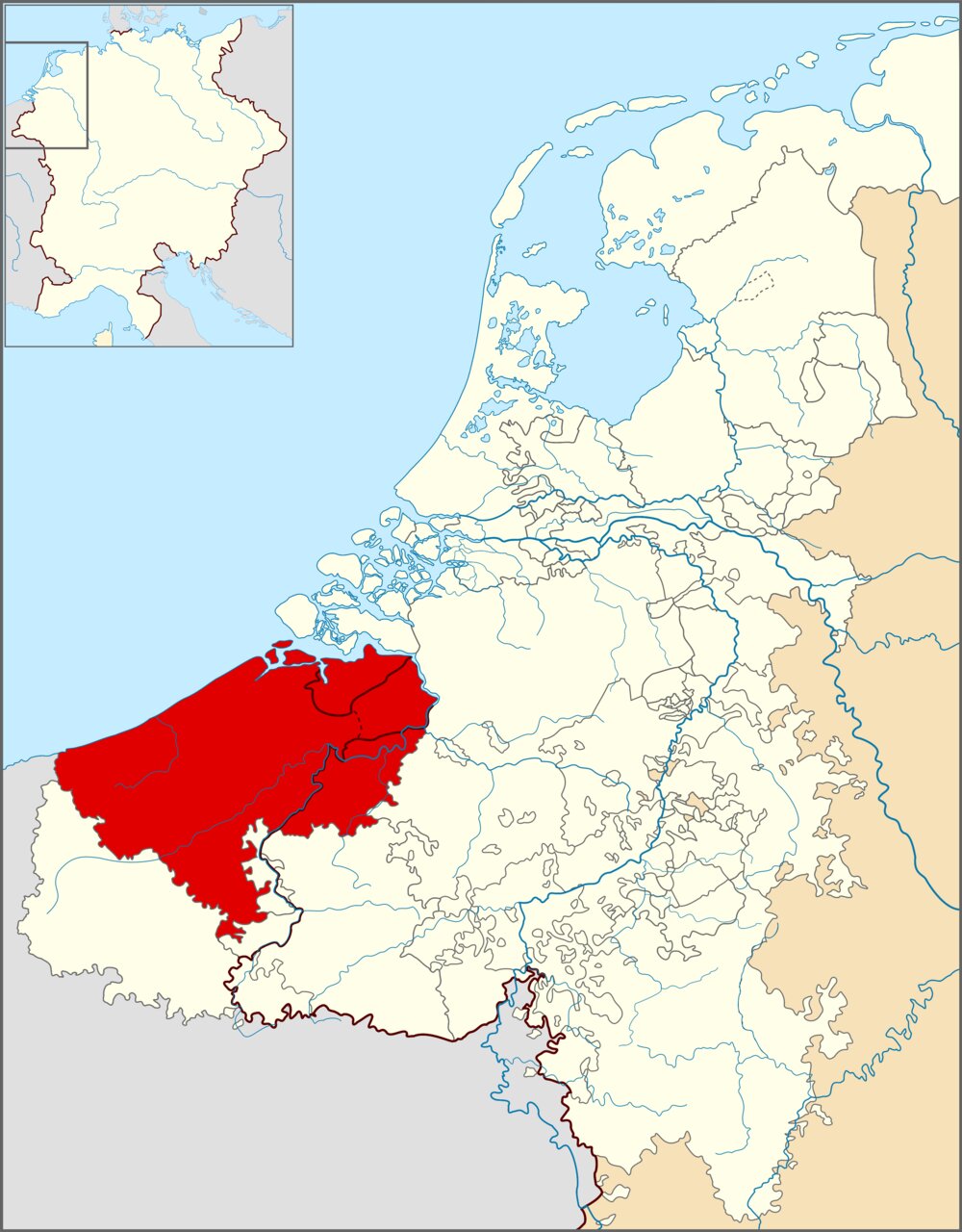
The County of Flanders (862-1529) began when the Carolingian king Charles the Bald granted the region to Baldwin 'Iron Arm'. Its early counts expanded methodically at the expense of their neighbors, annexing the coast south to Artois and the lands across the Scheldt in the Empire, so that Flanders straddled the frontier between France and the Holy Roman Empire, its counts vassals of two crowns. The counts protected the abbeys and the growing trade along the coast.
From the 12th century Flanders became the workshop of northern Europe. Flemish towns, Bruges, Ghent, Ypres, turned English wool into the finest cloth of the age, and Bruges and Ghent grew into the richest commercial cities of the north, their weavers and fullers famous and their yearly fairs drawing the trade of Europe. Wealth bred independence: the great communes won charters of self-government and militias of craftsmen that could defeat kings, as at the Battle of the Golden Spurs (1302), where the Flemish urban infantry destroyed the flower of French chivalry at Courtrai. The tension between the counts, backed by France, and the proud towns ran through Flemish history, exploding in revolts under leaders like the Arteveldes of Ghent during the Hundred Years' War.
In 1369 the heiress Margaret of Flanders married Philip the Bold, duke of Burgundy, and in 1384 Flanders passed to the Valois dukes of Burgundy. Under them Flanders was the economic heart of the Burgundian composite state: Bruges and then Antwerp handled its trade, and Flemish art, the brothers van Eyck, Memling, van der Goes, and Flemish music became the glory of the Burgundian court. The towns still fought for their privileges; Bruges was humbled by Philip the Good in 1440, and Ghent rose repeatedly against Maximilian of Habsburg.
Through Mary of Burgundy's marriage Flanders passed to the Habsburgs in 1482, then to their Spanish branch; by the Treaties of Senlis (1493) and Cambrai (1529) France renounced its suzerainty, and Flanders became part of the Habsburg Netherlands. In the Dutch Revolt the southern provinces, unlike the north, were reconquered by Spain, and 'Flanders' lived on as the Spanish and then Austrian Netherlands, and eventually as the Flemish half of Belgium. The medieval county left a double legacy: the urban culture of self-governing towns that shaped the Low Countries, and an artistic tradition that made Flanders a byword for painting.
 Encyclopaedia Britannica, 11th ed. (1911) via Wikisource: Flanders
 Britannica: Baldwin I
Britannica: Battle of the Golden Spurs
Britannica: Jacob van Artevelde
Britannica: Maximilian I
Britannica: Treaty of Cambrai