 Go Back

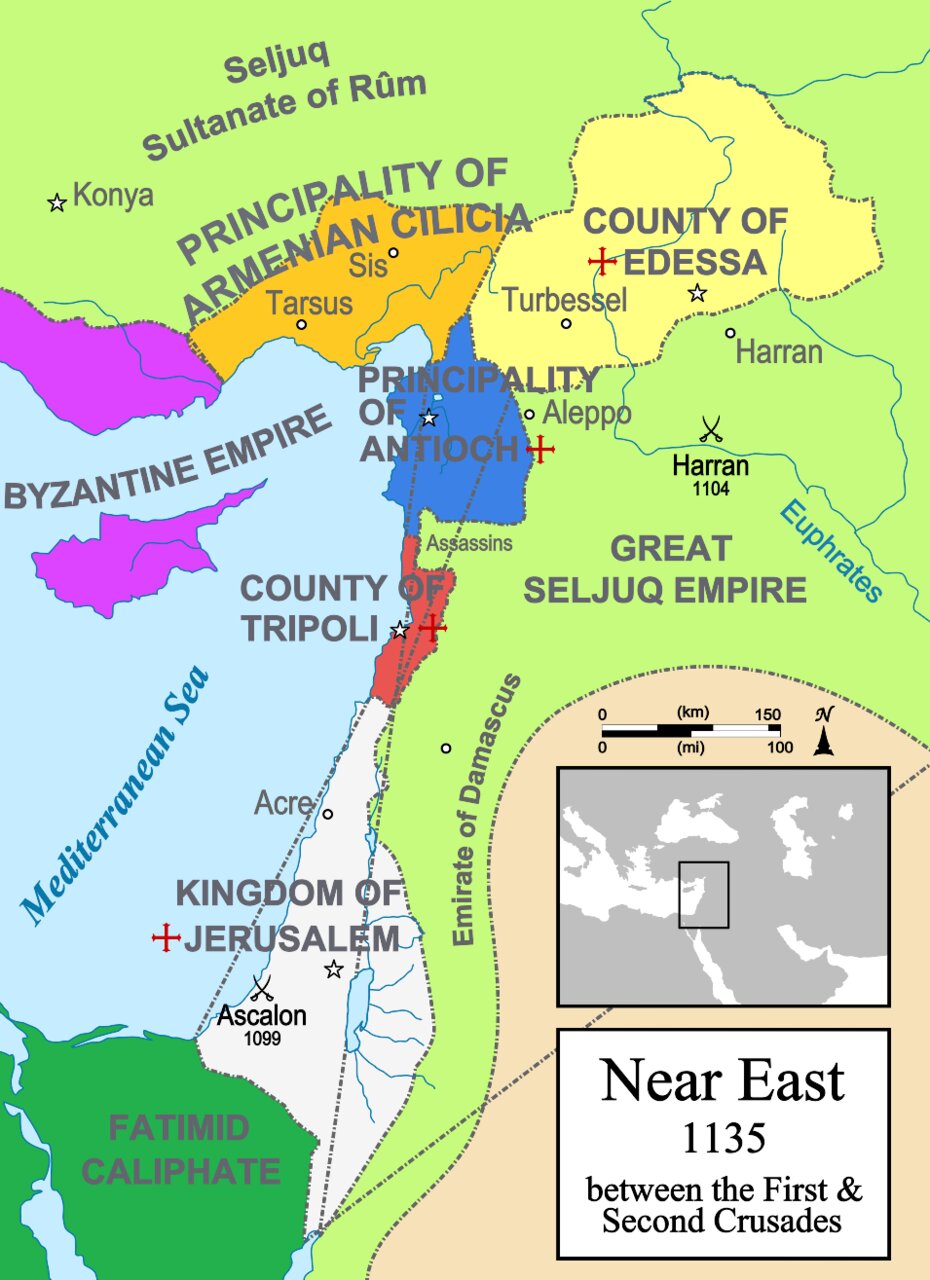
The Crusades (1095-1291) were a series of armed pilgrimages summoned by the Latin Church to recover the Holy Land and defend Christians in the East. In 1095, at the Council of Clermont, Pope Urban II answered the Byzantine emperor Alexios I's appeal for help against the Seljuk Turks with a call for an expedition to free Jerusalem, promising participants remission of penance for their sins. The response astonished Europe: tens of thousands, nobles, knights, clergy and poor pilgrims, 'took the cross'. The First Crusade (1096-1099), led by Godfrey of Bouillon, Bohemond of Taranto and others, crossed Anatolia, took Antioch after a terrible siege, and stormed Jerusalem in July 1099, massacring much of its population, a brutal beginning that Muslims and Eastern Christians never forgot.
The crusaders established four states in the Levant: the Kingdom of Jerusalem, the County of Tripoli, the Principality of Antioch and the County of Edessa, known collectively as Outremer. Thinly ruled by a Frankish warrior elite, they depended on reinforcements from Europe and on the new military orders, the Templars and Hospitallers. Muslim recovery began under Zengi, who took Edessa in 1144, prompting the failed Second Crusade (1147-1149), and climaxed under Saladin, who destroyed the crusader army at Hattin in 1187 and took Jerusalem. That loss launched the Third Crusade (1189-1192): Frederick Barbarossa drowned on the way, Philip II of France went home early, and Richard the Lionheart of England won at Arsuf and Jaffa but could not retake Jerusalem, settling for pilgrim access by treaty.
Later crusades showed the movement's widening and corrupting reach. The Fourth Crusade (1202-1204) was diverted by Venice to sack Christian Constantinople. Innocent III called the Albigensian Crusade (1209-1229) against heretics in southern France, and popes preached crusades in the Baltic, Spain and even against political enemies in Italy. The Fifth Crusade (1217-1221) attacked Egypt and failed; the excommunicated Emperor Frederick II recovered Jerusalem by negotiation in 1229, only to lose it again in 1244; and Louis IX of France led two crusades (1248-1254, 1270), dying on the second outside Tunis. After the fall of Acre in 1291, the mainland crusader states were gone.
The Crusades failed in their central aim, the lasting recovery of the Holy Land, but their effects were enormous. They deepened the split between Catholic and Orthodox Christianity, sharpened Muslim hostility and solidarity, and left a bitter inheritance of holy war. They also accelerated change in Europe: Venetian and Genoese fleets grew rich on crusader shipping, kings taxed and centralized in the crusading cause, the papal monarchy reached its height, and contact with the Islamic world and Byzantium transmitted goods, tastes and learning, sugar, citrus, Arabic science and Greek texts, westward. The memory of the crusades, heroic in Europe, traumatic in the Middle East, still shapes how both remember the age.
 Britannica: Crusades
 World History Encyclopedia: Crusades
World History Encyclopedia: The Crusades: Causes & Goals
World History Encyclopedia: Saladin