 Go Back

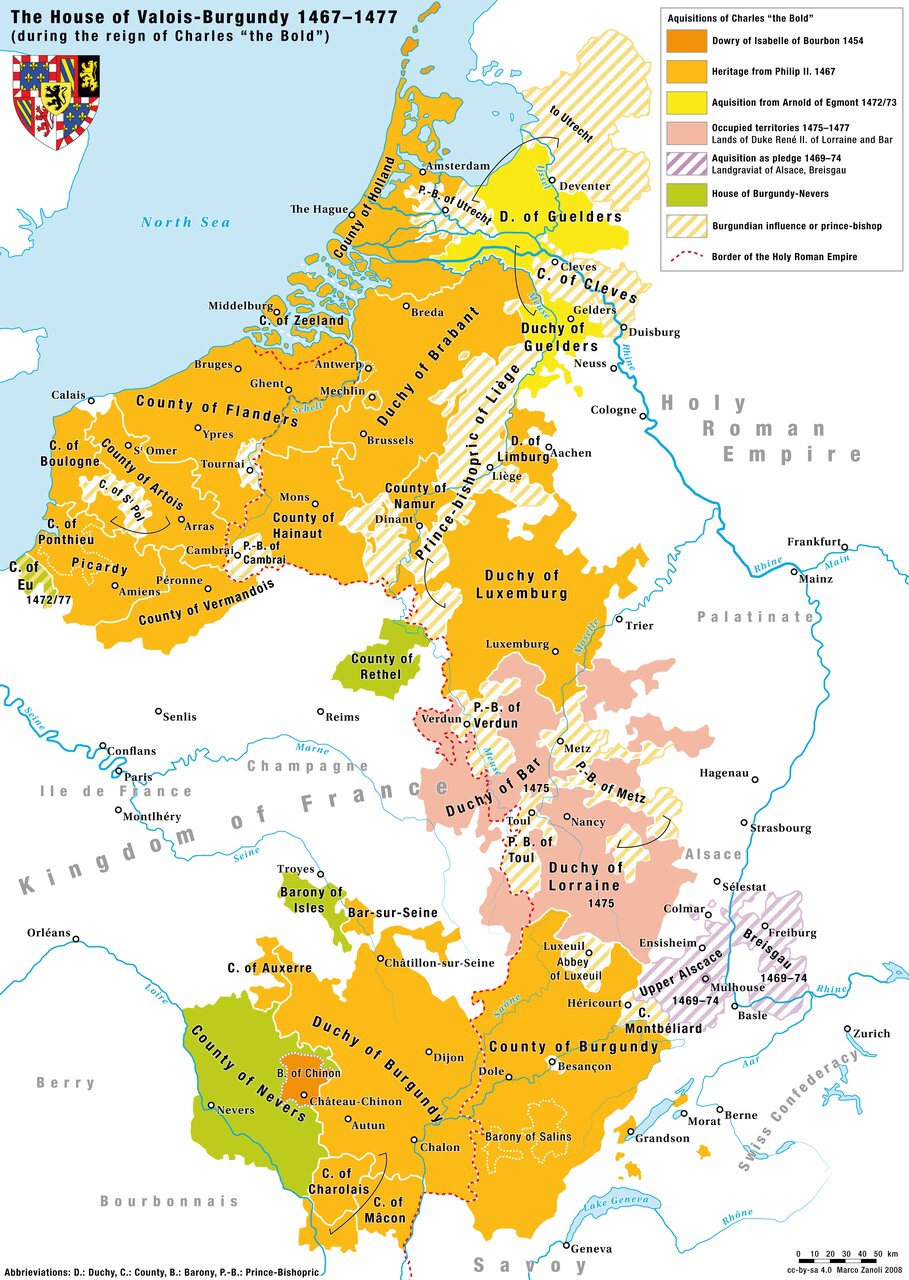
The Duchy of Burgundy (918-1482) began as a Carolingian border province granted in 918 to Richard the Justiciar, and from 1032 it was ruled by a branch of the French royal house. For centuries it was one of several French principalities, its dukes vassals of the king of France, with the Free County of Burgundy (Franche-Comte) across the Saone belonging instead to the Holy Roman Empire. The duchy was transformed when the direct Capetian line of dukes ended in 1361: King John II of France granted it to his youngest son Philip 'the Bold' (1364-1404), founding the Valois-Burgundian dynasty that would nearly create a middle kingdom between France and Germany.
Philip the Bold married the heiress of Flanders, adding the richest trading towns of northern Europe to Burgundian rule, and his successors piled inheritance on inheritance: John the Fearless (1404-1419), whose murder of the Duke of Orleans plunged France into civil war and who was himself assassinated on the bridge of Montereau; and Philip the Good (1419-1467), who allied with England during the Hundred Years' War, captured Joan of Arc at Compiegne, and added Holland, Zeeland, Hainaut, Brabant, Limburg and Luxembourg. Under Philip the Burgundian court at Dijon, Bruges and Brussels became the most splendid in Europe: painters like Jan van Eyck and Rogier van der Weyden, the musicians of the Burgundian school, the lavish banquets of the Order of the Golden Fleece, founded 1430, and a library of illuminated manuscripts rivaled only by kings.
The dynasty's last and most ambitious duke, Charles the Bold (1467-1477), set out to weld his scattered lands, Burgundy, Franche-Comte and the Low Countries, into a continuous kingdom by conquering Lorraine, the corridor between them. He clashed with Louis XI of France, who coordinated a web of enemies against him, and with the Swiss Confederates, allied to Lorraine and France. Charles took Nancy and Grandson, but in 1476 the Swiss destroyed his army at Grandson, seizing his fabulous artillery and treasure, crushed him again at Morat with enormous slaughter, and in January 1477 killed him before the walls of Nancy, his body found frozen in a ditch.
Charles left only a daughter, Mary of Burgundy. Louis XI seized the duchy and Picardy by force, while Mary saved the Low Countries by marrying Maximilian of Habsburg; she died in 1482, leaving her inheritance to her son Philip the Fair. The settlement split the Burgundian legacy: the French crown kept Burgundy proper, the Habsburgs took Franche-Comte and the Netherlands, and Franco-Habsburg rivalry over that inheritance dominated European wars for two centuries. The Valois dukes had failed to found a kingdom, but their court set the standards of European splendor, and their Low Countries became the heartland of Habsburg power.
 Britannica: Burgundy
 Encyclopedia.com: Burgundy