 Go Back

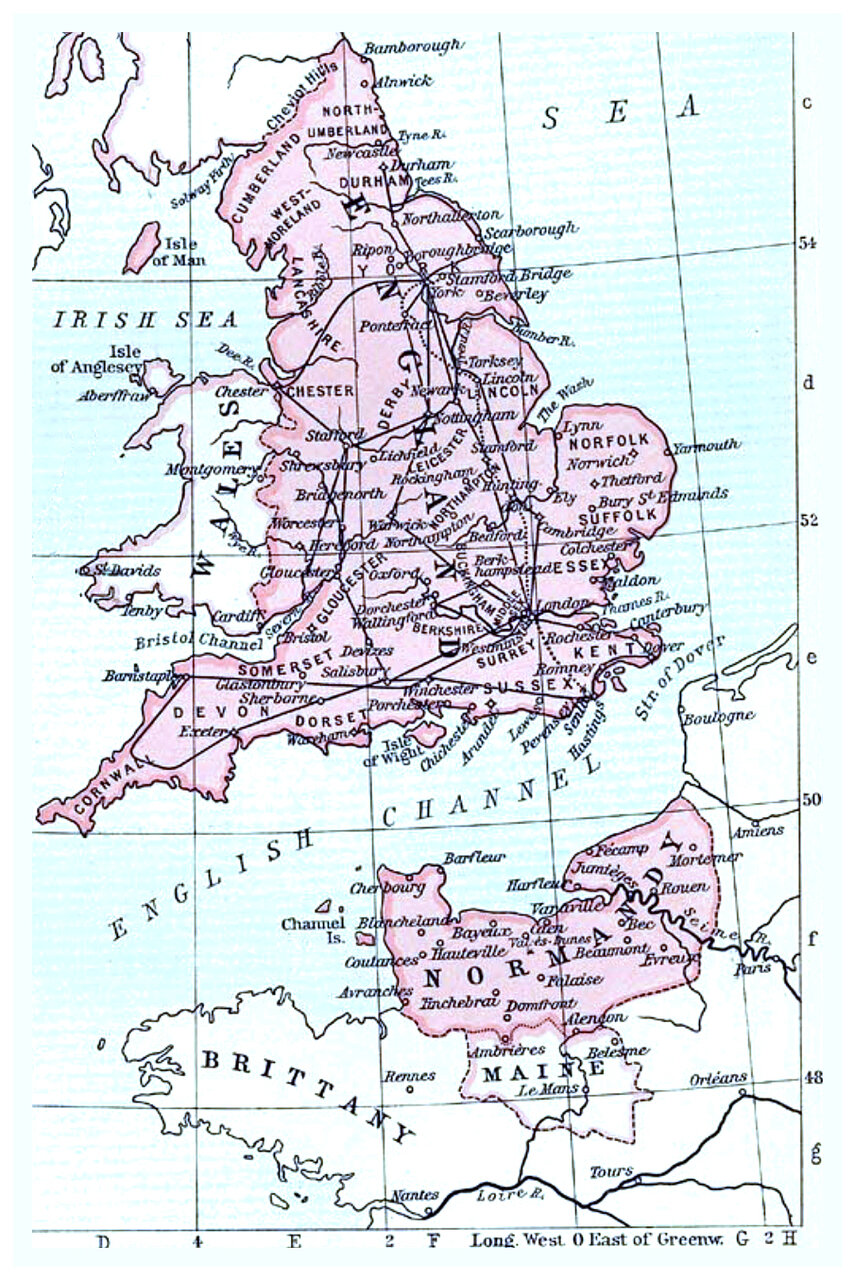
The Duchy of Normandy (911-1204) began with a bargain between the West Frankish king Charles the Simple and the Viking leader Rollo at the Treaty of Saint-Clair-sur-Epte in 911: Rollo received lands around Rouen on the lower Seine, accepted baptism, and pledged to defend the kingdom against other Vikings. Within a century the Norse settlers, 'Northmen', had absorbed the local Frankish population, adopting its language, religion and law while keeping a reputation for seamanship and war. Under dukes such as Richard I 'the Fearless' and Richard II 'the Good', Normandy became one of the best-organized principalities in France, its dukes controlling castles, mints and a loyal mounted warrior class, and patronizing monasteries such as Fecamp, Jumieges and Mont-Saint-Michel.
Norman energies overflowed the duchy's borders. In the 11th century Norman knights seeking fortune went to southern Italy, where they seized Apulia, Calabria and Sicily from Byzantine and Muslim rulers, and to the edges of Spain and the crusading East. At home, Duke William, the illegitimate but forceful son of Robert I, survived a dangerous minority and the battle of Val-es-Dunes (1047) to impose his authority. Marrying Matilda of Flanders and cultivating papal support, he transformed Normandy into a springboard for the most consequential gamble of the century.
In 1066 William claimed the English throne after the death of Edward the Confessor, arguing that Edward had promised it to him and that Harold Godwinson had sworn to support him. He assembled a fleet and an army drawn from across northern France, landed in Sussex, and defeated and killed Harold at Hastings on 14 October 1066. The Norman Conquest replaced England's ruling class wholesale: Norman French became the language of court and law, castles rose across the country, the Domesday Book of 1086 surveyed the conquered land in unprecedented detail, and the English church was reorganized under Norman bishops. Normandy and England were now held in personal union, binding English politics to northern France for a hundred and fifty years.
The union was often uneasy: William's sons fought over the inheritance, and after Henry I's son died in the White Ship disaster of 1120, civil war followed under Stephen. Henry II Plantagenet, son of Geoffrey of Anjou and Henry I's daughter Matilda, inherited Normandy with England in 1154 and built the Angevin 'empire'. Normandy's independent life ended in 1204, when King Philip Augustus of France conquered the duchy from King John, driving a wedge between England and France that fed centuries of conflict. The Normans' legacy is immense: England's monarchy, law and language all bear their stamp, and Norman churches and castles from Durham to Sicily still mark the lands they ruled.
 Britannica: Normandy
 World History Encyclopedia: Rollo of Normandy
World History Encyclopedia: Battle of Hastings
World History Encyclopedia: The Impact of the Norman Conquest of England