 Go Back

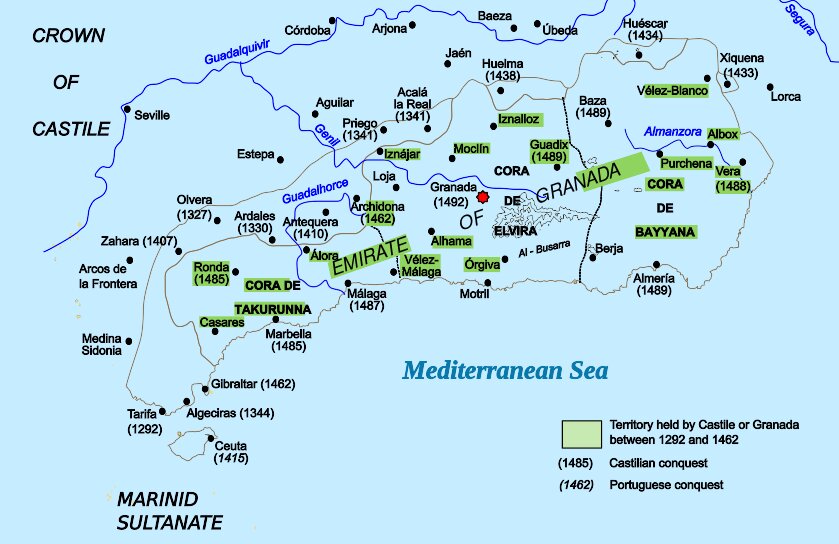
The Emirate of Granada (1232-1492) was the last Muslim state of the Iberian Peninsula, founded by Muhammad ibn Yusuf ibn Nasr, called Ibn al-Ahmar, who seized Granada in 1232 and built the Nasrid dynasty that ruled for two and a half centuries. Wedged between the Castilian conquests and the sea, the emirate survived by agility: Ibn al-Ahmar did homage to Ferdinand III of Castile and even helped him take Seville in 1248, in exchange for recognition. Granada became a tribute-paying vassal of Castile, its kings balancing Castile, the Marinids of Morocco, Aragon and their own ambitious frontier clans.
Protected by the Sierra Nevada and a chain of hilltop fortresses, the emirate prospered. It drew wealth from silk, sugar and dried fruit, from the ports of Malaga and Almeria, and from its position on trade routes to Africa and Italy. Refugees from the conquered north doubled its population and enriched its culture. The Nasrids lavished their resources on Granada's palaces, above all the Alhambra, the red-walled palace city begun under Ibn al-Ahmar and completed under Yusuf I and Muhammad V in the 14th century, whose courtyards of the Myrtles and the Lions, with their carved stucco, tile and muqarnas vaults, remain the supreme monument of Islamic art in western Europe. Scholars, poets and Sufis, among them the vizier and historian Ibn al-Khatib, made Granada a final brilliant chapter of Andalusi civilization.
The 15th century brought decline. Succession disputes, the feuds of the powerful Abencerraje clan, and Castile's growing strength after its own civil wars weakened the emirate. Muhammad XI 'the Little' and his successors paid ever heavier tribute, and frontier war, raids, sieges and the loss of strongholds such as Antequera (1410), became routine. The marriage of Ferdinand of Aragon and Isabella of Castile in 1469 united the two great Christian kingdoms, and when the rebel Boabdil (Muhammad XII) fought his father and then his uncle for Granada's throne, the Catholic Monarchs seized their chance.
From 1482 Ferdinand and Isabella ground the emirate down in a ten-year war, taking Ronda, Malaga and Baza piecemeal with superior artillery and resources. Boabdil surrendered Granada on 2 January 1492 and received a small lordship in the Alpujarras before leaving for Morocco. The capitulations promised Muslims their property, law and worship, but these protections were revoked within a decade, and forced conversions, revolts and eventual expulsion of the Moriscos followed. The fall of Granada ended nearly eight centuries of Muslim rule in Iberia, completed the Reconquista, and freed the Catholic Monarchs' resources for the year that also saw Columbus sail and the expulsion of Spain's Jews.
 Britannica: Nasrid dynasty
Britannica: Granada
 World History Encyclopedia: Reconquista