 Go Back

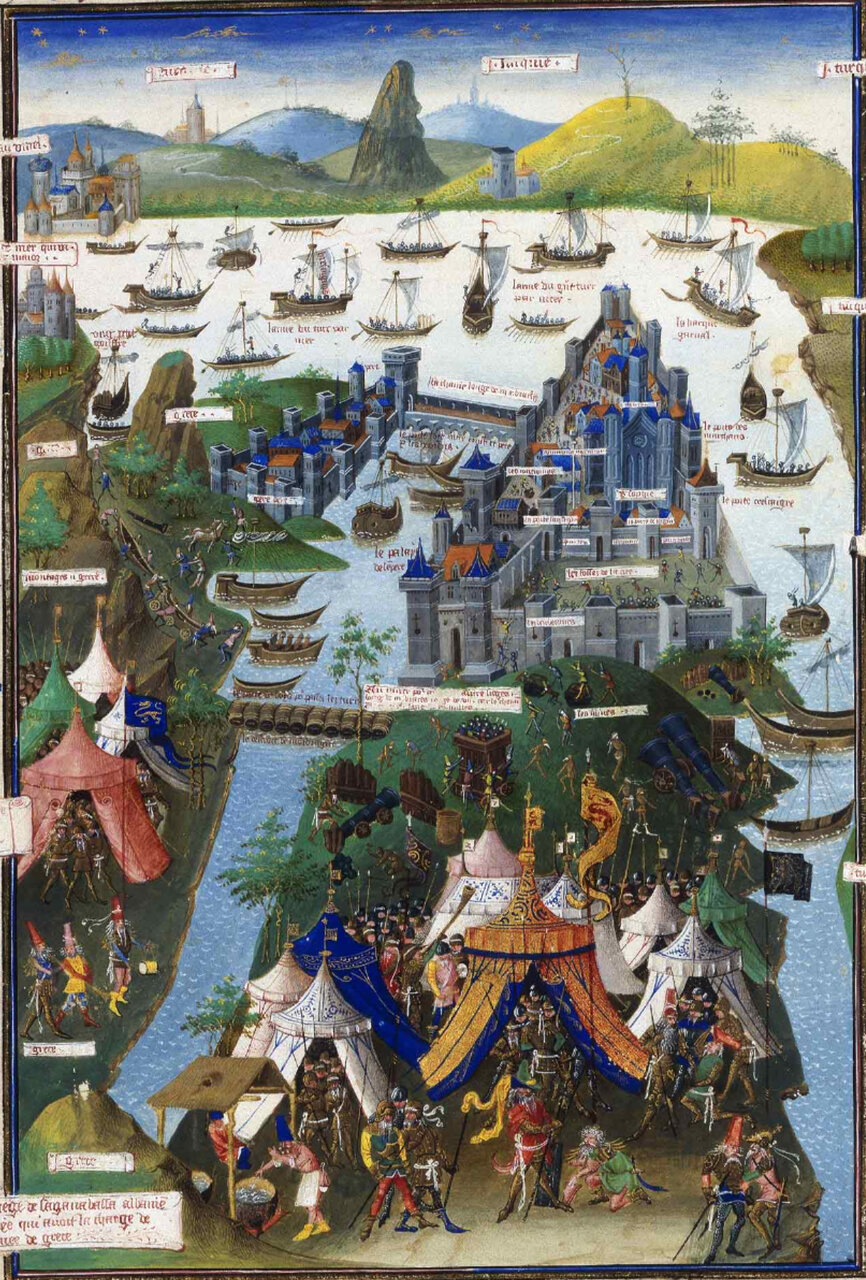
The Fall of Constantinople on 29 May 1453 ended the Byzantine Empire after more than eleven centuries. By then the empire had shrunk to the capital, a few Aegean outposts and the Morea, its population a fraction of its former size. The young Ottoman sultan Mehmed II, determined to take the city that guarded the junction of Europe and Asia, prepared methodically: he built the fortress of Rumeli Hisari on the Bosporus to cut the city from the Black Sea, gathered an army of perhaps 80,000, and commissioned from the engineer Orban bronze cannon of unprecedented size, bombards that could batter the ancient Theodosian Walls, which had stood unconquered for a thousand years.
Against this, Emperor Constantine XI Palaiologos could field only about 7,000 defenders, including 700 Genoese under Giovanni Giustiniani, a few Venetians, Catalans and Cretans, and the crews of the ships sheltering behind the great chain that closed the Golden Horn. The siege began on 6 April 1453. Ottoman guns pounded the walls near the Gate of St Romanus; a daring night attack on the boom failed; four Genoese supply ships beat the entire Ottoman fleet in a famous action; but the defenders' numbers told. Mehmed had ships dragged overland into the Golden Horn, bypassing the chain, forcing the city to stretch its thin line even thinner.
After seven weeks of bombardment, and rejected terms that would have spared the city, Mehmed launched the general assault before dawn on 29 May. Wave after wave of irregulars, Anatolian troops and finally the elite Janissaries tested the breaches; Giustiniani was wounded and carried off, the defense wavered, and Ottoman troops found their way in through a small sally port, the Kerkoporta, left unsecured. Constantine XI died in the fighting, last of the Roman emperors. The city was given over to three days of sack, as custom allowed, its people killed or enslaved, its churches and palaces stripped, though Mehmed soon called a halt and began restoring his prize.
Constantinople became the Ottoman capital, Istanbul, and Hagia Sophia its chief mosque. The fall resonated far beyond the city: Greek scholars had already carried manuscripts and learning westward, feeding the Renaissance; Orthodox Moscow later styled itself the 'Third Rome'; popes preached crusades that never came; and Europe understood that Ottoman power was now planted permanently in the Balkans. The date 1453 is conventionally taken to close the Middle Ages, not because the world changed in a day, but because the last direct link to ancient Rome, the empire Augustus founded, had finally disappeared.
 Britannica: Fall of Constantinople
 World History Encyclopedia: 1453: The Fall of Constantinople
World History Encyclopedia: Constantinople
World History Encyclopedia: Mehmed II