 Go Back

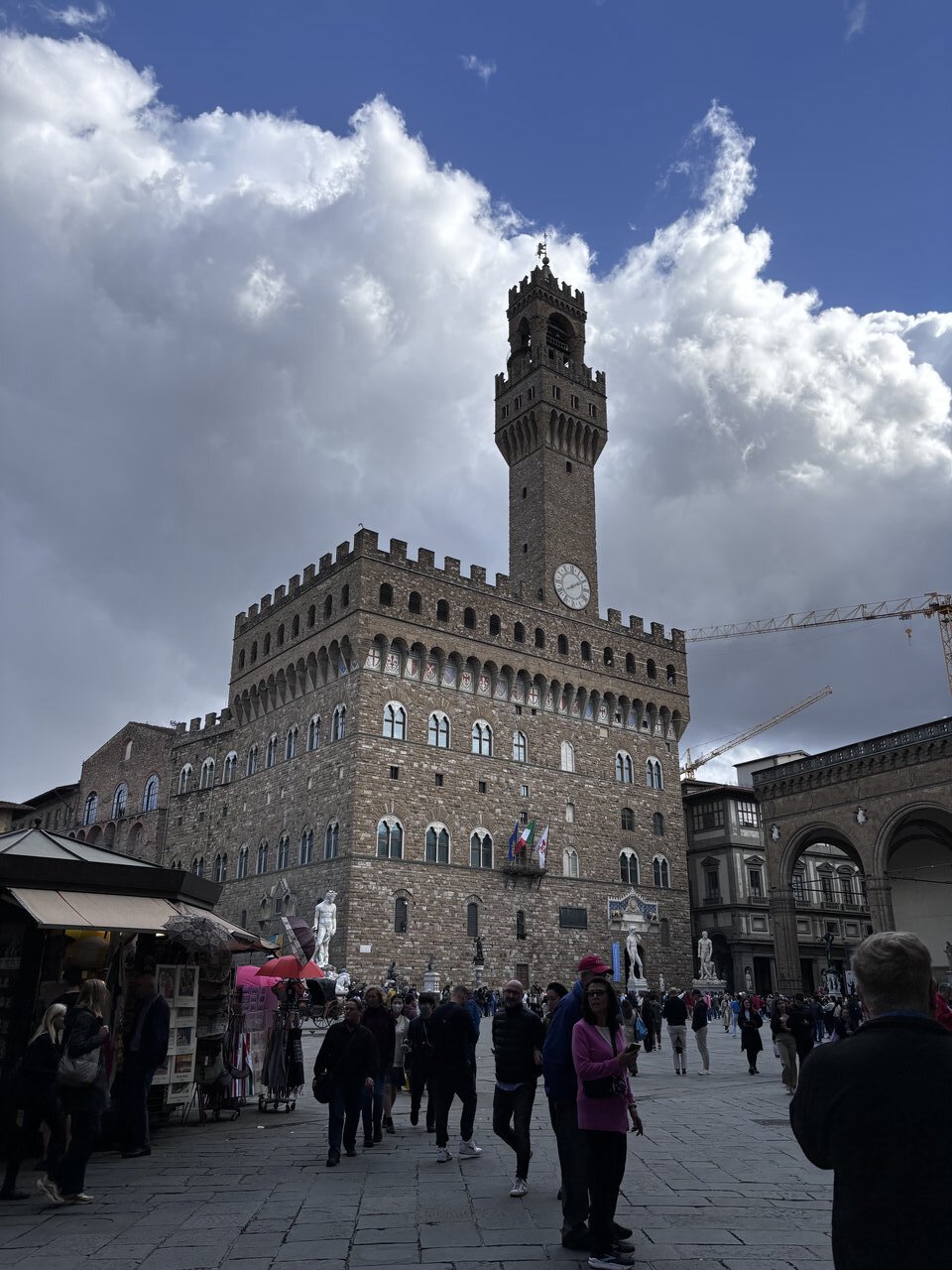
The Florentine Republic (1115-1532) grew from a medieval commune that won effective self-government in the 12th century and dominated Tuscany for four hundred years. Its wealth came from wool and banking: Florentine companies, the Bardi, Peruzzi and later the Medici, financed popes and kings from London to Naples, and the city's gold florin, first minted in 1252, became the standard coin of European trade. Florence was also violently divided: the 13th-century struggle of Guelfs and Ghibellines, and then of Black and White Guelfs, the feud that exiled the poet Dante Alighieri in 1302, gave the commune a politics of faction, exile and confiscation.
The constitution rested on the guilds: the seven 'greater' guilds of bankers, cloth-merchants and lawyers, and the 'lesser' guilds of craftsmen, whose priors formed the Signoria, chosen by lot for two-month terms in the Palazzo Vecchio. Popular risings, the Ciompi revolt of wool-workers in 1378, and the reaction that crushed it, showed how narrow that republic could be, yet the ideal of civic liberty defined Florentine identity. In 1434 Cosimo de' Medici, 'the Elder', returned from exile and mastered the city without any title: through banking wealth, clientage, control of elections and the purse, he and his house guided the republic for sixty years.
Under Cosimo's grandson Lorenzo 'the Magnificent' (1469-1492), Florence was the capital of the Renaissance. Lorenzo held the state through the councils while posing as a private citizen, survived the Pazzi conspiracy of 1478, in which his brother Giuliano was murdered in the cathedral, and the war with Pope Sixtus IV that followed, and balanced the Italian powers through personal diplomacy. His court and commissions gathered Botticelli, the young Michelangelo, Leonardo, Poliziano and Pico della Mirandola; the Platonic Academy, the Laurentian Library and the workshops of the city made Florence the standard of European culture. After Lorenzo's death his son Piero blundered before the invading French in 1494, and the Medici were expelled.
The last phase of the republic was its most turbulent: the Dominican friar Girolamo Savonarola led a puritan popular republic that burned the 'vanities' in 1497 and was himself burned in 1498; the chancellor Niccolo Machiavelli organized a citizen militia and wrote the works that founded modern political thought from the republic's ruins. The Medici returned in 1512 with Spanish arms, were again expelled in 1527, and finally besieged Florence into surrender in 1530. In 1532 the republic was abolished and Alessandro de' Medici made hereditary duke, and in 1569 the Medici became Grand Dukes of Tuscany. The republic fell, but its civic humanism, art and banking techniques had already reshaped Europe.
 Britannica: Florence
 Encyclopedia.com: Florence