 Go Back

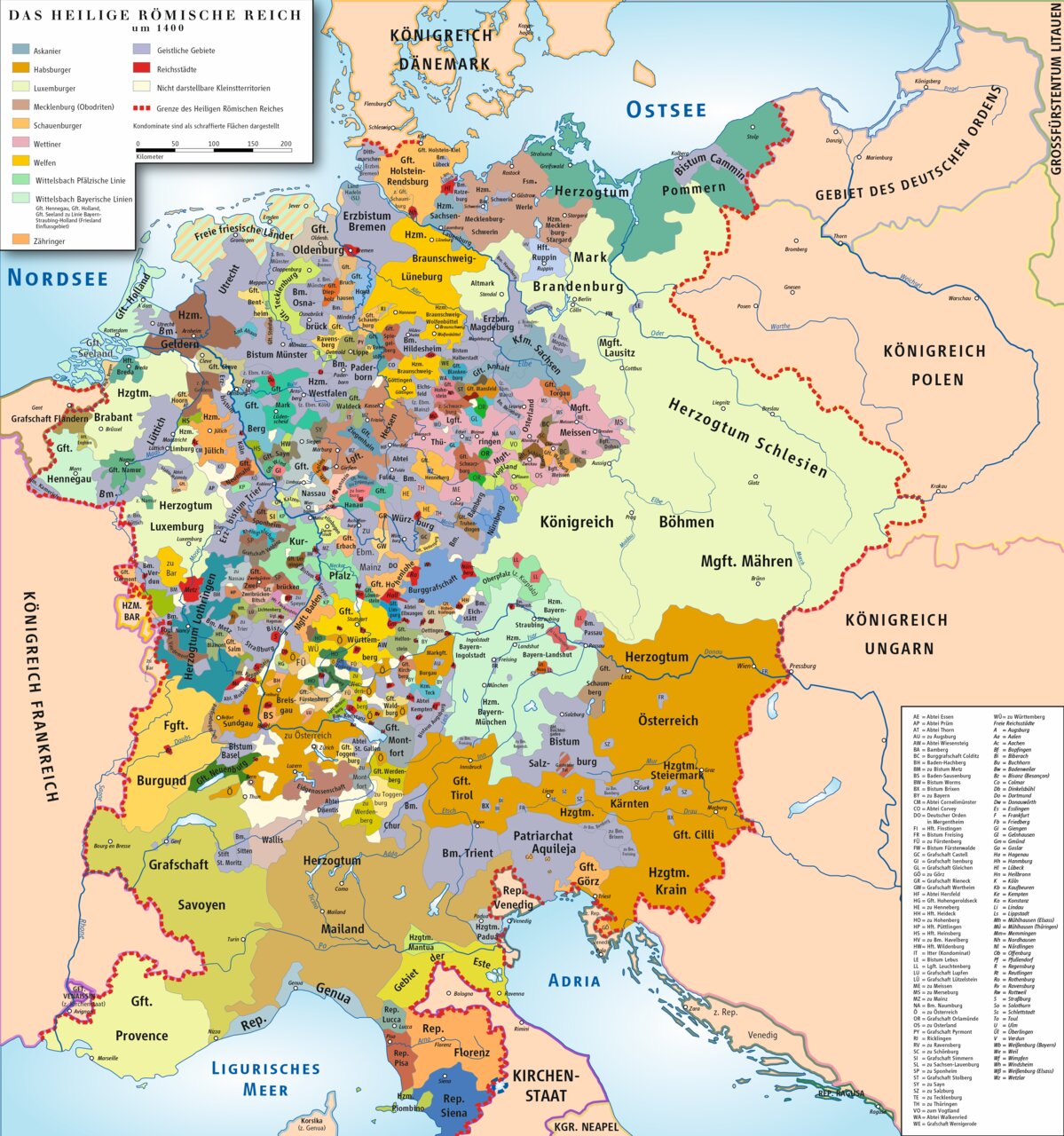
The death of Emperor Frederick II in 1250 broke imperial power in Germany. The papacy had fought his dynasty to destruction, and after his son Conradin's execution in 1268 no king was recognized for years: foreign princes sold their support for bribes, and the nobility, towns and church states governed themselves. This 'Great Interregnum' (1250-1273) showed that the Holy Roman Empire, the loose federation of hundreds of territories claiming continuity with Rome and Charlemagne, would never again be a centralized monarchy. In 1273 the electors, the great princes who chose the king, picked a minor count, Rudolf of Habsburg, expecting a weak ruler; instead Rudolf defeated Ottokar of Bohemia at Marchfeld (1278) and won Austria, the foundation of his dynasty's power.
A century of experimentation followed. The Swiss cantons broke free of Habsburg lordship at Morgarten (1315); rival kings fought at Muhldorf (1322); and the Wittelsbach emperor Louis IV clashed with the papacy over his very title, defended in writing by Marsilius of Padua's argument that political authority comes from the community, not the pope. What the monarchy lost in power it gained in definition: the imperial crown became effectively elective, and the question was who chose.
The answer came with Charles IV of Luxembourg (1346-1378), king of Bohemia and the empire's greatest late-medieval ruler. In 1356 he issued the Golden Bull, a constitutional charter that fixed the election of the 'King of the Romans' in the hands of seven prince-electors: the archbishops of Mainz, Cologne and Trier, and the secular rulers of Bohemia, the Palatinate, Saxony and Brandenburg. The Bull made the electors nearly sovereign in their own lands, gave them regalian rights over mines, tolls and justice, and codified the empire as a federation led by its greatest princes rather than a state ruled from the top.
Under the Golden Bull's framework the empire remained Europe's central political fact for 450 years. Charles IV made Prague an imperial capital, founded its university (1348), the first in central Europe, and built the Charles Bridge; yet after his death his son Wenceslaus was deposed (1400), and the empire faced the Hussite Wars in Bohemia and conciliar crisis in the church. In 1438 the crown passed to Albert II of Habsburg, beginning a Habsburg monopoly that lasted, with one break, until the empire's end in 1806. The late-medieval empire, weak at the center but resilient as a framework, would outlast stronger kingdoms and shape German political life into the modern age.
 Britannica: Golden Bull of Emperor Charles IV
Britannica: Holy Roman Empire
 World History Encyclopedia: Holy Roman Empire