 Go Back

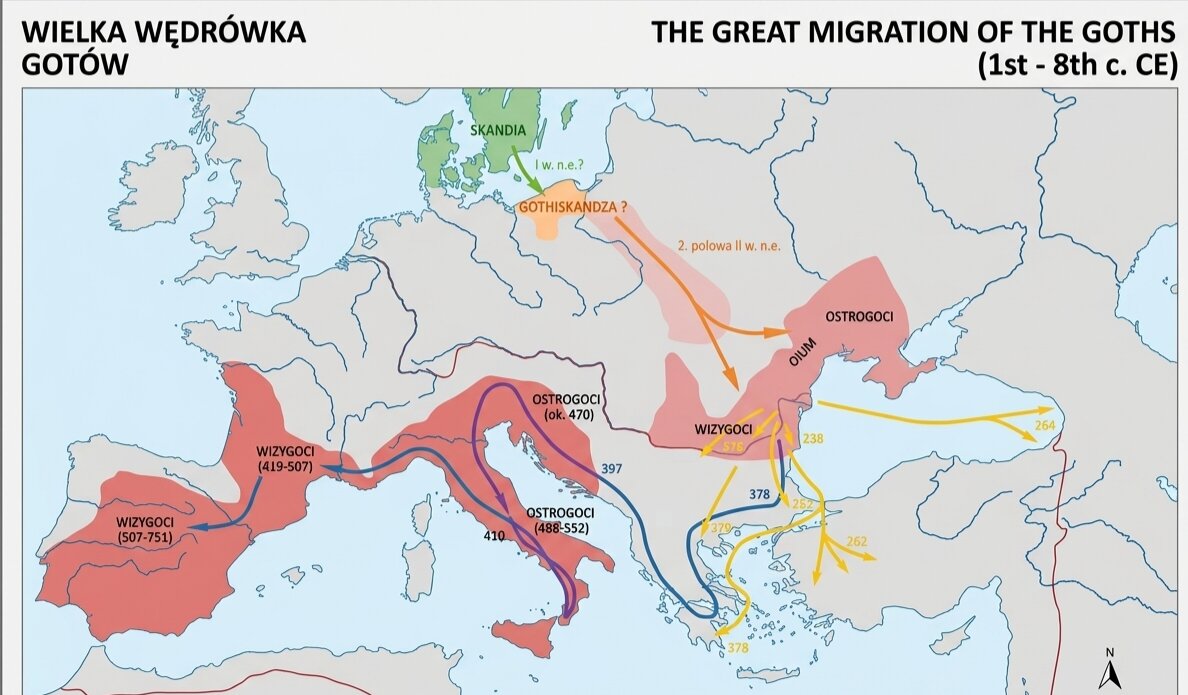
The Goths were Germanic peoples who, by the 3rd century CE, had moved from the Baltic region to the lands north of the Black Sea, where they split into two broad groups: the Greuthungi, later called Ostrogoths, and the Tervingi, later called Visigoths. From the Pontic steppe they raided the Roman Balkans and Asia Minor by land and sea, defeating and killing the emperor Decius at Abritus in 251. Contact with Rome also transformed them: Gothic mercenaries served in Roman armies, Gothic captives and traders adopted Roman goods, and the missionary Ulfilas converted many Goths to the homoean (Arian) form of Christianity, devising a Gothic alphabet to translate the Bible.
The Alans were an Iranian-speaking nomadic people of the steppe between the Don and the Caspian, famous as horsemen and heavy cavalry. Pressured and partly subdued by the Huns in the 370s, some Alans joined the Hunnic empire while others fled west. In 406 a large body of Alans crossed the Rhine alongside the Vandals and Suebi, fought their way through Gaul, and passed into Spain in 409. There the Vandal-Alan bloc divided the peninsula, until Visigothic attacks on behalf of Rome shattered the Alans as an independent power around 418. The surviving Alans of Spain put themselves under the Vandal king Gunderic and crossed with the Vandals to Africa in 429, where 'rex Vandalorum et Alanorum', king of the Vandals and Alans, remained the royal title of the Carthage kingdom.
The Visigoths made their own deal with Rome after sacking it in 410: settled first in Aquitaine as federate soldiers, they built a kingdom centered on Toulouse, fought Attila's Huns beside the Romans at the Catalaunian Fields in 451, and under Euric (466-484) ruled most of Spain and southern Gaul. Defeated by the Franks at Vouille in 507, they kept their Spanish kingdom, based on Toledo, until it fell to Muslim armies in 711. The Ostrogoths, after years in the Balkans, invaded Italy in 489 under Theodoric, who overthrew Odoacer and ruled a Romano-Gothic state from Ravenna, preserving Roman administration, law and letters under figures such as Boethius and Cassiodorus.
Justinian's wars destroyed the Ostrogothic kingdom in a ruinous twenty-year struggle (535-554) that left Italy devastated for the Lombards who followed. The Visigothic kingdom of Toledo lasted longer, converted from Arian to Catholic Christianity under Reccared in 589, and developed a distinctive Hispano-Gothic law and church culture before its sudden collapse in 711. Alans remaining in the Caucasus survived as the medieval Alania, ancestors of the modern Ossetians, while Alan groups in Gaul left place-names such as Alencon. Together, Goths and Alans show how the peoples of the migration age could shatter Roman provinces and yet also preserve and reshape Roman civilization.
 Britannica: Goth
 World History Encyclopedia: Goths
Britannica: Alani