 Go Back

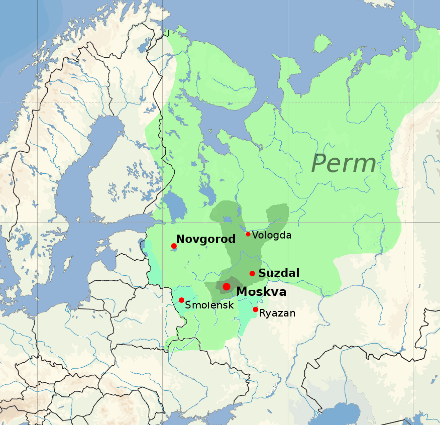
The Grand Duchy of Moscow. Muscovy rose from nothing: in 1263 Moscow was a minor appanage town, given to Daniel, youngest son of Alexander Nevsky. Within two centuries it had swallowed its rivals, thrown off the Mongol yoke, and become the core of Russia - the most improbable rise in medieval Europe.
Moscow's princes succeeded by cunning more than valor. They served the Mongol khans as tribute-collectors - Ivan I (1325-1340), called 'Moneybag,' grew rich gathering the khan's taxes from the other Russian princes - and they won over the Church: the seat of the Russian metropolitan moved to Moscow, making it the spiritual as well as political center of the Russian lands. Prince by prince, 'the gathering of the Russian lands' went on.
The defiance began under Dmitry Donskoy, who in 1380 inflicted a milestone defeat on the Tatars and permanently joined the grand principality of Vladimir to Moscow. The liberation was completed under Ivan III (1462-1505), who formally annexed Novgorod in 1478, absorbed nearly all the Russian states, and took the title 'sovereign of all Russia'; his defeat of the Tatars in 1480 traditionally marks the end of Tatar suzerainty, after which he styled himself autocrat. He laid claim to the whole legacy of Kievan Rus' - a claim that brought Moscow into conflict with the Grand Duchy of Lithuania. Meanwhile the Russian Church had declared its independence (autocephaly) in 1448, and the fall of Constantinople in 1453 left Moscow the capital of the Orthodox world.
In 1547 Ivan IV - 'the Terrible' - was crowned not grand prince but Tsar of all Russia: Muscovy had become the Tsardom of Russia. The little principality on the Moskva river had become, in three centuries, the largest state in Europe.
 Britannica: Grand Principality of Moscow
 World History Encyclopedia: Ivan III of Russia
 Humanities LibreTexts: 13.5: Reading: The Grand Duchy of Moscow
 BBC: BBC Radio 4 - Russia: The Wild East, Series 1, Moscow - The New Capital