 Go Back

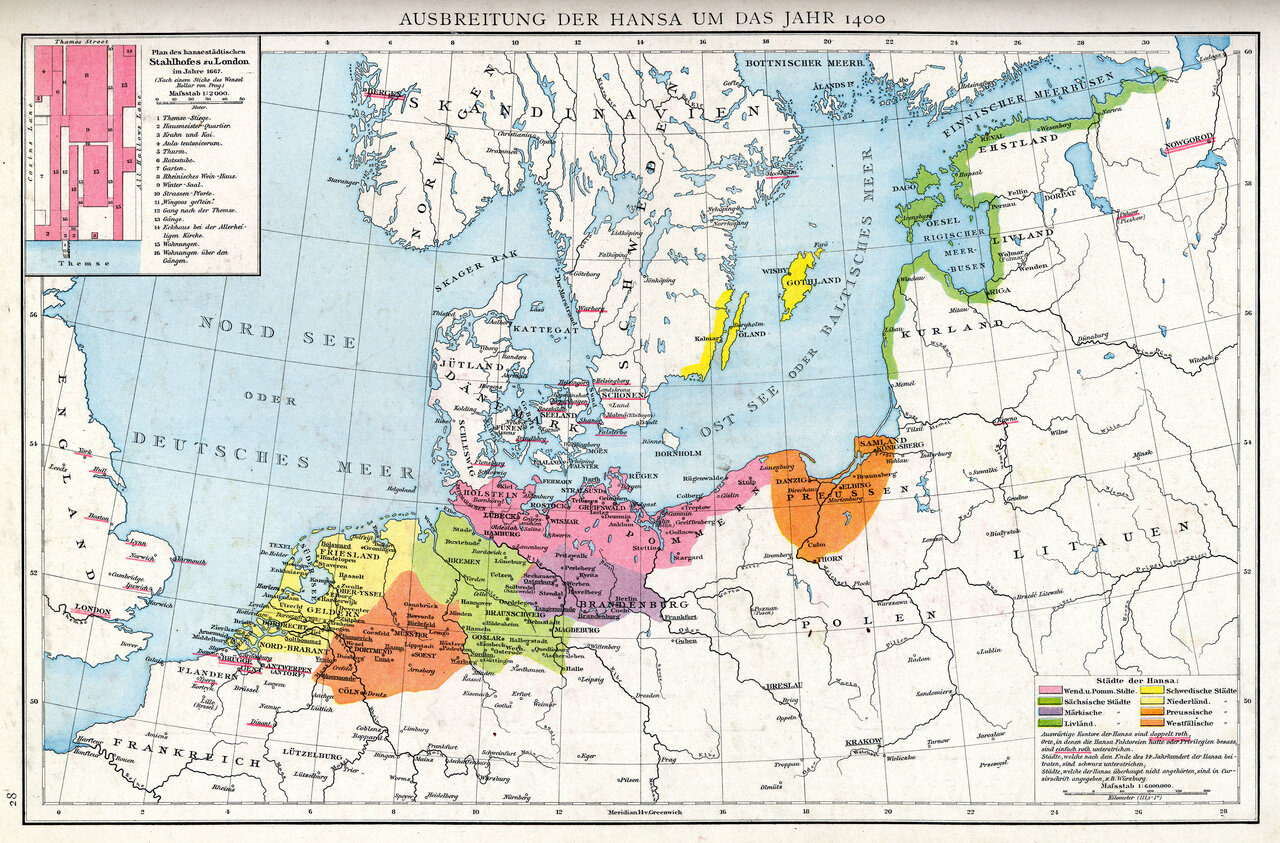
The Hanseatic League (c. 1150-1669) was a confederation of merchant guilds and trading towns that dominated commerce in the Baltic and North Seas for four centuries. It grew from partnerships among German merchants trading to Gotland and England, and took institutional shape after Lubeck, founded in 1158, became the hub of the Baltic trade in herring, salt, furs, grain, timber, wax and metals. Towns joined for protection of their merchants abroad and privileges at home; at its height the league counted around two hundred member and associated towns, from Novgorod in the east to London and Bruges in the west, though it had no permanent government, treasury or army.
The league's power rested on its kontore, fortified trading compounds in foreign ports. The four great kontore were Novgorod, where Germans bought Russian furs and wax; Bergen, which funneled Norwegian dried cod to Europe; Bruges, the financial market of the west; and the London Steelyard. Hanseatic privileges were won by negotiation and by economic pressure: a boycott could starve a prince of revenue, and a blockade could ruin a port. When Waldemar IV of Denmark tried to break Hanseatic dominance of the herring fisheries, the league went to war and forced the Treaty of Stralsund (1370), which confirmed its control of Danish trade and even a say in the Danish succession, the peak of its political power.
Hanseatic ships, above all the broad, high-sided cog, sailed regular routes carrying bulk goods that fed and clothed northern Europe: Baltic grain to the Low Countries, salt from Luneburg to the fisheries, English wool to Flemish looms, and Russian furs and flax to the west. The league enforced common rules of trade, standardized weights, and protected its members with convoys and reciprocal justice. It also shaped its cities: the brick-Gothic town halls, churches and merchants' houses of Lubeck, Stralsund, Wismar, Danzig (Gdansk), Riga and Tallinn, and the legal self-government of towns under 'Lubeck law', spread the same civic culture around the Baltic rim.
From the 15th century the league slowly lost ground. The herring shoals left the Baltic sounds, Dutch and English merchants outcompeted the cogs with cheaper shipping, the kontore in Novgorod (1494) and London (1598) were closed, and rising territorial states, Sweden, Denmark, Brandenburg and the Polish kings, no longer tolerated an independent power. The Thirty Years' War shattered the Baltic economy, and the last Hanseatic diet met in 1669 with only nine towns attending; Lubeck, Hamburg and Bremen kept the 'Hanseatic' title long after. The league's real legacy is the urban, trading culture of northern Europe: it tied the Baltic world into the European economy and showed how cities, organized together, could rival kings.
 Britannica: Hanseatic League
 World History Encyclopedia: Hanseatic League
 Encyclopedia.com: Hanseatic League