 Go Back

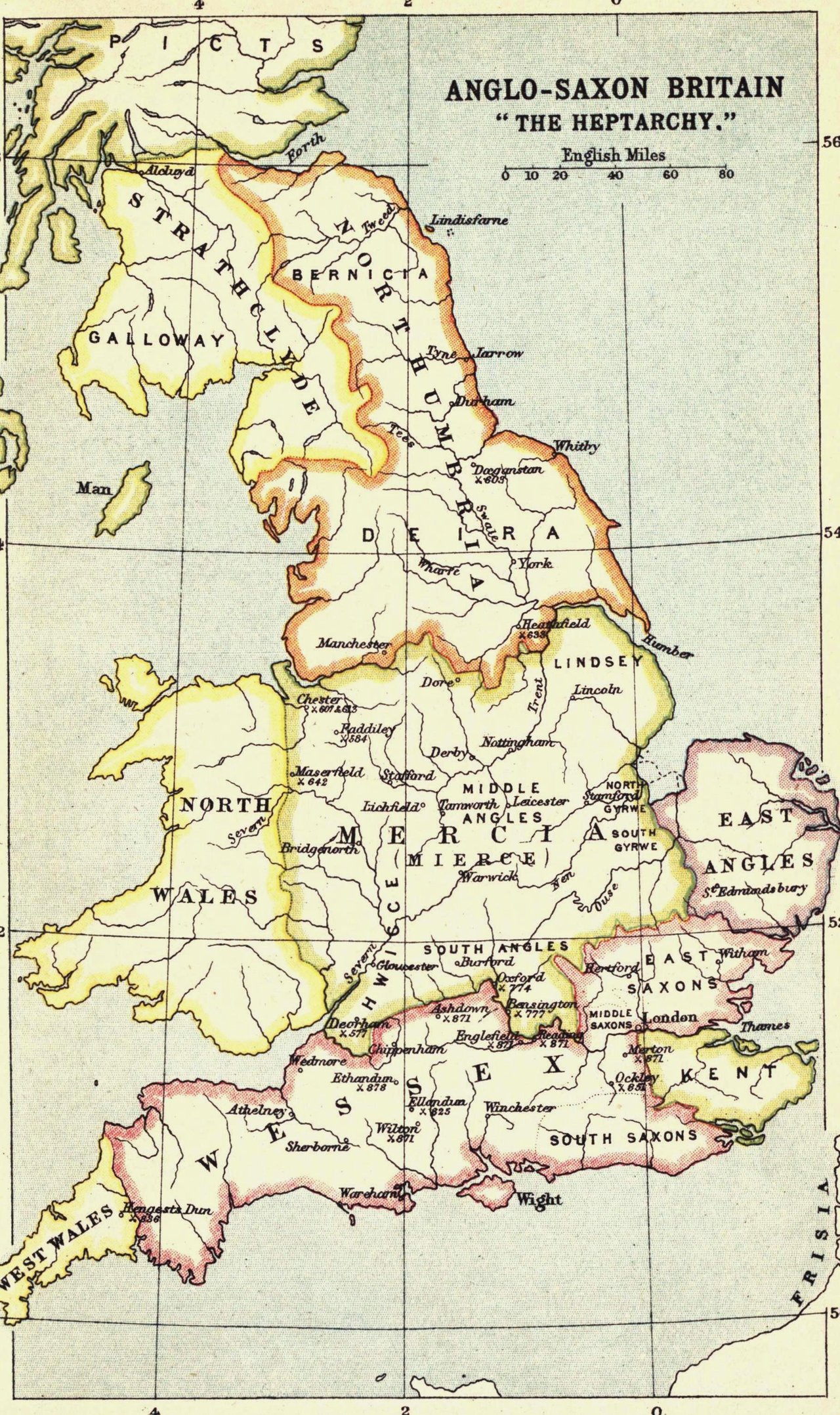
The Heptarchy. After the Roman legions left Britain, the Angles, Saxons and Jutes who settled the island built not one kingdom but many. Historians call the patchwork the Heptarchy, the seven kingdoms: Kent, Sussex and Wessex in the south, Essex and East Anglia in the east, Mercia in the midlands, and Northumbria in the north. In truth there were always more than seven, and the little kingdoms warred, married and swallowed one another for three centuries, each king striving to be bretwalda, the overlord who could exact tribute from the rest.
Supremacy passed from kingdom to kingdom like a torch. Kent under Aethelberht held it first; then Northumbria, whose seventh-century golden age joined military power to the learning of Bede and the art of Lindisfarne. In the eighth century the torch passed to Mercia: King Offa (757-796) treated with Charlemagne as an equal, minted fine coin, and threw up Offa's Dyke, the great earthwork along the Welsh border that still bears his name. Each supremacy was personal, and died with the man who held it.
Then came the Vikings. The Great Heathen Army that landed in 865 destroyed East Anglia and Northumbria, overran Mercia, and by 878 had driven the last free English king, Alfred of Wessex, into the marshes of Athelney. Alfred's survival changed the fate of England. From Athelney he came back to win at Edington, pen the Danes behind the Danelaw, and rebuild his kingdom on fortified burhs, a reformed army and a revival of learning.
Alfred's children and grandchildren finished the work. Edward the Elder and his warrior sister Aethelflaed, Lady of the Mercians, rolled up the Danelaw burh by burh, and in 927 Athelstan took York and was acknowledged as king of all the English - and, for a moment, overlord of Britain after his crushing victory at Brunanburh in 937. The seven kingdoms had become one: England. Wessex had risen from a southern shire to the royal house of a united nation, and its line would hold the throne until the Normans came.
 Britannica: Heptarchy
 World History Encyclopedia: Kingdom of Wessex
Britannica: Offa, King of Mercia