 Go Back

The Hundred Years' War (1337-1453) was a series of conflicts between the kings of England and France over the French crown and the English-held lands in France. Its roots lay in the odd position of English kings, who ruled Gascony as vassals of the French crown, and in the succession crisis of 1328, when the direct Capetian line failed. Edward III of England, whose mother was the last Capetian king's sister, was passed over for Philip VI of Valois; after years of friction over Gascony and Flanders, Edward claimed the French crown in 1340, quartering the lilies of France with the leopards of England on his arms.
The first phase favored England spectacularly. English armies, built around dismounted men-at-arms and longbowmen, won at Crecy in 1346 and captured Calais after a famous siege; at Poitiers in 1356 the Black Prince captured King John II of France himself, who died in captivity awaiting a ruinous ransom. The Treaty of Bretigny (1360) gave Edward an enlarged Aquitaine in full sovereignty, but it unraveled within a decade as Charles V of France and his constable Bertrand du Guesclin recovered nearly everything by patient attrition. Both crowns were meanwhile strained by taxation, plague and revolt: the Jacquerie in France and the Peasants' Revolt of 1381 in England.
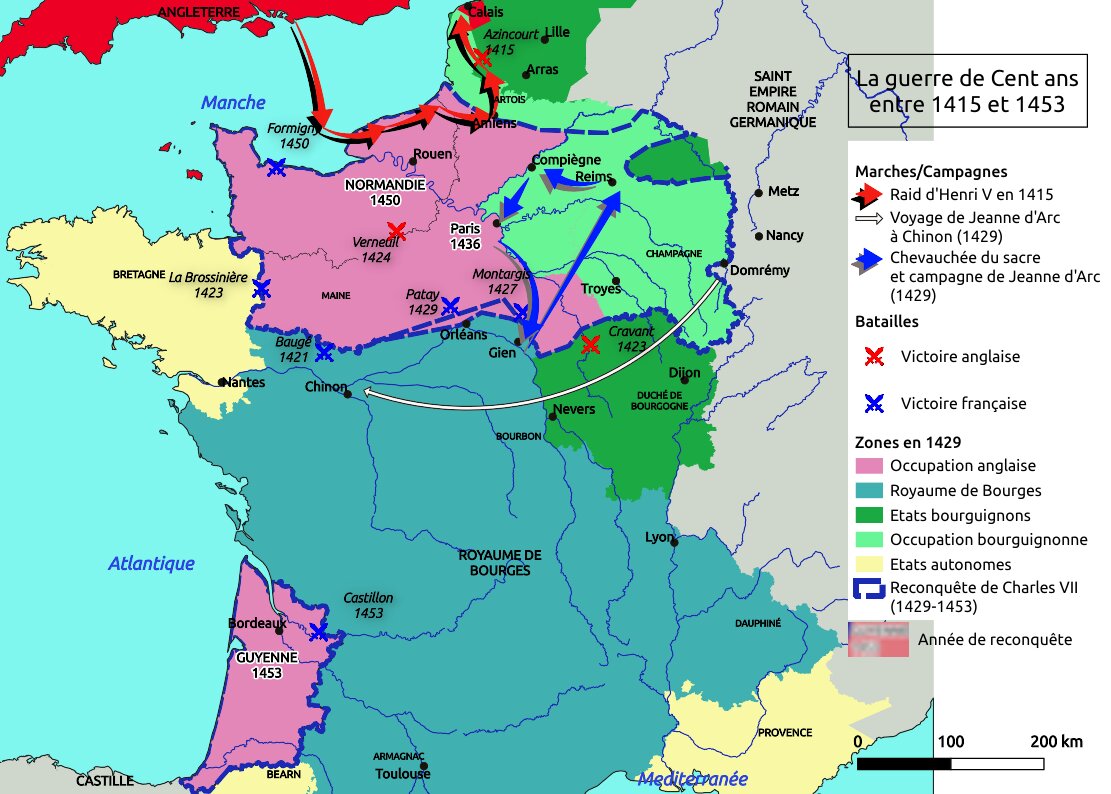
War resumed under Henry V of England, who exploited a French civil war between Burgundians and Armagnacs. His victory at Agincourt in 1415, where longbowmen annihilated the flower of French chivalry, led to the conquest of Normandy and the Treaty of Troyes (1420), by which Henry married Charles VI's daughter and was recognized as heir to France. Both kings died in 1422, leaving the infant Henry VI as nominal king of both realms. The turning point came in 1429, when Joan of Arc, a peasant girl convinced she was sent by God, rallied the Dauphin Charles' cause, relieved the siege of Orleans and saw him crowned at Reims as Charles VII. Captured by the Burgundians and sold to the English, she was tried and burned in 1431, but the French recovery she began did not stop.
The Burgundians abandoned the English alliance at Arras in 1435, Paris was retaken in 1436, and Charles VII reformed his army with permanent companies and a powerful train of artillery. Normandy fell after the battle of Formigny in 1450, and Gascony after Castillon in 1453, where French cannon decided the day; England kept only Calais, until 1558. The war transformed both kingdoms: France emerged with a standing army, direct royal taxation and a stronger monarchy, while England, bankrupted and demoralized, slid toward the Wars of the Roses. It also changed warfare, ending the dominance of feudal cavalry, and forged new senses of English and French national identity, symbolized above all by Joan of Arc.
 Britannica: Hundred Years' War
 World History Encyclopedia: Hundred Years' War
World History Encyclopedia: Causes of the Hundred Years War
World History Encyclopedia: Battle of Crecy
World History Encyclopedia: Battle of Agincourt