 Go Back

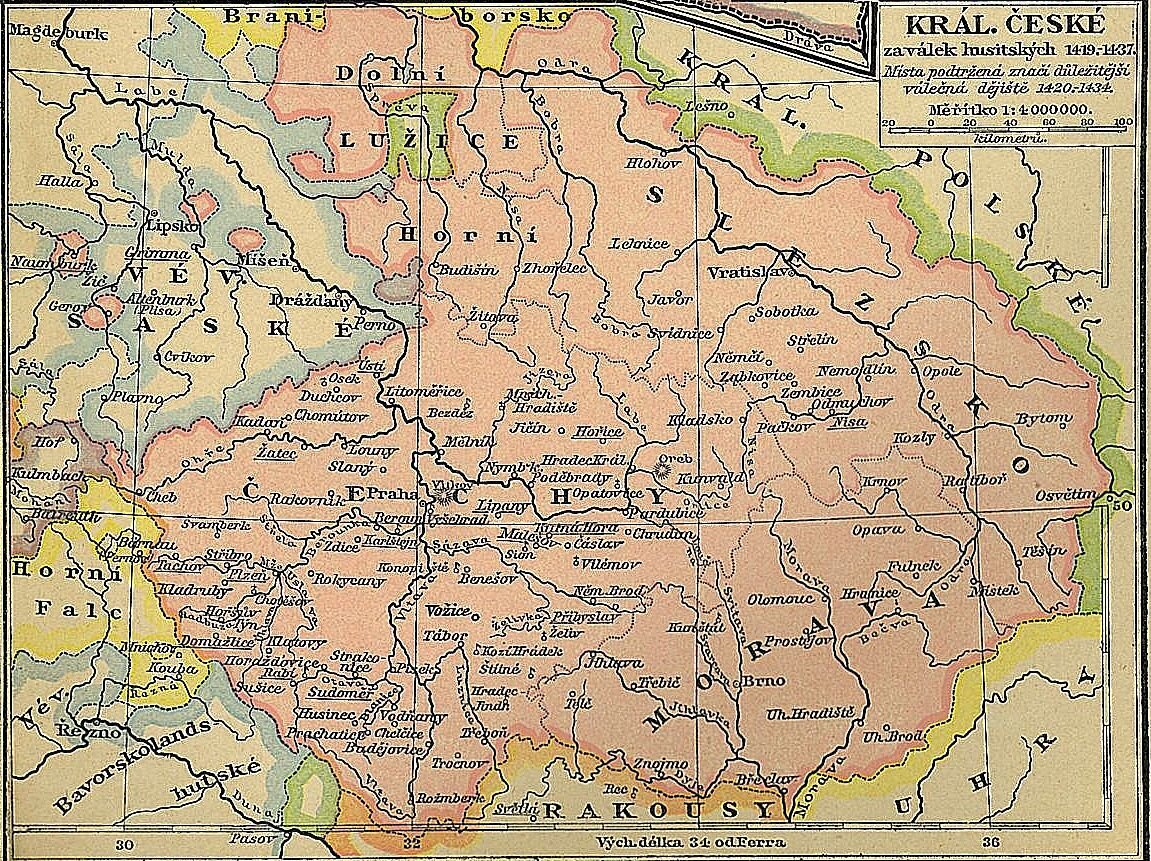
The Hussite Wars (1419-1434) were a series of conflicts in Bohemia sparked by the execution of the reformer Jan Hus. Hus, a Prague preacher and university master inspired by John Wyclif, attacked indulgences, clerical wealth and the worldly power of the church, and demanded that laypeople receive communion in both kinds, bread and wine, symbolized by the chalice that became the Hussite emblem. Summoned to the Council of Constance under a safe conduct from King Sigismund, he was imprisoned, condemned for heresy and burned on 6 July 1415. Bohemia erupted: nobles formed a league to defend free preaching, and in July 1419 Prague radicals threw the Catholic town councillors from the New Town Hall windows, the first Defenestration of Prague.
The Hussites were never one party. The moderate Utraquists of Prague wanted chiefly the chalice for the laity and church reform within the old framework; the radical Taborites, gathered at their new fortress-town of Tabor, rejected most of the inherited church order and awaited God's kingdom; smaller groups went further. All united against King Sigismund, heir of the hated council and brother of the dead King Wenceslaus IV, whose claim to the Bohemian crown they refused. Under the one-eyed Jan Zizka, the Hussites developed a revolutionary way of war: laagered wagon forts chained together, manned by peasant infantry with flails, pikes and handguns, supported by field artillery, tactics that defeated mounted knights again and again.
Five crusades were preached against Bohemia (1420, 1421, 1422, 1427, 1431), and all failed. Zizka, though fully blind from 1421, crushed the first two, winning at Vitkov Hill, Kutna Hora and Nemecky Brod; after his death in 1424 the Taborite general Prokop the Great carried the war into Germany, Austria and Silesia in 'beautiful rides' that terrified central Europe. The fifth crusade broke at Domazlice (Taus) in 1431 at the mere rumor of the Hussite wagons, and the church changed course: at the Council of Basel it negotiated the Compactata (1436), granting the Utraquists communion in both kinds, the first time the medieval church made doctrinal concessions to a reform movement under pressure.
The radicals would not compromise. In 1434 the Utraquist nobles and Prague, allied with Catholics, destroyed the Taborite and Orphan armies at Lipany, where Prokop fell. Bohemia kept its Hussite character under King George of Podebrady (1458-1471), a Utraquist 'king of two peoples', and the Compactata remained Bohemia's religious settlement for two centuries. The Hussites left a lasting mark: they anticipated themes of the Reformation, gave Bohemia a distinct national and religious identity, revolutionized infantry warfare with wagons and gunpowder, and inspired later movements, the Moravian Brethren among them, that carried Hus's memory into the modern world.
 Britannica: Hussite
Britannica: Jan Hus
 World History Encyclopedia: Hussite Wars