 Go Back

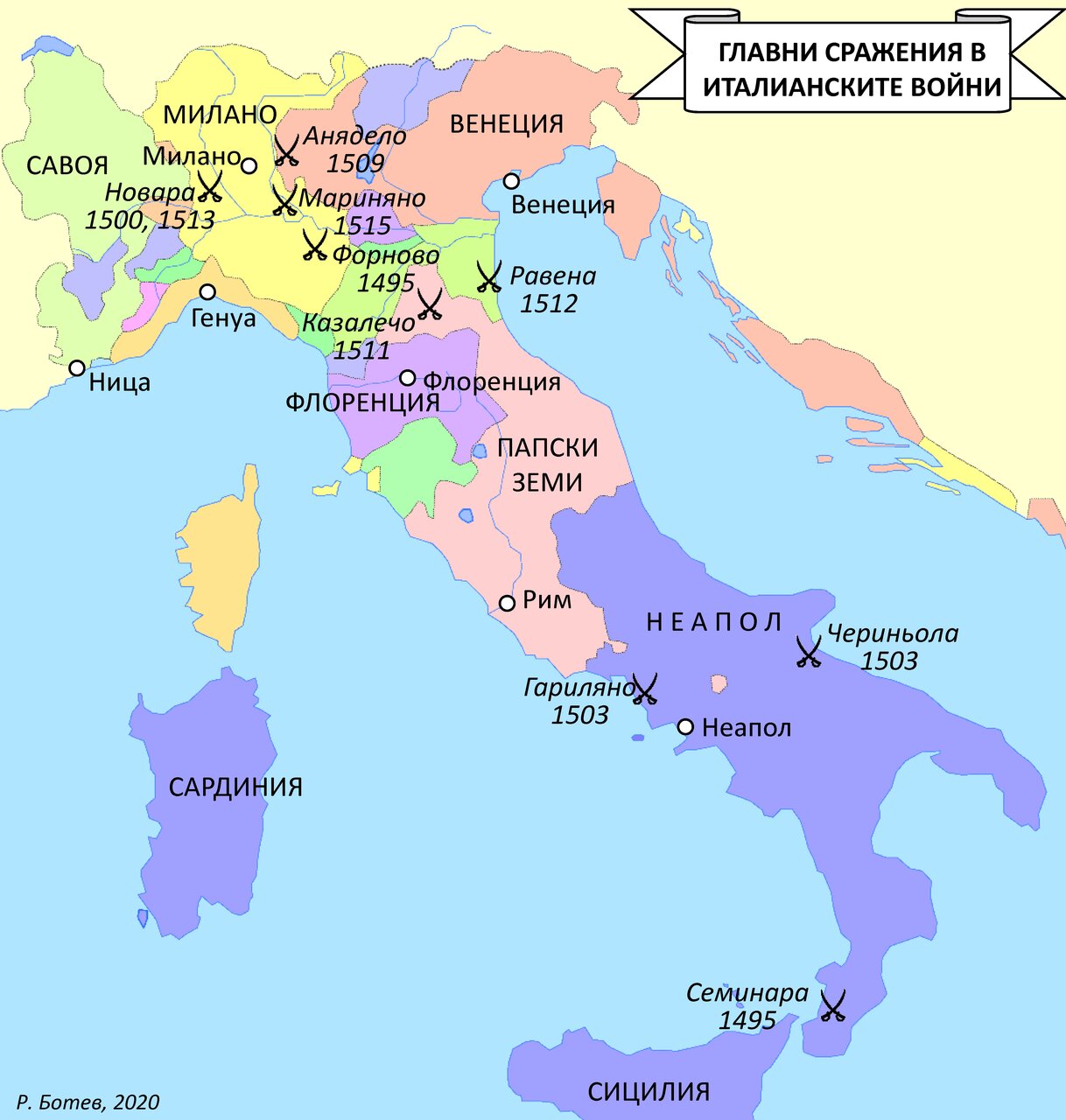
The Italian Wars (1494-1559) were a series of conflicts fought on Italian soil, above all between the French Valois and the Habsburgs, that made Italy the battlefield of Europe for two generations. They began when Charles VIII of France, claiming the Kingdom of Naples through Angevin inheritance, marched down the peninsula in 1494 with modern siege artillery that battered medieval walls into rubble and briefly took Naples. His invasion shattered the Italian balance of power maintained since the Peace of Lodi (1454) among Milan, Venice, Florence, the Papacy and Naples, and it summoned the first of many anti-French coalitions, the League of Venice (1495), which forced Charles home.
The wars widened under Charles's successors. Louis XII seized Milan (1499) and Naples (1501) but lost both after the Holy League of 1511, organized by the combative Pope Julius II, drove France from Milan; the French returned under the young Francis I, whose victory at Marignano (1515) retook Milan and set up the great duel of the age between Francis and the Habsburg Charles V, who from 1519 combined Spain, the Netherlands, Austria and the Empire. After years of campaigning in Lombardy, Francis was captured at Pavia (1525), the decisive battle of the wars, where Spanish shot and pike destroyed the French army and its king.
Pavia opened the war's ugliest phase. Released under the Treaty of Madrid (1526), Francis promptly repudiated it and joined the League of Cognac with the pope; Charles's unpaid imperial army, partly Lutheran landsknechts, mutinied and sacked Rome in May 1527, massacring citizens and holding Pope Clement VII prisoner, an atrocity that shocked Christendom. The French were expelled from Naples after a last failed siege (1528), and the Peace of Cambrai (1529) and, after two more wars, the truce of Nice (1538) settled the peninsula under Spanish control: Milan and Naples were Habsburg, the Medici ruled Florence and Siena, and French attempts under Francis and Henry II to return failed, at Saint-Quentin in 1557 catastrophically.
The Peace of Cateau-Cambresis (1559) ended the wars, confirming Spanish hegemony in Italy that would last a century and a half. Italy's independent political life was strangled: only Venice kept real freedom. Yet the wars spread the Italian Renaissance northward, French, Spanish and imperial soldiers and courts carried home Italian art, architecture, learning and manners, while demonstrating the new age of warfare: artillery fortresses, professional pike-and-shot infantry, and diplomacy as a permanent tool, with resident ambassadors invented in Italy now spreading across Europe. The Franco-Habsburg rivalry the wars fixed would shape European politics until the eighteenth century.
 Britannica: Italian Wars
 Encyclopedia.com: Italian Wars (1494-1559)