 Go Back

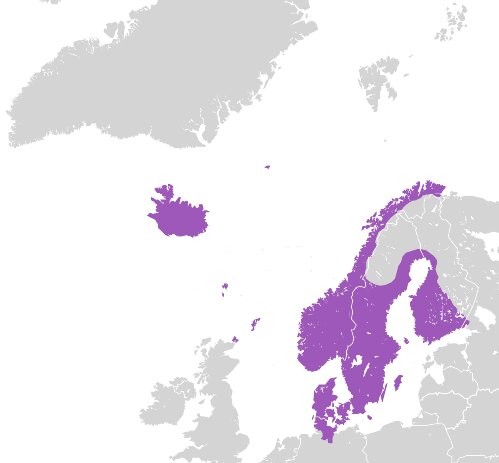
The Kalmar Union (1397-1523) joined the three Scandinavian kingdoms of Denmark, Norway and Sweden under a single crown. Its architect was Margaret I, daughter of the Danish king Valdemar IV and wife of King Haakon VI of Norway. After the deaths of her husband (1380) and her son Olaf (1387), Margaret was accepted as regent of Denmark and Norway, then defeated and captured Albert of Mecklenburg, the unpopular German king of Sweden, in 1389. In 1397 at Kalmar her grandnephew Erik of Pomerania was crowned king of all three realms, while Margaret continued to rule in fact until her death in 1412.
The union was personal, not a merger: each kingdom kept its own laws, councils and administration. Margaret governed skillfully, recovering crown lands, balancing the powerful nobles and churchmen of three countries, and maintaining peace with the Hanseatic League, which dominated Baltic trade. Denmark was the senior partner, supplying most kings and the union's foreign policy; Sweden, the largest and poorest realm, chafed at Danish officials and taxes. Norwegian and Swedish councils hoped the union would protect them from German princes and the Hansa, but resentment grew whenever royal power reached too far into local affairs.
Erik of Pomerania's autocratic rule and his wars with the counts of Holstein and the Hansa strained the union to breaking. Sweden rose under the peasant-noble revolt of Engelbrekt Engelbrektsson (1434-1436), and Erik was deposed in all three kingdoms (1439-1442), replaced by his nephew Christopher and then, in Sweden and Norway, by Karl Knutsson (Bonde). For the rest of the 15th century the union existed on and off: Danish kings of the Oldenburg dynasty, from Christian I (1448), were repeatedly recognized in Sweden and repeatedly expelled by Swedish regents such as Sten Sture, who defeated Christian I at Brunkeberg in 1471.
Christian II briefly restored the union by force, but his massacre of Swedish nobles and churchmen at the 'Stockholm Bloodbath' (1520) provoked the final break: Gustav Vasa's rebellion drove the Danes out, and in 1523 Gustav was elected king of an independent Sweden. Denmark-Norway remained united until 1814. The Kalmar Union showed both the pull of Scandinavian cooperation and the strength of separate national institutions; its failure left Denmark and Sweden as rivals who fought for Baltic mastery for the next three centuries.
 Britannica: Kalmar Union
 Encyclopedia.com: Kalmar, Union of