 Go Back

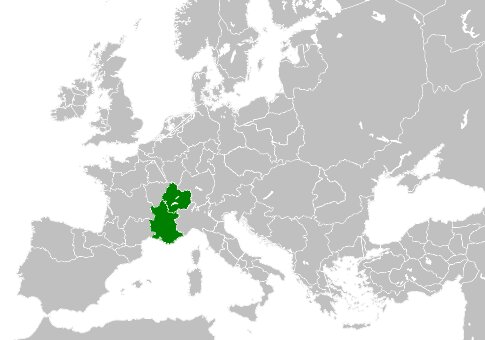
The Kingdom of Arles, also called the Kingdom of Burgundy, was the medieval kingdom of the lands around the western Alps and the Rhone, Savoy, Provence, the Dauphine, Franche-Comte and western Switzerland. Its origins lay in the partition of the Carolingian world: by the Treaty of Verdun (843) and later divisions, middle-Frankish territories between France and Germany were repeatedly reassembled. Around 888, as Carolingian authority collapsed, Rudolf I of the Guelph family founded the kingdom of Upper Burgundy in the Transjuranian lands, while Provence and the lower Rhone formed Lower Burgundy under Boso of Vienne (879). In 933 the two were united under Rudolf II, forming a single kingdom stretching from the Jura to the Mediterranean.
The second kingdom of Burgundy occupied the strategic spine of western Europe: the Alpine passes that linked Italy and Germany and the Rhone corridor that linked the Mediterranean to the north. Its rulers profited from, and were squeezed by, their greater neighbors. They were frequently kingmakers: Hugh of Arles was king of Italy (926-947), and Adelaide of Burgundy married Otto I of Germany. But the kingdom lacked a capital, a common law and a strong fiscal base, and its kings, Rudolf III chief among them, gradually lost control of the church lands and counties to local nobles and bishops. The German kings, holding Italy through the Alpine routes, could not allow the passes to fall into hostile hands.
Rudolf III, childless, named the German king Henry II as his heir, and on Rudolf's death in 1032 the kingdom passed to Henry's Salian successor Conrad II after a brief war. From 1033 the kingdom of Arles was part of the Holy Roman Empire, its crown one of the Empire's three, with Germany and Italy. Imperial control was nominal: Provence drifted toward the French orbit and passed to the Angevins in 1246, the Dauphine was sold to the French heir in 1349, and the counts of Savoy grew into a great power of their own. Emperors were still occasionally crowned king of Arles at Arles or Lyons, Frederick Barbarossa among them in 1178.
By the later Middle Ages the kingdom had dissolved in practice. France absorbed the left bank of the Rhone, Savoy monopolized the Alps, and the Free County of Burgundy, Franche-Comte, passed by marriage to the Valois dukes of Burgundy in 1369 and with them into the Habsburg inheritance after 1477. Only Switzerland escaped the pattern: the confederation founded in the Arlesian lands of the Empire won practical independence by 1499 and recognition at Westphalia. The Kingdom of Arles thus disappeared into the map of Europe, but it is the ancestor of the Rhone valley's contested politics and the reason imperial, French and Italian spheres met where they did.
 Britannica: Burgundy
Britannica: Savoy
 Encyclopedia.com: Burgundy