 Go Back

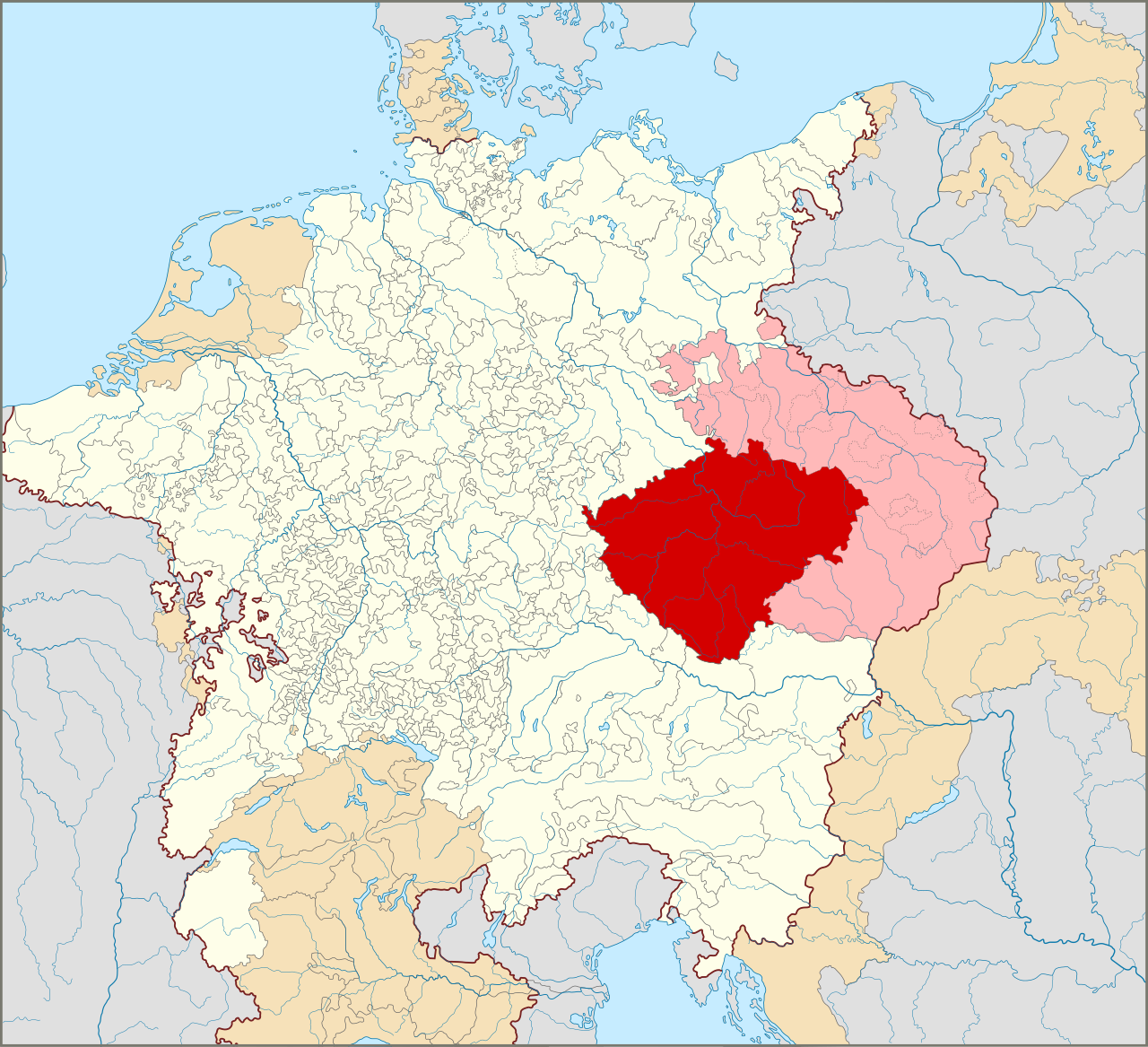
The Kingdom of Bohemia. The Kingdom of Bohemia was the Czech crown - the state of the Premyslid dukes raised to royalty within the Holy Roman Empire. Though earlier dukes had worn personal crowns, the hereditary kingdom was established in 1198 by Ottokar I and confirmed by Frederick II's Golden Bull of Sicily in 1212: the Czech king was freed from nearly all obligations to the Empire, and Bohemia became, in effect, the Empire's most privileged kingdom - its king later an elector of emperors.
Under the last Premyslids, Bohemia briefly dominated Central Europe: Ottokar II ruled from Prague to the Adriatic before falling in battle in 1278. The kingdom's golden age came under the Luxembourgs, above all Charles IV - king of Bohemia and Holy Roman Emperor - who made Prague the imperial capital, founded Charles University in 1348, rebuilt the royal castle of Hradcany and founded Prague's New Town, and made the Crown of Bohemia the Empire's richest land.
Bohemia was also Europe's first Protestant battleground: from the teachings of Jan Hus - rector of Charles University from 1403, preaching the anti-papal doctrines of England's John Wycliffe - grew the Hussite movement (1402-1485), whose armies defeated four crusades sent by the Holy Roman Empire. A century before Luther, Bohemia had already defied Rome - and the Hussite movement is counted part of the roots of the Protestant Reformation.
The kingdom passed to the Habsburgs in 1526 and remained theirs for nearly four centuries; after the Bohemian Revolt was suppressed, German gradually displaced Czech as the language of the Diet until the Czech National Revival of the 19th century. But the kingdom's name and crown survived until 1918, and Prague remained the heart of the Czech nation.
 Britannica: Bohemia
 BBC: BBC Radio 4 - In Our Time, Bohemia
 The Metropolitan Museum of Art: Prague, 1347–1437
 British Museum: Collections Online