 Go Back

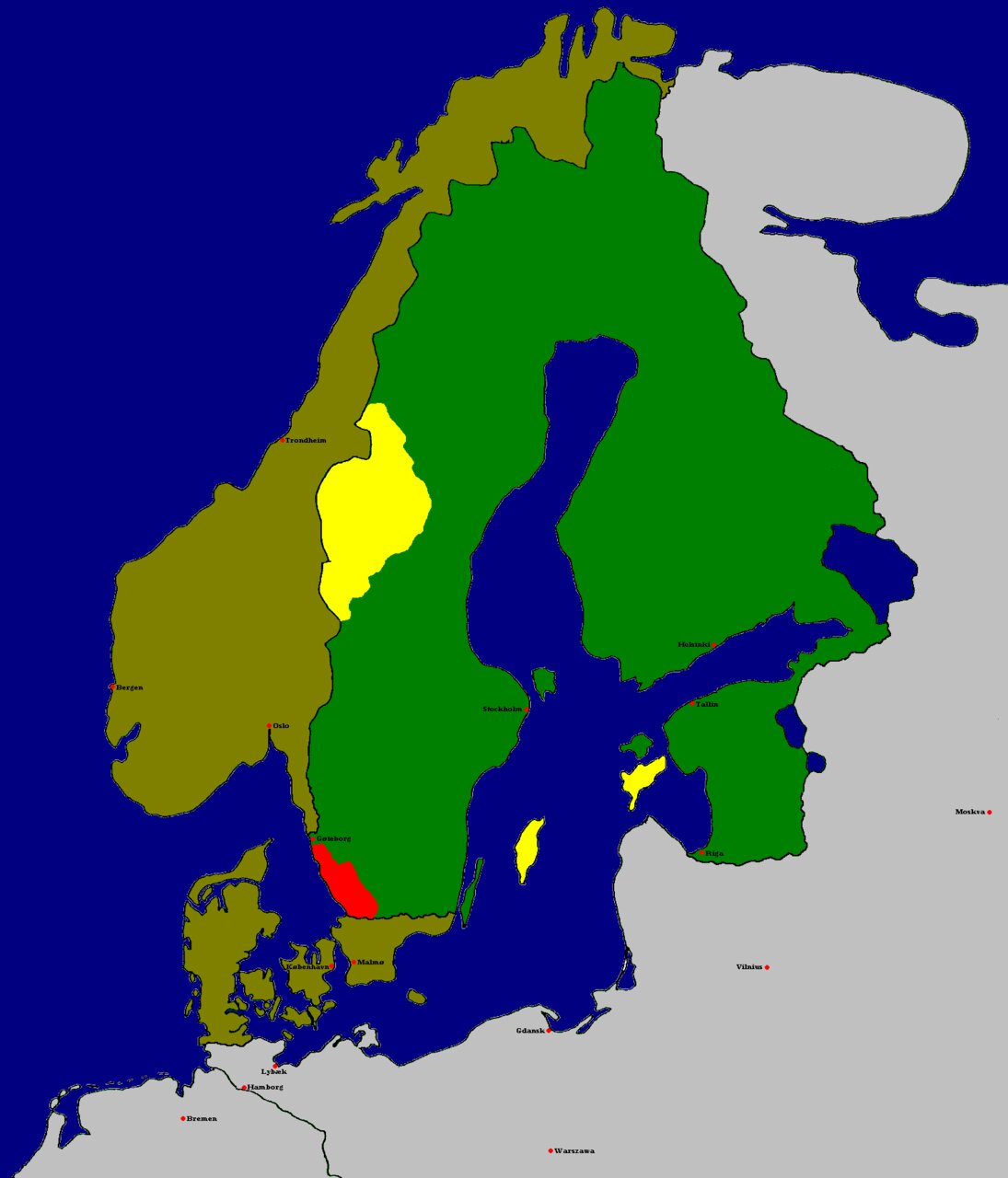
The Kingdom of Denmark-Norway (1523-1814) was the dual monarchy formed when Gustav Vasa's rebellion dissolved the Kalmar Union in 1523, leaving Denmark and Norway, with Iceland, Greenland and the Faroe Islands, under the Oldenburg kings of Denmark. Norway was by far the weaker partner: its council faded, its administration filled with Danish officials, and in 1537 it was formally declared a dependency of the Danish crown. From Copenhagen, the kings ruled a composite state that also included the duchies of Schleswig and Holstein, and which competed with Sweden for control of the Baltic, the Sound tolls on passing shipping being the monarchy's richest revenue.
The 16th century was the monarchy's golden age. Frederick I and Christian III accepted the Lutheran Reformation in 1536, confiscating the wealthy church lands into the crown; Christian III rebuilt the navy and fortified the Sound. Frederick II and Christian IV, builder of Rosenborg Castle and the Bourse, presided over a flourishing trade and a court famous for music, science, Tycho Brahe observed the heavens from his island of Hven, and culture. But Christian IV's ambition overreached: the Kalmar War (1611-1613) with Sweden ended indecisively, and his intervention in the Thirty Years' War (1625-1629) was crushed by Wallenstein's armies.
The 17th century turned catastrophic. In the Torstenson War (1643-1645) Denmark lost Jemtland, Herjedalen and Gotland; worse came in 1658, when Charles X Gustav of Sweden marched his army across the frozen Belts in one of history's boldest maneuvers, forcing the Peace of Roskilde, which ceded Scania, Halland, Blekinge and Bornholm's neighbors, Denmark's richest provinces east of the Sound. The shock produced a domestic revolution: in 1660 the estates gave Frederick III absolute and hereditary power, making Denmark-Norway Europe's most formally absolute monarchy, governed by the Lex Regia of 1665. The crown then rebuilt: a new navy, mercantile colonies in Africa, India and the Caribbean, and an efficient centralized bureaucracy.
Denmark-Norway regained nothing from Sweden despite fighting in the Scanian War (1675-1679) and the Great Northern War (1700-1721), and the 18th century brought prosperity through neutral trade, Enlightenment reform under ministers such as the Struensee episode and then Crown Prince Frederick's regency, and the abolition of serfdom in 1788. The Napoleonic Wars destroyed the state: Britain attacked neutral Copenhagen twice (1801, 1807) and seized the fleet, and in 1814 Denmark ceded Norway to Sweden by the Treaty of Kiel, keeping only the North Atlantic islands. Norway promptly declared independence, wrote Europe's most liberal constitution, and entered a union with Sweden that lasted until 1905.
 Britannica: Denmark
 Encyclopedia.com: Denmark