 Go Back

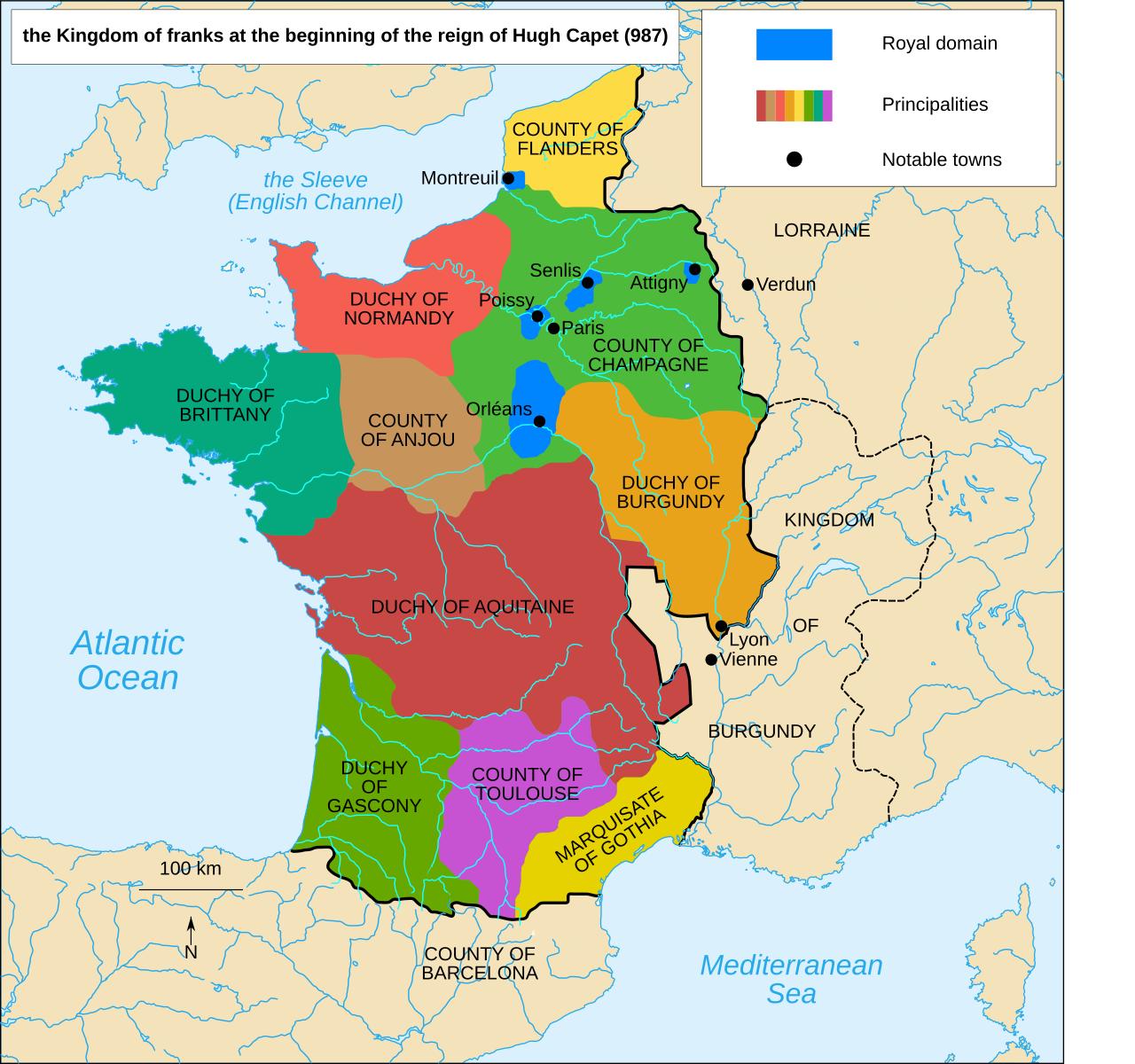
The Kingdom of France (Capetians). The Capetian dynasty ruled France from 987 - when the barons elected Hugh Capet to replace the last Carolingian - until 1328 in the direct line, and through its Valois and Bourbon branches until the Revolution: the longest royal line in European history. The first Capetians were among Europe's weakest kings, ruling directly little more than the Ile-de-France around Paris while great vassals like the dukes of Normandy and Aquitaine held more power than the crown.
Two things saved them: an unbroken line of adult heirs for three hundred years (they crowned sons as co-kings in their own lifetimes), and the Church's loyalty. Then came the transformation. Philip II Augustus (1180-1223) broke the power of the English Plantagenet kings in France, seized their continental lands for the crown, and made the King of France the strongest ruler in the kingdom in fact as well as name. His grandson Louis VIII added Poitou and the south in the wake of the Albigensian Crusade.
The dynasty's zenith was Louis IX - Saint Louis (1226-1270): the crusader king admired across Europe for his justice, who made the French crown the moral as well as political center of Christendom. Under his successors Philip III and Philip IV - who defied and kidnapped a pope, destroyed the Templars and seized their wealth in 1307, and summoned the first Estates General in 1302 - France stood as the pre-eminent power in Western Europe.
When Philip IV's three sons all died without male heirs, the direct line ended in 1328 and the throne passed to the Valois - still Capetians by blood. The line Hugh founded has given France (and Navarre, Spain, Naples, and more) kings for a thousand years: a dynasty that turned a small lordship around Paris into the kingdom of France.
 Britannica: France - Later Capetians, Monarchy, Revolution
 The Metropolitan Museum of Art: France, 1000–1400 A.D.
 Livius: Merovingians - Livius
Britannica: Capetian dynasty