 Go Back

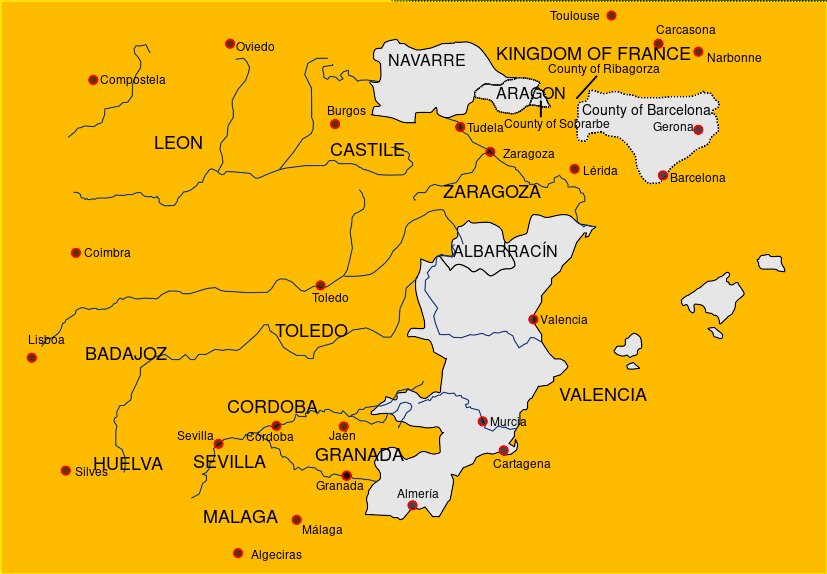
The Kingdom of Leon (910-1230) was the leading Christian kingdom of early medieval Iberia, heir of the Visigothic refugees who had held out in the northern mountains as the Kingdom of Asturias after the Muslim conquest of 711. In 910 Garcia I moved the capital south from Oviedo to the old Roman city of Leon, closer to the frontier, and the kingdom took the city's name. Leonese kings claimed to continue the Visigothic monarchy and pushed the frontier south into the Duero valley, settling it with colonists and building the castle lines, the origin of the name Castile, that guarded it.
The kingdom's fortunes rose and fell with the struggle against Muslim al-Andalus. Almanzor, the all-powerful minister of Cordoba, sacked Leon itself in 988 and devastated the Christian states, but after the caliphate collapsed into taifa kingdoms in 1031, the balance reversed. Ferdinand I (1037-1065) united Leon with Castile, defeated and killed his brother the king of Navarre, and made the taifas of Toledo, Seville and Badajoz pay tribute. His son Alfonso VI took Toledo in 1085, the first great Muslim capital to fall, and ruled an empire of 'the two religions'. The Almoravid and then Almohad counterattacks from North Africa, victors at Zallaqa (1086), Ucles (1108) and Alarcos (1195), kept the frontier in blood for another century.
Leon was also a kingdom of pilgrims and laws. The road to Santiago de Compostela ran through its lands, bringing French monks, merchants and settlers and tying the kingdom to European currents of reform and Romanesque art. In 1188 Alfonso IX summoned the Cortes of Leon, which included town representatives alongside nobles and clergy, among the earliest parliaments in Europe to admit the third estate. Its decrees protected property and limited royal power, and Leon developed its own legal tradition, later codified in Castilian law.
The kingdom's unity with Castile repeatedly broke on inheritance: Alfonso VII's empire split between his sons in 1157, and Leon went its own way under Ferdinand II and Alfonso IX. The final reunion came through the remarkable Ferdinand III, who inherited Castile in 1217 and Leon from his father in 1230, this time permanently. Warrior and later saint, Ferdinand conquered Cordoba (1236) and Seville (1248), reducing Muslim power in Iberia to Granada. Thereafter Leon's identity was absorbed into the Crown of Castile, but its laws, its parliament and its old capital remained monuments of the kingdom that carried the Reconquista from the mountains to the Guadalquivir.
 Britannica: León
Britannica: Castile-Leon
 Encyclopedia.com: Early Medieval Iberia
 World History Encyclopedia: Reconquista