 Go Back

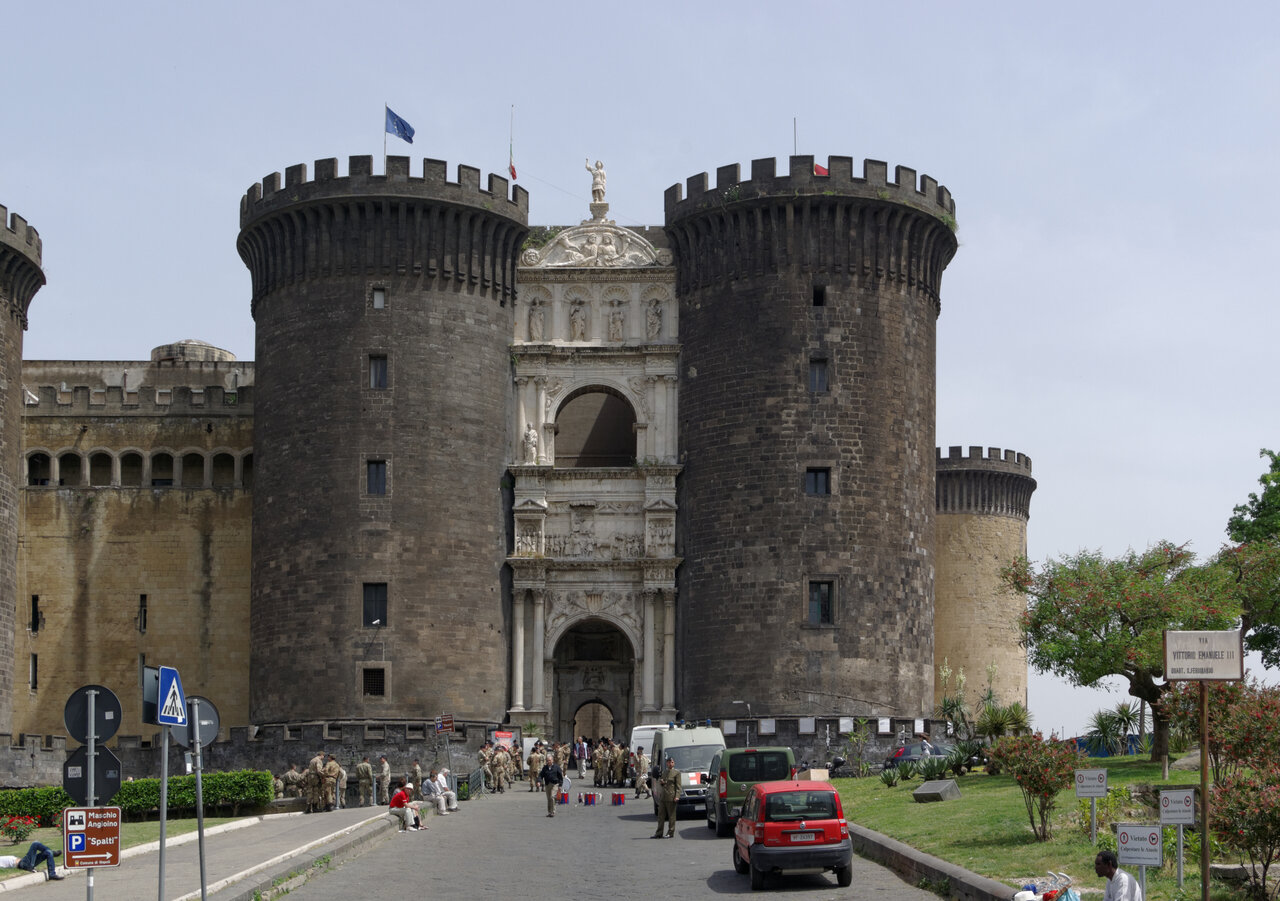
The Kingdom of Naples (1282-1504) was born from the Sicilian Vespers, the revolt that in 1282 expelled the Angevin French from Sicily and broke the kingdom of southern Italy in two: the Aragonese took Sicily, while the Angevins kept the mainland, which came to be called, from its capital, the Kingdom of Naples. Under Robert 'the Wise' (1309-1343), patron of Petrarch and Boccaccio, Naples was a center of early Renaissance culture and Guelf politics, but the dynasty dissolved into murder and succession crisis under his granddaughter Joanna I, who was deposed and killed by her cousin Charles of Durazzo (1382), while the popes, the kingdom's overlords, backed now one claimant, now another.
The Angevin-Durazzo line exhausted itself in these wars, and in 1442 Alfonso V of Aragon, already king of Sicily, took Naples after a long struggle. 'Alfonso the Magnanimous' made the city his capital and one of the great courts of the Renaissance: he rebuilt the Castel Nuovo with its triumphal arch, gathered scholars like Lorenzo Valla and Panormita, and governed Italy through alliances that anticipated the balance of power. At his death in 1458 Sicily and Aragon went to his brother, while Naples passed to his illegitimate son Ferdinand I (Ferrante), whose barons rebelled with Angevin and papal support and were defeated only after years of war; Ferrante's reprisals, including the massacre of barons invited to a wedding feast, made his name a byword for cunning despotism.
The kingdom's weakness invited invasion. The old Angevin claim passed to the French crown, and in 1494 Charles VIII of France marched the length of Italy and took Naples almost unopposed, chased out within a year by the Holy League. Louis XII of France returned in 1501, partitioning the kingdom with Ferdinand the Catholic of Aragon, but the partners fell out, and the Spanish general Gonzalo de Cordoba, 'the Great Captain', destroyed the French armies at Cerignola and on the Garigliano (1503). By 1504 Naples was Spanish.
For two centuries the kingdom was governed by Spanish viceroys, one of the richest and most heavily taxed provinces of the Habsburg monarchy, its barons' estates and grain feeding the empire's wars. The medieval kingdom left a double mark: the south's incorporation into the Spanish imperial system, which shaped its society until 1860, and the brilliant court culture of Angevin and Aragonese Naples, from Boccaccio's decade at Robert's court to the humanist academy of Alfonso, that made the city for a time a capital of European letters.
 Britannica: Kingdom of Naples
 Encyclopedia.com: Naples, Kingdom of