 Go Back

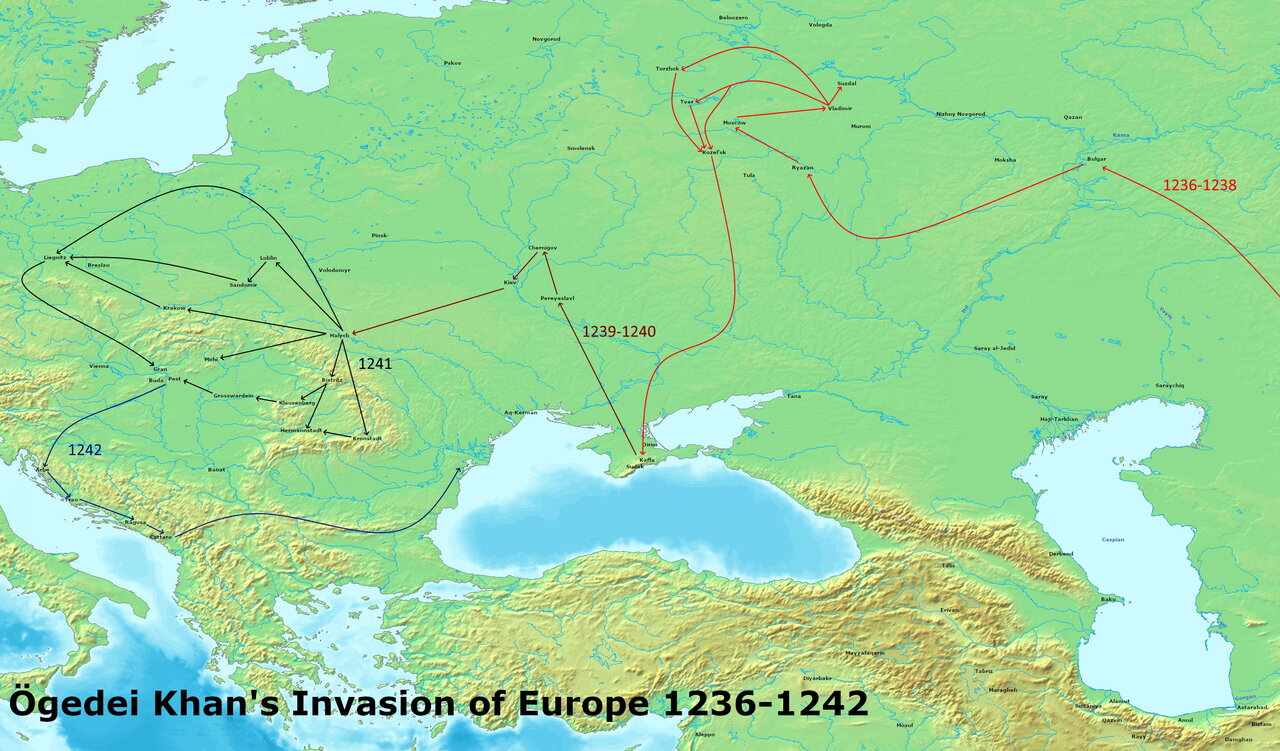
The Mongol invasions of Europe (1236-1242) were part of the great western campaign ordered by the Great Khan Ogodei and commanded by Batu, a grandson of Genghis Khan, with the veteran general Subedei as his strategist. After securing the steppe, the Mongols fell on the Volga Bulgars and then on the Rus' principalities: Riazan, Vladimir and Suzdal were stormed and burned in the winter of 1237-1238, and Kiev, the mother city of Rus', fell in December 1240 after a siege. The Russian lands, except Novgorod, became tributaries of the Golden Horde for two centuries, paying tribute and supplying troops to the khans of the Volga.
In the spring of 1241 Batu's army split into columns and struck Poland and Hungary simultaneously. In Silesia, a Polish-German army under Duke Henry II the Pious was annihilated at Legnica (Liegnitz) on 9 April, the duke killed, the Mongols reportedly filling nine sacks with the right ears of the dead. Three days later the main army destroyed King Bela IV of Hungary at Mohi on the Sajo River, using feigned retreat, encirclement and catapults to break the Hungarian host. Hungary lay open: Pest was burned, the plain was ravaged, and perhaps a quarter of its population perished, while Bela fled to the Adriatic and Mongol detachments chased him into Croatia and reached the walls of Vienna's neighborhood.
Latin Europe panicked but did not unite. The emperor Frederick II and the pope were at war, and no crusade materialized; the Mongols faced no coherent western army. Then, in the spring of 1242, Batu unexpectedly withdrew his whole host eastward. The death of Ogodei in December 1241 required the princes to attend the election of a new khan, though scholars also point to Hungary's spring floods, dwindling pasture and the limits of steppe logistics. The Mongols raided the Balkans again, Bulgaria, Serbia and Thrace, and later invaded Poland (1259, 1287) and Hungary (1285) with diminishing success against rebuilt stone castles and prepared armies.
The invasions transformed eastern Europe. Hungary repopulated its plains, walled its towns and welcomed settlers, including Cumans; Poland and the Rus' lands rebuilt under the shadow of the Horde; and the 'Tatar yoke' shaped Russian political development for generations. The terror also opened a door: Europe sent envoys like John of Plano Carpini and William of Rubruck to the khans, merchants like the Polos followed the Mongol peace across Asia, and for a century East and West were in closer contact than ever before. The Golden Horde itself survived on the lower Volga until the 16th century, Islamized, Turkicized, and finally broken among successor khanates.
 Britannica: Golden Horde
 World History Encyclopedia: The Mongol Invasion of Europe
World History Encyclopedia: Mongol Empire
World History Encyclopedia: Batu Khan