 Go Back

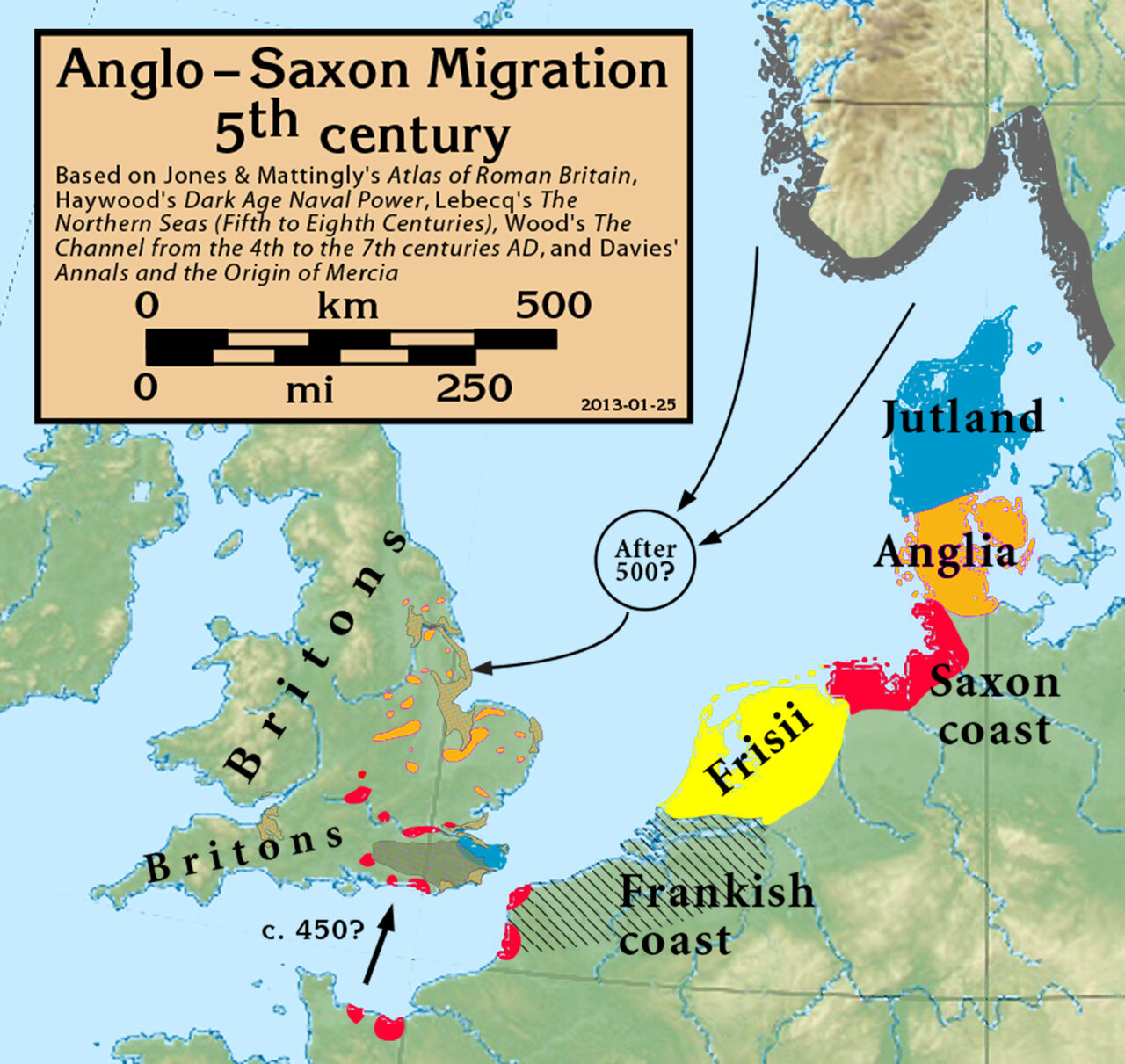
The Saxons, Angles and Jutes were Germanic peoples of the North Sea coastlands, Saxons from the lower Elbe region, Angles from the Schleswig-Angeln peninsula, and Jutes, probably, from Jutland, who migrated to Britain in the 5th and 6th centuries CE. After Rome withdrew its legions around 410, the Romano-British civitates faced Pictish and Irish raiding. According to the tradition preserved by Bede, the British king Vortigern hired Saxon mercenaries led by the brothers Hengist and Horsa, who then turned on their employers and invited more settlers across the sea. Archaeology confirms a deep cultural shift: new styles of pottery, dress fasteners, houses and cremation and inhumation cemeteries spread across eastern and southern England in the 5th century.
Settlement proceeded by small groups of warriors, farmers and families rather than by coordinated conquest, and British resistance was real. The Britons won a major victory at Mons Badonicus (Mount Badon) around 500, associated in later legend with King Arthur, which checked the invaders for a generation. But the balance tipped decisively in the later 6th century, as Anglian and Saxon warbands carved out permanent kingdoms. In the process much of the Romano-British urban, Christian and Latin-speaking order vanished from what became England, though British communities and British Christianity survived strongly in Wales, Cornwall and the north.
By about 600 the settlers had formed a patchwork of kingdoms traditionally called the Heptarchy: Kent, linked to the Jutes and famous for its early law code; the Saxon kingdoms of Sussex, Wessex and Essex; the Anglian kingdoms of East Anglia, Mercia and Northumbria; and smaller peoples such as the Hwicce and the Middle Angles. These kingdoms fought constantly for overlordship, and their kings traced descent from Woden. Pagan cemeteries such as Sutton Hoo, whose great ship burial of about 625 held a king's helmet, sword, and gold-and-garnet regalia, reveal an aristocratic warrior culture tied by gift-giving and feasting, celebrated in the Old English epic Beowulf.
The conversion of the English began when Pope Gregory the Great sent Augustine to Kent in 597; King Aethelberht, whose wife was a Frankish Christian princess, allowed the mission to preach, and Canterbury became the English church's center. Irish monks from Iona converted Northumbria from the 630s, and the Synod of Whitby (664) aligned the English kingdoms on Roman practice. Christianity brought literacy back, and with it charters, written law codes and eventually the monastic scholarship of Bede's Northumbria. The Angles and Saxons gave England its name ('land of the Angles'), its language, and the kingdoms from which a united English monarchy would later emerge.
 Britannica: Anglo-Saxon
 World History Encyclopedia: Saxons