 Go Back

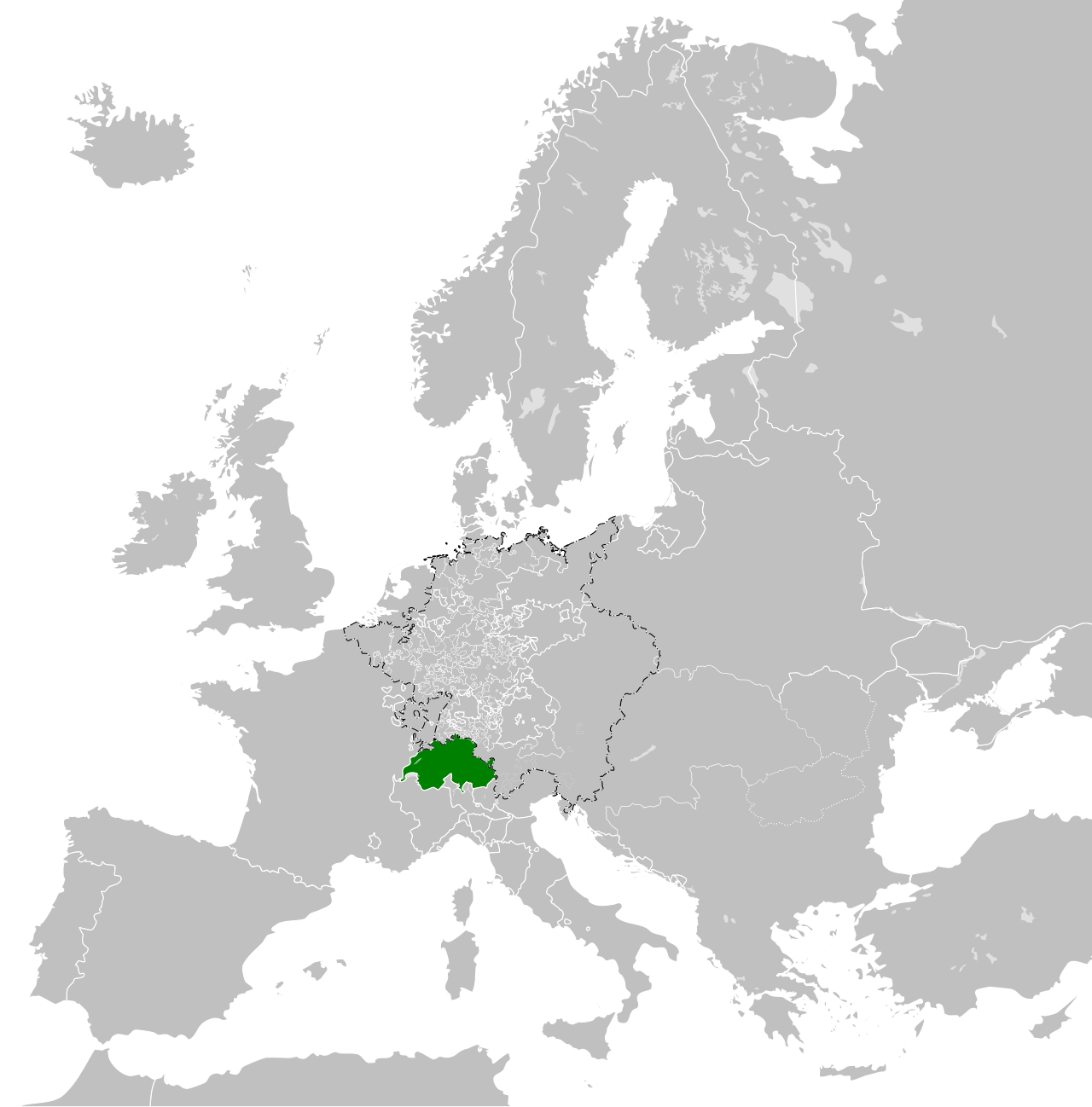
The Swiss Confederacy. The Swiss Confederacy began as an oath in the mountains: on 1 August 1291, three Alpine valley communities - Uri, Schwyz, and Unterwalden - swore an 'Everlasting League' of mutual defense. They were reichsfrei - answerable to no lord but the emperor himself - and when the Habsburgs tried to turn that theoretical overlordship into real rule, the forest cantons fought.
The Swiss proved that valley communities could beat knights: at Morgarten (1315) they destroyed Duke Leopold I's Habsburg army, and at Sempach (1386) they killed Leopold III and shattered another, and at Nafels (1388) they won again. They also saw off the Guglers - marauding mercenary knights from France - in 1375. Canton by canton the league grew - Lucerne, Zurich, Bern, and five more joined the original three - bound by a web of pacts like the Sempacherbrief of 1393, in which all eight cantons promised that none would make war without the consent of all.
The 15th century made them a power: they shattered Charles the Bold of Burgundy in the Burgundian Wars (1470s), and in 1499 victory over Emperor Maximilian I in the Swabian War secured de facto independence from the Holy Roman Empire - a confederation of thirteen cantons that also took the Ticino during the Italian Wars, governed by periodic diets, without king, capital, or common government: an anomaly in a Europe of monarchies.
The confederacy had no king, no capital, and no common government - only periodic diets and sworn pacts - an anomaly in a Europe of monarchies, and the direct ancestor of the modern Swiss federal state, which still celebrates the oath of 1 August 1291 as its national day.
 UNESCO: The Treaty of Perpetual Peace of Friborg (1516)
 Wikipedia: Old Swiss Confederacy
 Britannica: Everlasting League
Britannica: Switzerland - Alps, Neutrality, Confederation