 Go Back

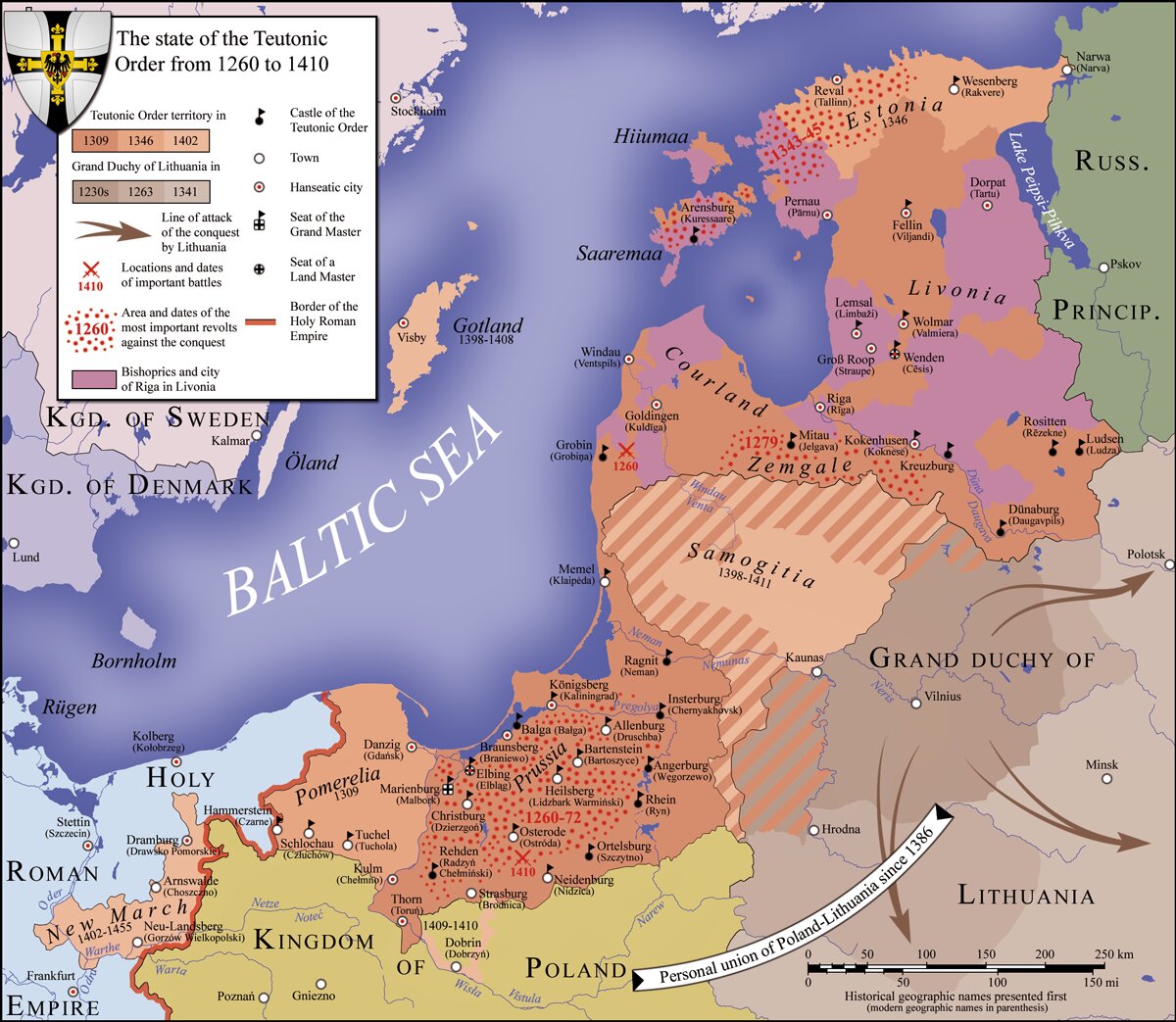
The Teutonic Order (founded 1190) was a German military religious order born during the Third Crusade, when merchants from Bremen and Lubeck set up a field hospital outside Acre. Modeled on the Templars and Hospitallers, it combined monastic vows with warfare, and after the failure of the crusades in the Holy Land it found a new field in Europe. In 1211 the order campaigned in Transylvania against the Cumans, and in 1226 Duke Conrad of Masovia invited it to fight the pagan Prussians on his Baltic frontier. Backed by imperial and papal grants, the knights began a conquest that lasted fifty years, building castles, founding towns and settling German colonists.
The Prussian Crusade was part of the wider Baltic Crusades (12th-14th centuries), church-blessed campaigns against the pagan peoples of the southern and eastern Baltic coast: Wends, Prussians, Lithuanians, Latvians and Estonians. The Sword Brothers, founded in Riga in 1202, conquered Livonia before being destroyed by Lithuanians at Saule in 1236 and merged into the Teutonic Order as its Livonian branch. The Danes took northern Estonia. Alongside conquest came conversion, colonization and the founding of cities, Riga, Danzig, Konigsberg, Thorn, under German town law, and by 1300 the southeastern Baltic was tied into Latin Christendom and Hanseatic trade.
From its new capital at Marienburg (1309) the order ruled a unique state: a theocracy of knight-brothers and priests governing Prussian, Polish and German subjects through castle districts. Its wars continued against still-pagan Lithuania and increasingly against Christian Poland, which disputed Pomerelia, seized by the order in 1308. The turning point came in 1410 at Grunwald (Tannenberg), where the Polish-Lithuanian army of Wladyslaw Jagiello and Vytautas destroyed the order's field army and killed its grand master. The order survived the siege of Marienburg, but the enormous indemnity of 1411 and the costs of war ruined its finances and discredited its mission now that Lithuania was Christian.
In 1454 the order's own Prussian subjects, the German and Polish towns and nobles of the Prussian Confederation, revolted with Polish support. After the Thirteen Years' War the Peace of Thorn (1466) split the state: western 'Royal Prussia' went to Poland, while the order kept East Prussia as a Polish vassal. In 1525 Grand Master Albert of Brandenburg converted to Lutheranism and secularized the remnant as the Duchy of Prussia, a fief of the Polish crown, the seed of the later Prussian state. The order's legacy is double: it brought towns, castles, churches and German settlement to the Baltic, and it left a long memory of conquest in Polish and Lithuanian national history.
 Britannica: Teutonic Order
 World History Encyclopedia: Teutonic Knight
World History Encyclopedia: Northern Crusades