 Go Back

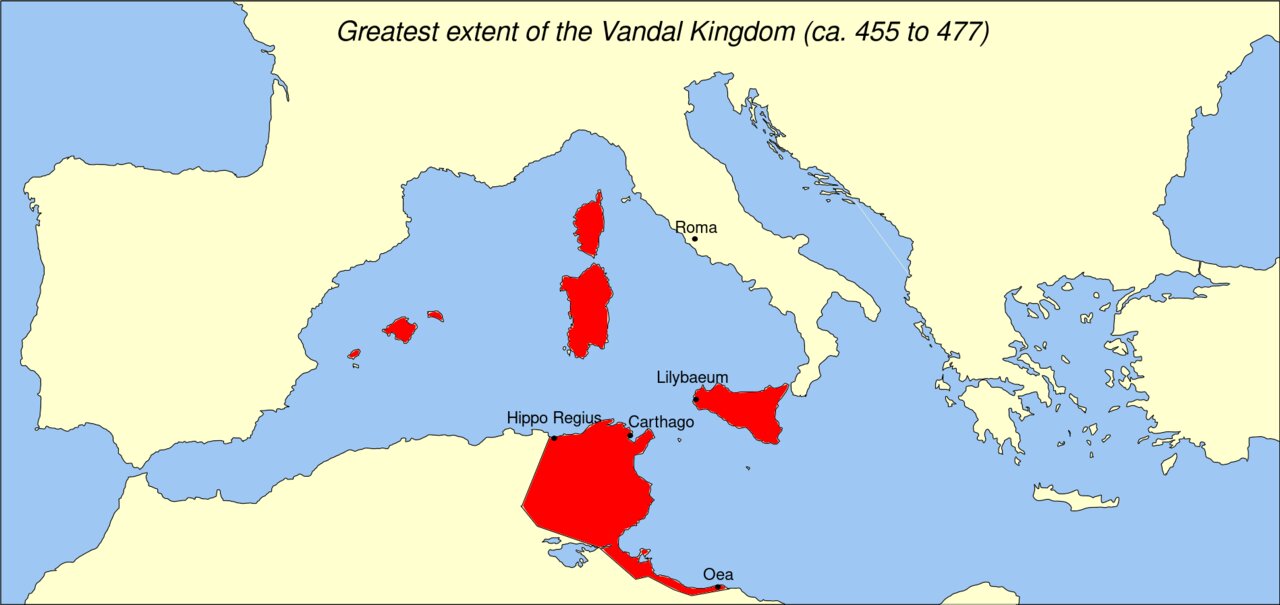
The Vandal Kingdom (439-534) was a Germanic kingdom established in Roman North Africa by the Vandals and Alans, peoples who had crossed the Rhine in 406, fought their way through Gaul, and settled in Spain in 409. Pressed by the Visigoths acting for Rome, some eighty thousand Vandals and Alans crossed the Strait of Gibraltar into Mauretania in 429 under their new king Genseric, one of the most capable war leaders of the age. Marching east along the coast, defeating Roman and Moorish forces alike, Genseric took Hippo Regius in 431, shortly after the death of its bishop Augustine, and in 439 captured Carthage, the second city of the western Mediterranean.
From Carthage the Vandals did something no other successor people managed: they built a fleet. Vandal squadrons seized the Balearic Islands, Sardinia and Corsica, raided the coasts of Italy and Greece, and in 455, after the murder of the emperor Valentinian III, Genseric landed in Italy and sacked Rome itself, carrying off the empress Eudoxia and her daughters and treasure that included the Temple vessels Titus had taken from Jerusalem. Roman attempts to crush the kingdom ended in disaster: the great joint expedition of 468, assembled by both halves of the empire under Basiliscus, was destroyed off Cape Bon by Vandal fireships. The Eastern Empire made peace in 474, recognizing Vandal control of Africa and the islands.
The kingdom was a thin military elite ruling over a large Roman population. The Vandals were homoean (Arian) Christians, while their Roman subjects were overwhelmingly Catholic; Genseric and his son Huneric exiled bishops and clergy and confiscated Catholic churches, though persecution eased under later kings. Roman administration, taxation and coinage continued, the elite of Carthage kept much of its culture, and the countryside remained prosperous through its olive oil and grain exports. But the dynasty was unstable: Genseric's will enforced succession by the eldest male of the family, producing a string of aging kings and palace coups, and Moorish confederations pressed the kingdom's borders.
In 530 the pro-Roman king Hilderic was overthrown by his cousin Gelimer, giving the eastern emperor Justinian a pretext to intervene. In 533 the general Belisarius landed with about fifteen thousand men, defeated Gelimer at Ad Decimum, took Carthage, and destroyed Vandal resistance at Tricamarum; Gelimer surrendered in 534 and ended his days on an estate in Galatia. North Africa became a Byzantine province, the Vandal aristocracy was shipped east or absorbed, and the Vandals vanished as a people so completely that their name survived mainly as a synonym for destruction, a verdict of the Roman writers whose churches and cities they had taken.
 World History Encyclopedia: Vandals
 Timeline