 Go Back

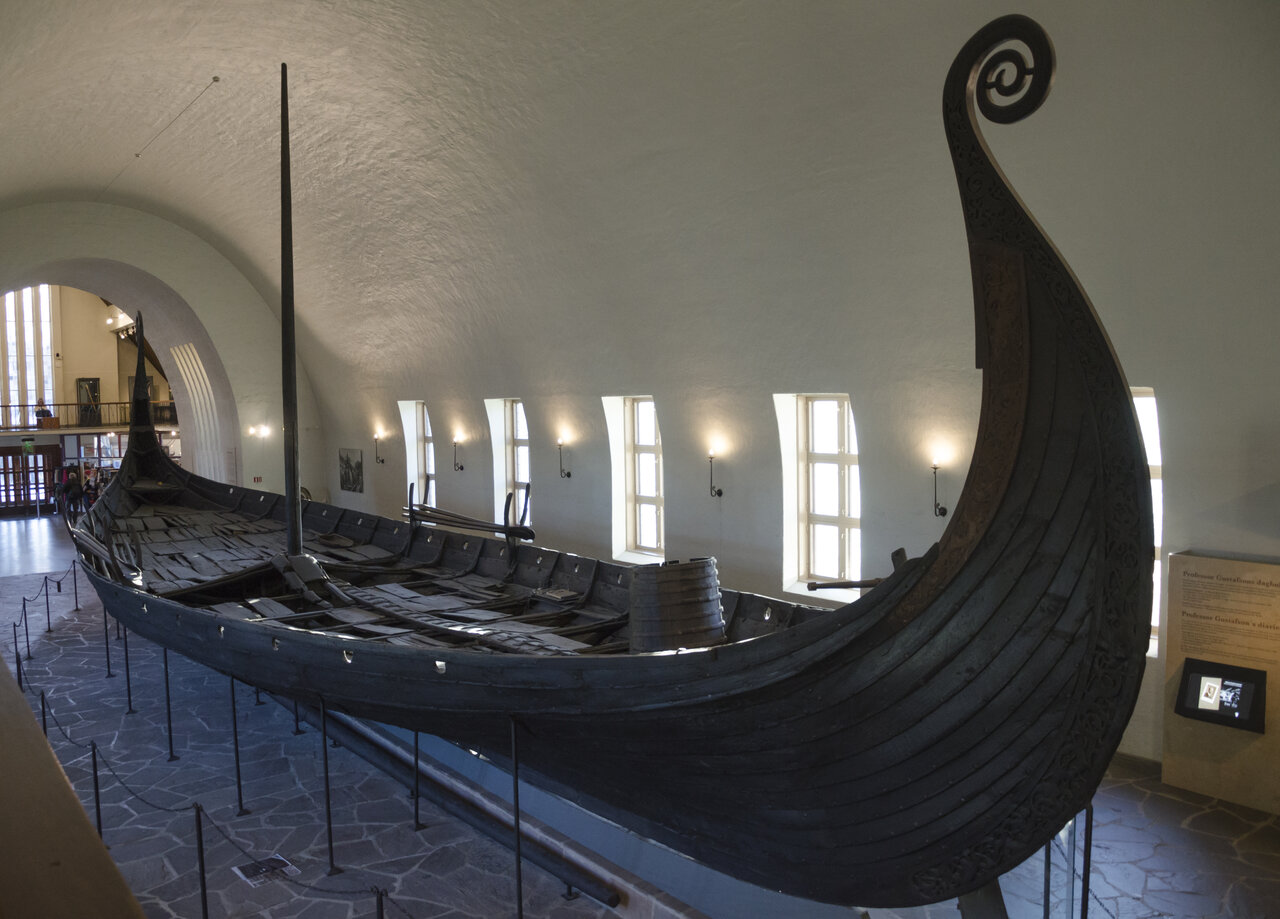
The Vikings were seafaring Scandinavians, Norwegians, Danes and Swedes, whose raids and settlements reshaped northern Europe between about 793 and 1066. Their era opens dramatically with the raid on the monastery of Lindisfarne in 793, recorded with horror by English churchmen. Behind the expansion lay growing populations, quarrels among petty kings, the lure of portable wealth in monasteries and towns, and above all the Viking ship: a clinker-built, shallow-draft vessel with sail and oars that could cross open seas yet slip up rivers, letting raiders strike far inland without warning. 'Viking' was an activity, going raiding and trading overseas, as much as a people.
Norwegian Vikings sailed west, settling the Faroes, Shetland, Orkney, the Hebrides and much of coastal Ireland, where they founded Dublin. From there they pushed to Iceland in the 870s, which became a self-governing commonwealth of farmers with an open-air assembly, the Althing, and then to Greenland under Erik the Red around 985. Leif Erikson reached North America about the year 1000, and the settlement at L'Anse aux Meadows in Newfoundland proves a Norse presence five centuries before Columbus. Danes concentrated on England and Francia: the Great Heathen Army of 865 conquered most of Anglo-Saxon England before Alfred of Wessex stopped it at Edington in 878, leaving the Danelaw under Norse rule, while other Danes besieged Paris in 845 and 885 and won the Seine valley that became Normandy in 911.
Swedish Vikings went east, down the rivers of what is now Russia and Ukraine. Known there as the Rus', they traded furs, slaves, wax and amber to the Black and Caspian Seas, founded river towns such as Novgorod, and according to the Primary Chronicle were invited to rule: the Varangian Rurik's dynasty ended up at Kiev, whose princes grew rich on the route 'from the Varangians to the Greeks'. Swedes served as the Byzantine emperor's Varangian Guard, raided the Caspian coasts of Persia, and left runic graffiti as far away as Hagia Sophia. Viking-age Scandinavia itself was transformed, as the kings of Denmark, Norway and Sweden converted to Christianity and forged national monarchies around the year 1000, and the Danish king Cnut briefly ruled an empire of England, Denmark and Norway (1016-1035).
The Viking Age closed with the failed Norwegian invasion of England defeated at Stamford Bridge in 1066, days before the Norman Conquest, and with the growing strength of European states that could resist raiders. Its legacy runs deep: Icelandic sagas preserving a unique window on Norse society; law, ship technology and trade networks from Dublin to Kiev; the ancestry of Normandy's dukes, Russia's first dynasty and many English families; and the Old Norse words embedded in English. Far from being only raiders, the Vikings were also farmers, merchants, explorers and state-builders whose diaspora connected the Atlantic islands to the rivers of the east.
 Britannica: Viking
 World History Encyclopedia: Vikings