 Go Back

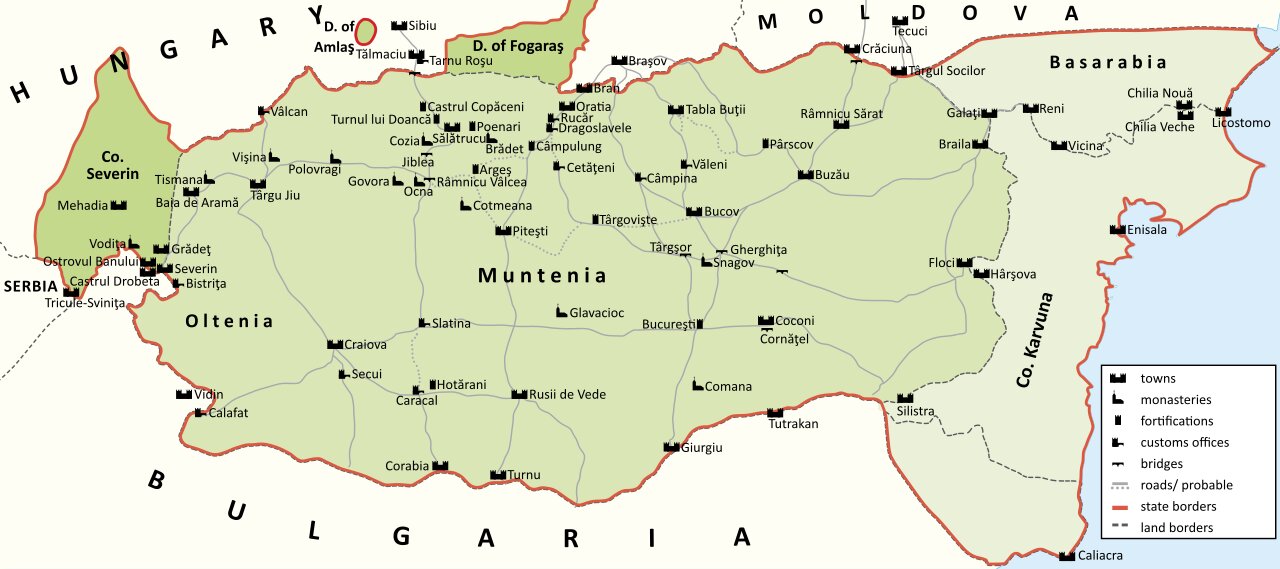
Wallachia and Moldavia, the two medieval Romanian principalities, formed in the 14th century between the Carpathian Mountains, the Danube and the Black Sea, where Romance-speaking communities, descendants of Romanized provincials, Vlachs, lived under loose Hungarian, Bulgarian and Tatar dominance. Wallachia ('land of the Vlachs') was founded about 1310 by Basarab I, who defied Hungary and routed King Charles Robert at Posada (1330); Moldavia followed in 1359, when Bogdan I threw off Hungarian suzerainty. Ruled by voivodes from the Basarab and Musat dynasties, the principalities held rich salt mines, cattle-raising plains and the Danube trade routes toward the Black Sea ports.
From the later 14th century the Ottoman advance overshadowed both states. Mircea the Elder of Wallachia (1386-1418) fought beside the Crusaders at Nicopolis (1396), survived, and paid tribute to keep his throne while building a strong administration. In Moldavia, Alexander the Good (1400-1432) balanced Poland and the Ottomans, founded churches and monasteries, and gave the principality a stable order. Both rulers used diplomacy, tribute and war in turns, a pattern that preserved autonomy even as Ottoman power surrounded them.
The 15th century produced the principalities' most famous rulers. Vlad III Dracula of Wallachia (1448, 1456-1462, 1476), whose father belonged to the crusading Order of the Dragon, ruled by terror, impaling thousands of enemies and criminals, and struck the Ottomans by night attack at Targoviste (1462) before Mehmed II drove him out; German and Russian pamphlets made his cruelty a legend that later fed the Dracula myth. His contemporary Stephen the Great of Moldavia (1457-1504) fought forty-six battles, defeating the Ottomans at Vaslui (1475), where Pope Sixtus IV named him 'Athlete of Christ', and holding his own against Hungary and Poland; he endowed dozens of the painted monasteries of Bucovina that survive as masterpieces of Byzantine-inherited art.
After Stephen's death both principalities slid into vassalage: they paid tribute, supplied troops, and suffered Ottoman interference in their succession, while keeping their own rulers, laws and armies, a status that preserved Romanian statehood when direct provinces had none. Greek merchants and Phanariot princes later dominated their courts, and Russian and Habsburg pressure grew from the 18th century. The two principalities finally united in 1859 under Alexandru Ioan Cuza, the act that created modern Romania. Their medieval heritage, Orthodox faith with Latin language, boyar landholding, and the monasteries and chronicles of Stephen's and Mircea's age, remains the foundation of Romanian national identity.
 Britannica: Walachia
Britannica: Moldavia