 Go Back

Long before the ancestors of today's Inuit spread across the Arctic, a different people made the far north their home. Archaeologists call them the Dorset, after Cape Dorset - Kinngait - on Baffin Island, where their remains were first recognized; Inuit oral tradition remembers them as the Tuniit, a race of strong giants who came before. Growing out of the earlier Pre-Dorset tradition around 800 to 500 BCE, Dorset people occupied the coasts of Arctic Canada and Greenland for some two thousand years, one of the longest-enduring cultures of the ancient Americas.
The Dorset were marine hunters of remarkable skill. They took seals and walrus at the breathing holes and ice edges with heavy harpoons, drove caribou along stone fences inland, and fished and fowled in season - yet they never used the bow and arrow, and unlike the Inuit who followed them they did not hunt the great whales. They pulled hand sleds, cut snow blocks with snow knives for winter houses, and lit and warmed their homes with carved soapstone lamps. In the Late Dorset period they even cold-hammered metal - copper gathered from the Coppermine River and iron pried from the Cape York meteorite in Greenland - and a few objects of smelted metal hint at encounters with the Norse then settling in southern Greenland.
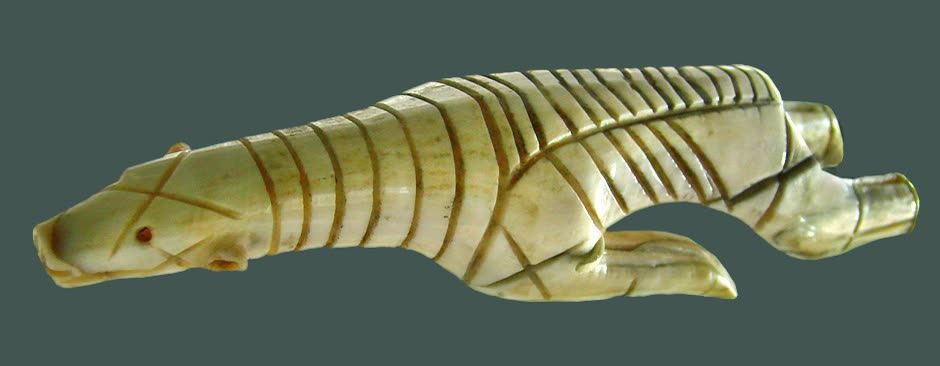
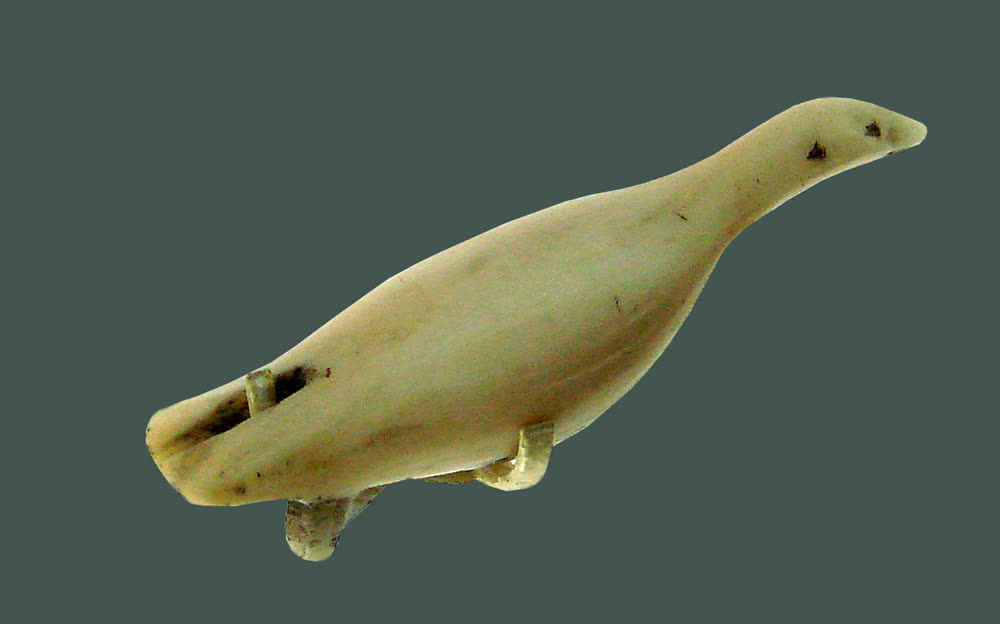
Dorset life left few grand monuments, but it produced one of the most striking small-scale art traditions in the ancient Americas. Dorset carvers shaped walrus ivory, antler, bone, and driftwood into miniature bears, seals, falcons, human figures, and masks, many of them probably used in hunting ritual or by spiritual specialists. The famous swimming bears, only a few centimeters long, show bears gliding through the water with an economy of line that modern artists envy. At Qajartalik in Nunavik they carved faces into the bedrock itself - the only known rock art of the eastern Arctic from this age.
Dorset fortunes turned near the end of the first millennium. The climate shifted, sea-ice patterns and game routes moved, and after about 1000 CE the Thule people - ancestors of the modern Inuit - swept rapidly eastward from Alaska with dog teams, large skin boats, and whale-hunting gear. Dorset communities vanished as Thule settlements spread; how the two peoples met, and how much contact, conflict, or disease passed between them, is still debated. On Southampton Island the Sadlermiut, whose ancestry and culture long puzzled scholars, kept a Dorset-derived way of life into recent centuries before an introduced epidemic destroyed them in 1902-1903.
The Dorset were recognized as a distinct culture only in 1925, when the archaeologist Diamond Jenness separated their strange artifacts from those of other Arctic peoples and named the culture for Cape Dorset. Genetic studies have since confirmed that they were a separate population, largely replaced rather than absorbed by the Thule. Their tiny carvings, now held in museums across the world, remain the most eloquent testimony of a hardy people who made the Arctic their own for two thousand years.
 Britannica: Dorset culture
 The Canadian Encyclopedia: Dorset Culture