 Go Back

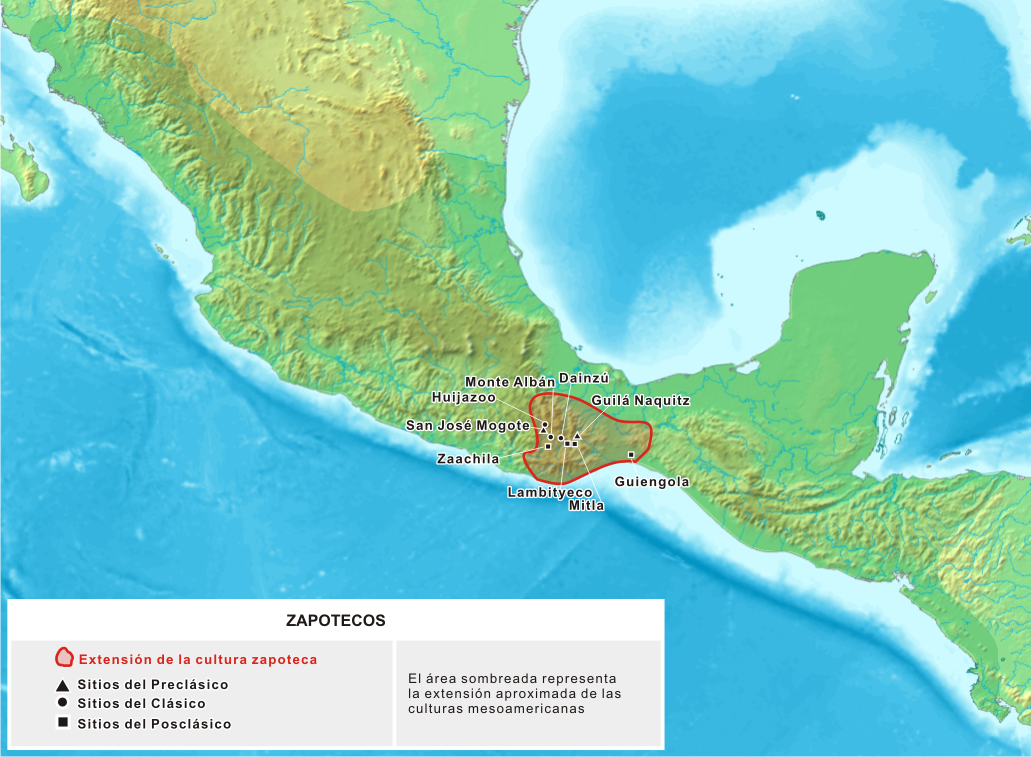
The Zapotec Civilization. The Zapotecs - who called themselves Be'ena'a, 'the People who came from the clouds' - built one of the earliest and longest-lived civilizations of Mesoamerica, flourishing in the Valley of Oaxaca from about 700 BC until the Spanish conquest in 1521: more than two thousand years, and archaeological evidence traces their culture back at least 2,500 years. Their capital was Monte Alban, founded around 700 BC on a flattened mountaintop above the valley: one of the first major cities in Mesoamerica, with monumental buildings, ball courts, tombs, and grave goods including finely worked gold jewelry - the whole great plaza carved from the flattened top of a mountain rising over the valley floor. From it, a Zapotec state dominated the territory of today's Oaxaca for a thousand years, until the capital's role passed to Mitla - whose Palace of Columns still stands - and then to Zaachila, which remained the center until the conquest.
The Zapotecs were among the pioneers of Mesoamerican civilization's defining arts: their early monuments carry some of the region's first hieroglyphic writing and calendrical dates - among the oldest texts in the Americas - and their influence reached far beyond Oaxaca in trade, art, and ideas. Remarkably, they survived as a people through every upheaval - the fall of Monte Alban around 700 AD, the rise of the Mixtecs, even the Spanish conquest that ended their state's independence in 1521. The modern Zapotec peoples of Oaxaca - still speaking their ancient language and preserving their distinct identity in the same valleys their ancestors ruled from Monte Alban - are their direct descendants, a remarkable continuity that few civilizations anywhere in the world can match.
 Britannica: Zapotec
 World History Encyclopedia: Zapotec Civilization
 Humanities LibreTexts: 12.3: The Zapotec
 Smarthistory: Zapotec civilization