 Go Back

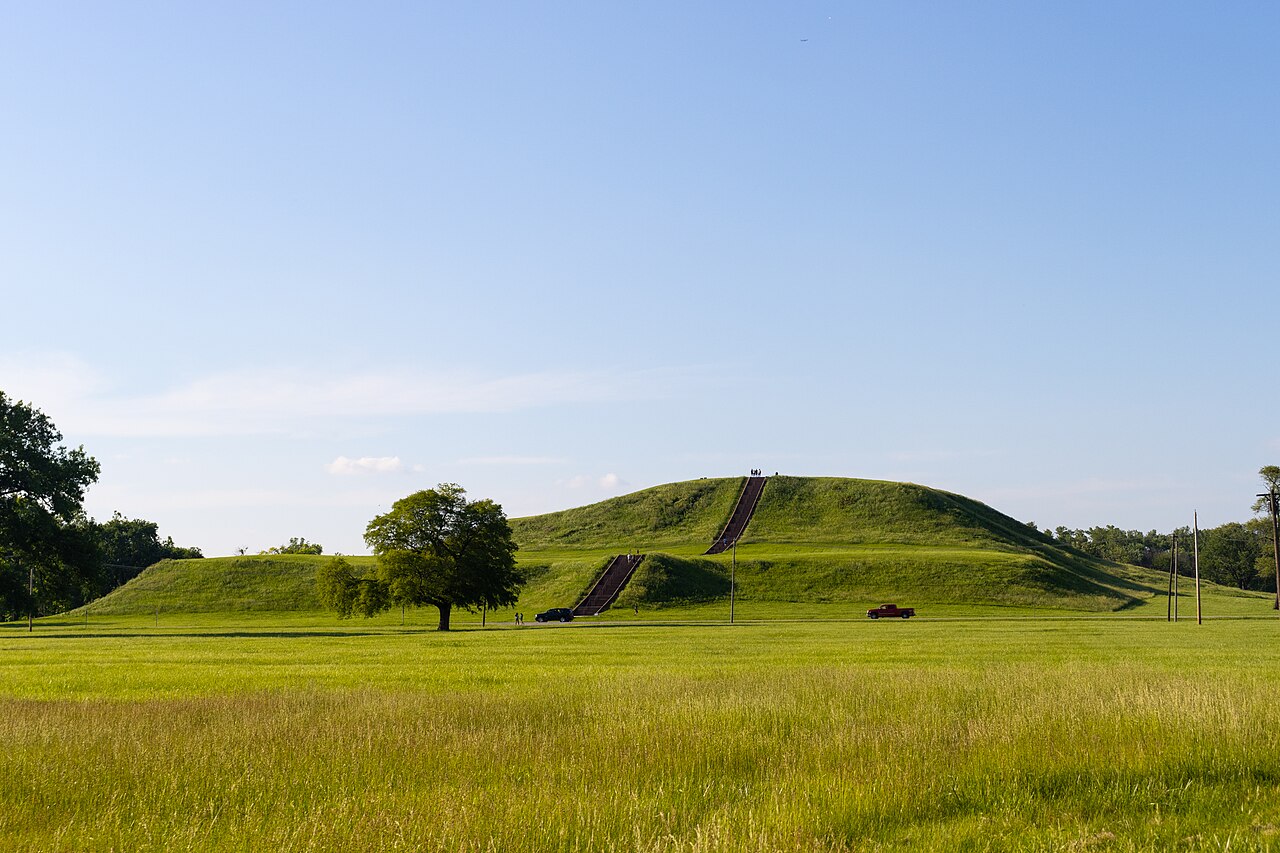
The Mississippian Culture and Cahokia. From the end of the 10th century to the 16th, the Mississippian culture transformed the river valleys of the American South and Midwest: theocratic chiefdoms, dense population centers, maize agriculture and shell-tempered pottery, the new technology of the bow and arrow, and above all the flat-topped platform mounds that crowned their towns - a leap beyond the burial mounds of the earlier Woodland peoples, crowned by a ritual world of the Corn-Mother religion and Datura ceremonies, though the Hopewell clan system endured, so that a traveler could find hospitality from a fellow clan member thousands of miles from home.
Its capital was Cahokia, near today's St. Louis: founded in 1050, it was likely a planned social and religious project, and at its peak around 1124 it held at least 22,400 people - the largest city north of Mexico. The 'Cahokian Big Bang' sent missionaries and influence 500 miles north, and sites like Angel Mounds served as pilgrimage destinations; but drought and political instability after 1150 sent half its people into exile - many to the Nashville area, which peaked around 1275 - and spread Mississippian culture outward to new centers like Moundville in Alabama, the Yazoo basin, and Etowah. Around 1300 new religious ideas swept in from the west - the Datura Ritual Complex - and the Late Mississippian world organized into larger paramount chiefdoms ruled by a 'Gran Cacique,' with whole river basins emptied into 'Vacant Quarter' buffer zones between rivals. These chiefdoms were still flourishing when de Soto's expedition found them in the 1540s; within two centuries, disease and disruption had shattered the mound-building world, leaving the great mounds to puzzle the continent's newcomers.
 Britannica: Mississippian culture
 World History Encyclopedia: Cahokia
 Humanities LibreTexts: 9.2: Mississippian Period (1000 CE – 1500 CE)
 UNESCO World Heritage Centre: Cahokia Mounds State Historic Site