 Go Back

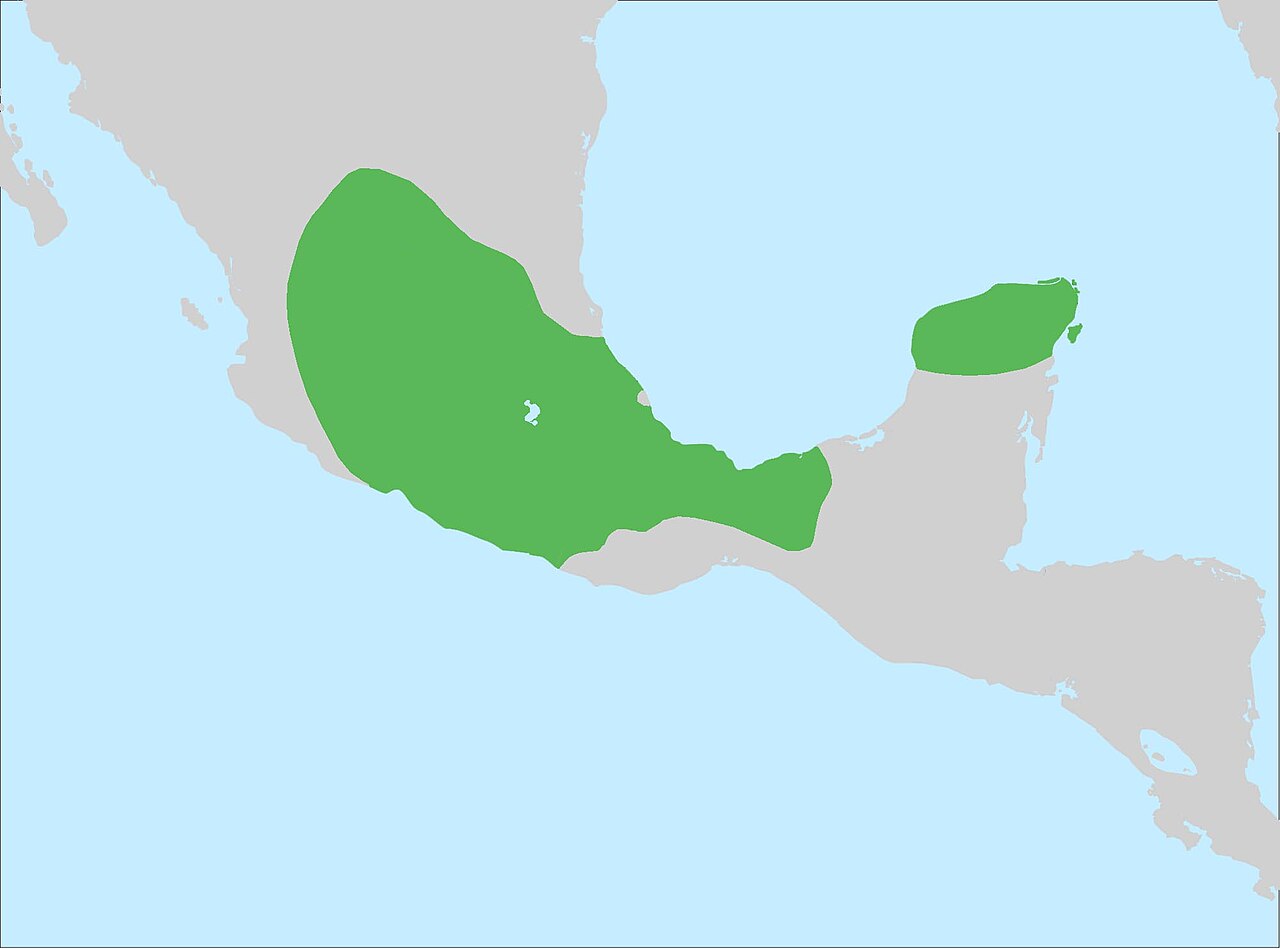
After Teotihuacan burned, the next great power of central Mexico was the Toltecs, whose capital was Tollan-Xicocotitlan, the Tula of the Mexican chronicles, with other important centers at Tulancingo and Huapalcalco. The Toltecs had roots in the Tolteca-Chichimeca peoples who migrated from the deserts of the northwest into the Valley of Mexico in the ninth century, first settling at Culhuacan. Their state flourished through the tenth to mid-twelfth centuries, and its influence reached as far as the Yucatan Peninsula.
The later Aztec chronicles remembered the Toltec past in legendary detail: a theocracy founded in the seventh century that became a monarchy, and above all the priest-king Topiltzin Ce Acatl Quetzalcoatl, placed by the traditional chronology in the tenth century, whose fall unleashed a long struggle between his followers and the cult of Tezcatlipoca. How much of this is history is honestly uncertain - modern scholars dispute whether the Toltecs were an empire at all, and whether Tula dominated or even directly influenced distant Yucatan - but the tradition shaped everything that came after.
The real Tula sits on a limestone promontory in what is now the state of Hidalgo. At its height the city covered some 14 square kilometers with a population of perhaps 30,000 to 40,000, its ceremonial heart laid out in a grid remarkably similar to the Maya city of Chichen Itza. The Aztecs remembered Tollan as a place of fabulous wealth, where craftsmen 'taught the clay to lie' and cotton grew in natural colors; the archaeology confirms at least a major trade in obsidian mined at nearby Pachuca.
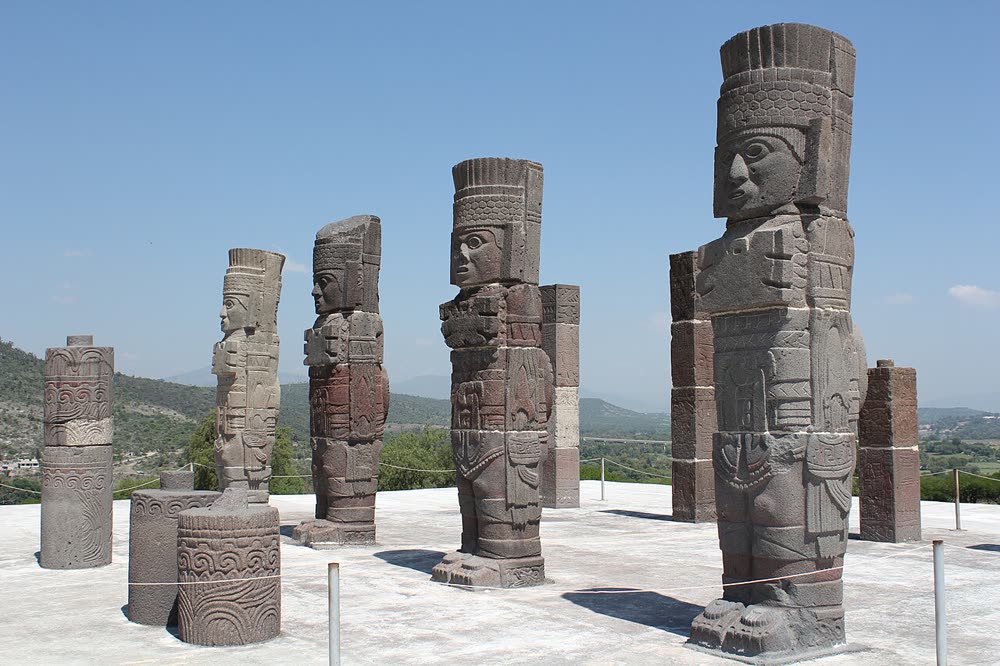
The surviving monuments are impressive: two large pyramids, a colonnaded walkway, a great palace, two ball courts, and a 40-meter L-shaped serpent wall. On top of Pyramid B stand the famous warrior columns, stone soldiers nearly five meters tall, each carved from four drums, holding a spear-thrower, wearing a butterfly pectoral and a drum-shaped headdress. Tollan also gives us the first known chacmools, the reclining stone figures holding offering vessels that would appear in temples across Mesoamerica.
At the center of Toltec memory stands Topiltzin Ce Acatl Quetzalcoatl, a priest-king who took the name of the Feathered Serpent god. The chronicles say he opposed large-scale human sacrifice and was driven from Tollan by the partisans of Tezcatlipoca, fleeing east toward the sea. In Yucatan the Maya knew a parallel figure as Kukulkan, and the striking central-Mexican styles at Chichen Itza - warrior columns, serpent columns, chacmools - have fueled centuries of debate about whether Toltec exiles conquered or transformed that city. No consensus has ever emerged about the direction of the influence.
The chronicles tell of a renewal of the religious conflict in the eleventh century and a great famine in the 1070s, and the archaeology agrees on the ending: in the mid-twelfth century Tollan was violently destroyed, its columns and statues burned and deliberately buried, the site later systematically looted. Led by their last ruler Huemac, the surviving Toltecs were said to have resettled at Chapultepec on Lake Texcoco, an event traditionally dated to 1156 or 1168, while other Toltec exiles carried their cult to Cholula and the Maya lands.
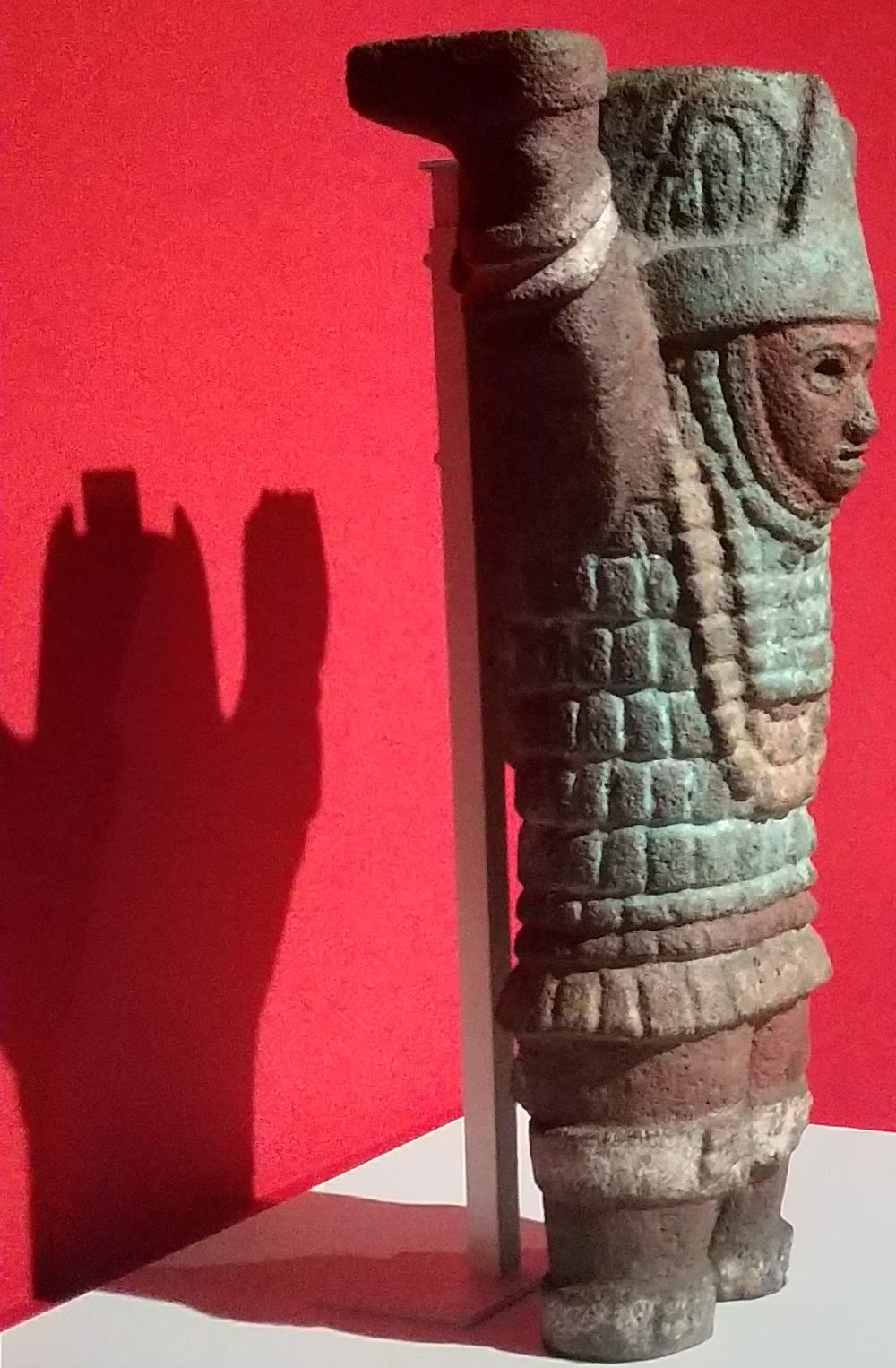
Whatever the Toltecs actually were, their name became the highest praise in Mexico. The Aztecs looked back on the Toltec age as a golden era when writing, medicine, and metallurgy were invented, called their own finest craftsmen tolteca, and sought above all to claim Toltec descent. Their expression Toltecayotl, 'to have a Toltec heart,' meant to excel in all things. Culhuacan, the city where the Mexica first served as mercenaries, was honored as a refuge of Toltec blood. The empire may be partly legend, but the legacy governed Mexican civilization until the Spanish came.
 Britannica: Toltec
 World History Encyclopedia: Toltec Civilization
 Humanities LibreTexts: 12.7: The Toltecs
 The Metropolitan Museum of Art: Mexico, 500–1000 A.D.