 Go Back

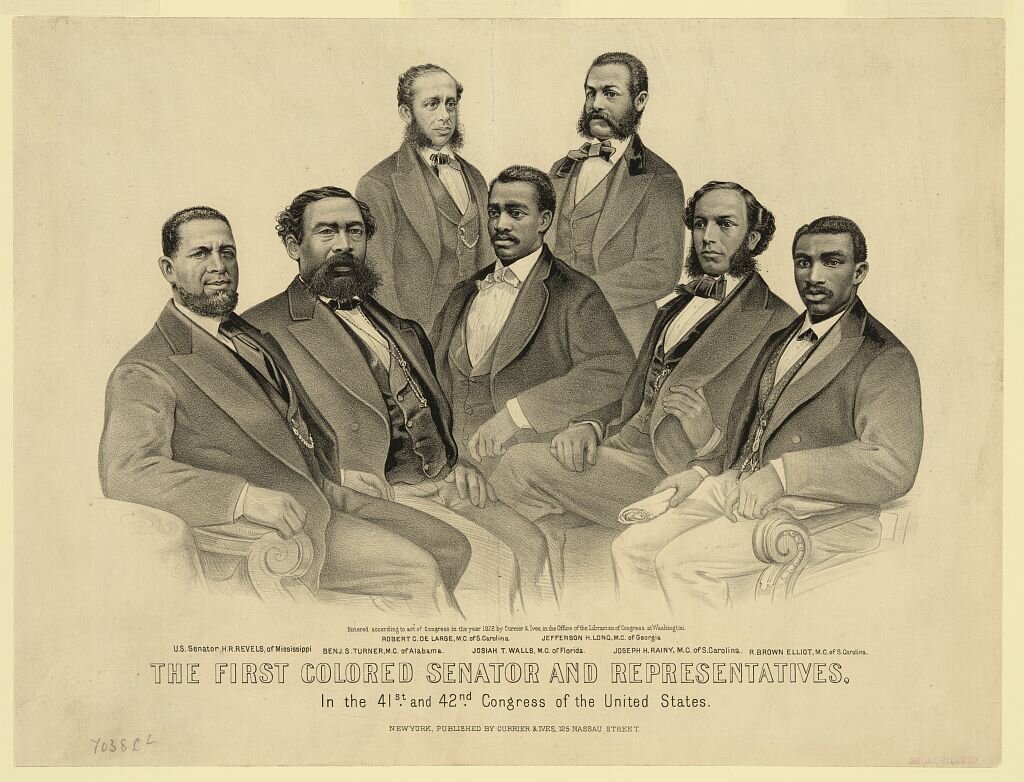
Reconstruction made citizens and voters of men who had been property. Under the Reconstruction Acts of 1867 and the Fifteenth Amendment, Black men registered to vote across the South, forming a majority of the electorate in South Carolina, Mississippi, and Louisiana. Organized through Union Leagues, churches, and Republican clubs, they built a biracial coalition with northern transplants and southern white Republicans that elected new state governments charged with rebuilding the region.
Roughly two thousand Black men held public office during Reconstruction, at every level from local school boards to the United States Senate. Hiram Revels of Mississippi took the Senate seat once held by Jefferson Davis in 1870, and Blanche Kelso Bruce, also of Mississippi, served a full term. Sixteen Black men served in the House of Representatives, including Robert Smalls of South Carolina, who had delivered a Confederate ship to the Union navy. P. B. S. Pinchback briefly served as acting governor of Louisiana, and Black legislators sat in every southern statehouse; South Carolina's lower house had a Black majority. Contrary to later caricature, these officeholders were often literate, experienced community leaders, and their governments were no more corrupt than others of the era.
The Reconstruction governments' achievements were real. They created the South's first public school systems for Black and white children, founded state universities and hospitals, reformed taxation and the courts, and rebuilt railroads and levees destroyed by war. Black communities built institutions of their own: independent churches became the region's Black civic centers, new colleges trained teachers, and Black newspapers and fraternal societies tied communities together.
Black political power was destroyed by violence. The Ku Klux Klan and allied paramilitary groups like the White League and the Red Shirts assassinated officeholders, whipped teachers, and massacred Black voters at Colfax, Louisiana, in 1873 and Hamburg, South Carolina, in 1876. Federal enforcement laws of 1870-1871 broke the first Klan, but northern will faded, and after 1877 the last Republican governments fell. Black southerners voted and held some offices into the 1890s, when disfranchisement ended the experiment, described on the End of Reconstruction page.
 Britannica: Hiram Rhodes Revels
Britannica: Blanche K. Bruce
 Library of Congress: Reconstruction and Its Aftermath