 Go Back

In 1819 the territory of Missouri applied for statehood as a slave state, and the House of Representatives, where the free states held a majority, tried to bar the further spread of slavery there. The Senate, evenly divided between eleven slave and eleven free states, refused. After a year of deadlock, Congress settled the first great sectional crisis in 1820: Missouri entered as a slave state, Maine was carved from Massachusetts as a free state to preserve the balance, and slavery was prohibited in the rest of the Louisiana Purchase territory north of the line of 36 degrees 30 minutes, Missouri's southern border. The aging Thomas Jefferson called the dispute a fire bell in the night, a warning of worse to come.
The Missouri Compromise held for three decades because it rested on a simple bargain: the Senate stayed balanced, and the vast western lands were divided in advance between freedom and slavery. But the bargain contained a fatal weakness. It settled only the Louisiana Purchase, and it depended on both sections accepting limits on slavery's expansion. Southern leaders increasingly rejected any limit as a threat to their political power, while northern opinion slowly turned against the extension of slavery on principle.
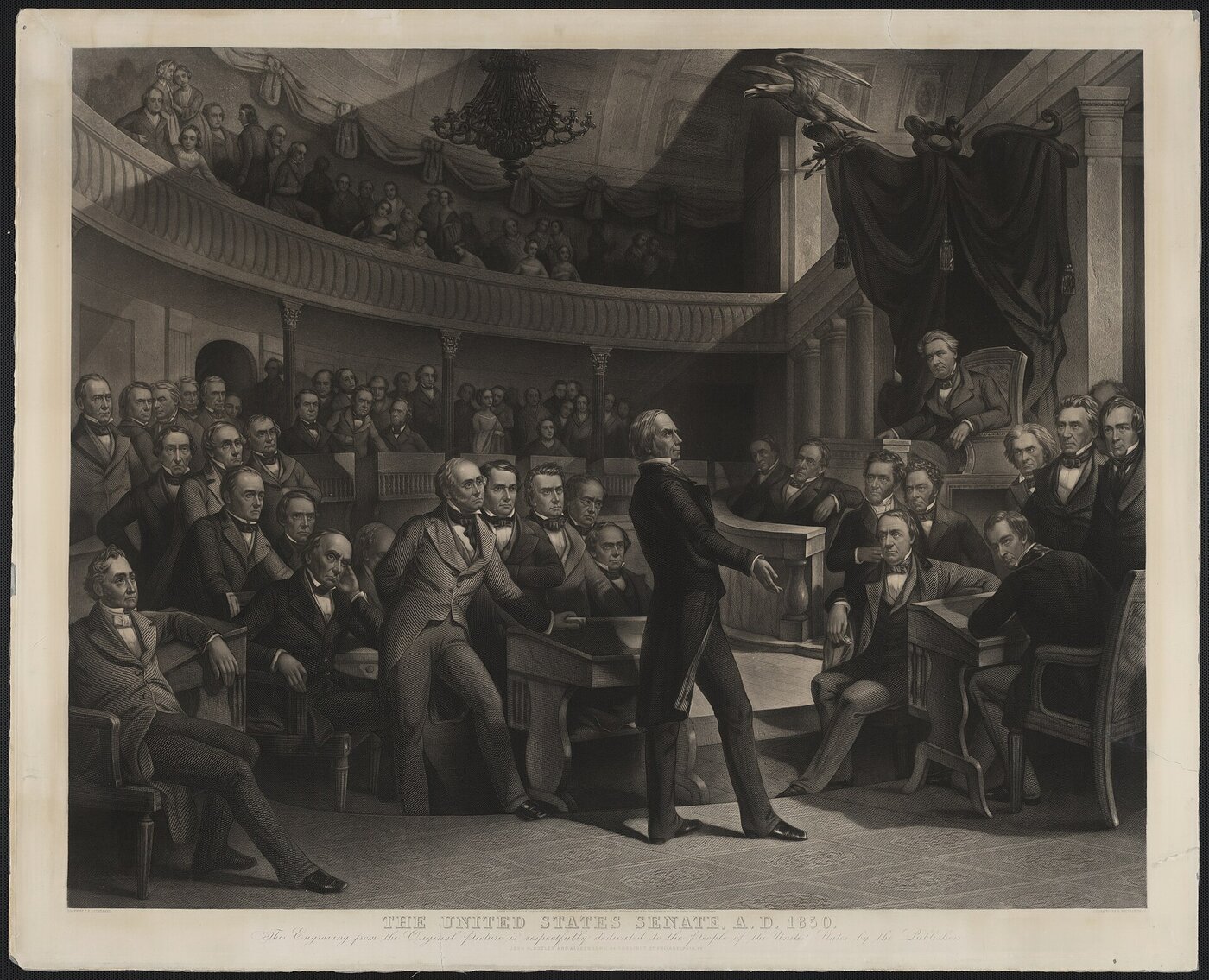
The war with Mexico shattered the arrangement. The Wilmot Proviso of 1846, repeatedly passed by the House and blocked in the Senate, demanded that slavery be excluded from any territory taken from Mexico. When gold rush California sought admission as a free state in 1849, the sectional balance collapsed. Henry Clay proposed a grand settlement, and after his omnibus bill failed, Stephen Douglas steered the measures through separately in 1850: California entered free; the territories of New Mexico and Utah were organized without a slavery prohibition; Texas surrendered its western claims for ten million dollars; the slave trade, though not slavery, was abolished in the District of Columbia; and a drastic new Fugitive Slave Act, described on the Underground Railroad page, put federal power behind the capture of escaped people.
The Compromise of 1850 bought the Union a decade, but its fugitive slave law poisoned northern opinion and its silence on the old 36-30 line invited new bargains. In 1854 the Kansas-Nebraska Act repealed the Missouri line outright, and in 1857 the Supreme Court's Dred Scott decision declared the original compromise unconstitutional. What two generations of statesmen had built to hold the Union together, the next generation tore apart within seven years.
 Britannica: Missouri Compromise
Britannica: Compromise of 1850
Britannica: Wilmot Proviso