 Go Back

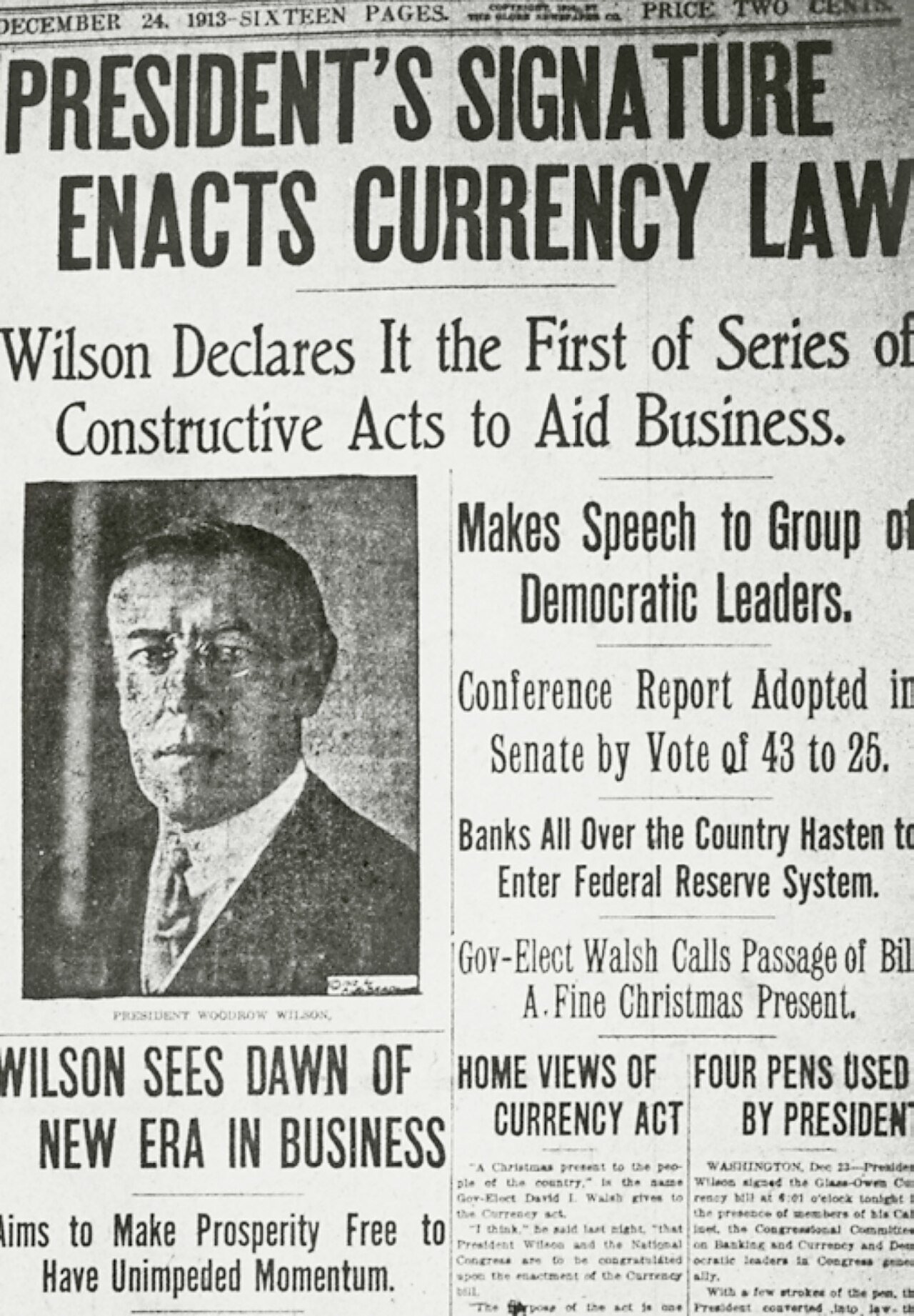
The Federal Reserve and the Progressive Amendments. Woodrow Wilson's first year, 1913, produced the greatest single harvest of reform legislation in American history. At its center was the country's oldest unsolved problem: money. Since Andrew Jackson killed the Second Bank in the 1830s, the United States had been the only great economy without a central bank, and the Panic of 1907 - stopped only when J.P. Morgan personally locked the bankers in his library - proved the arrangement untenable. The answer, passed in December 1913, was the Federal Reserve: twelve regional reserve banks under a public board in Washington, with power to expand and contract the currency - a deliberately decentralized, deliberately American central bank.
The same season completed the progressives' constitutional work. The Sixteenth Amendment, ratified in February 1913, gave Congress the power to tax incomes - and the first modern income tax followed in Wilson's tariff act that autumn, shifting the burden of the federal government from tariffs toward incomes. The Seventeenth Amendment, ratified in April, took the election of senators from the state legislatures - 'millionaires' clubs,' the reformers called them - and gave it to the people directly.
The two amendments had been a generation in the making: Populist demands of the 1890s, passed at last in the progressive tide. Together with the Federal Reserve Act and Wilson's antitrust legislation of 1914 - the Federal Trade Commission and the Clayton Act - they rebuilt the operating system of the American state: an income tax, an elected Senate, a central bank, and a federal referee for the marketplace.
The Federal Reserve grew into the most powerful economic institution on earth; the income tax into the foundation of the federal government; the direct election of senators into settled practice. The progressive reconstruction of 1913 - bank, tax, and ballot in a single year - stands beside the New Deal as one of the two great rebuildings of the American constitutional order between the founders and the present.
 Britannica: Federal Reserve System
Britannica: Sixteenth Amendment
Britannica: Seventeenth Amendment