 Go Back

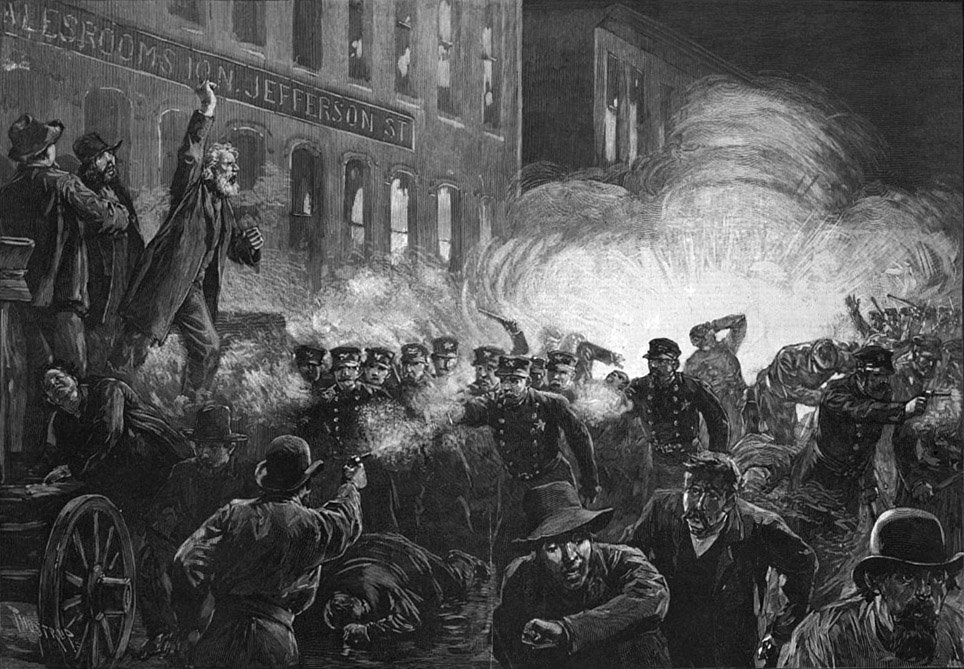
The Haymarket Affair. On 1 May 1886, America's labor movement struck nationwide for the eight-hour day - the first great May Day - and Chicago, the storm center of American labor, led the way. Two days later police fired on locked-out workers at the McCormick Reaper Works, killing several; and on the evening of 4 May a protest meeting gathered in Haymarket Square. It was nearly over, the crowd thinning in a drizzle, when 180 police marched in and ordered it dispersed. Someone - never identified - threw a bomb into the police ranks. The police fired in the dark, and when the firing stopped, one policeman lay dead of the bomb and six more were dying, with dozens of police and civilians wounded.
Chicago's answer was America's first red scare. Eight radical leaders - editors and organizers of the anarchist movement, several not even present when the bomb fell - were indicted for murder on the theory that their words had incited the thrower. The trial was a travesty by later standards: a picked jury, an openly hostile judge, and no evidence connecting the defendants to the bomb. Seven were sentenced to hang. Four - Parsons, Spies, Fischer, Engel - went to the gallows on 11 November 1887, Spies crying, 'The time will come when our silence will be more powerful than the voices you strangle today.' A fifth, Lingg, cheated the rope with a smuggled dynamite cap.
The affair broke the eight-hour movement for a generation and branded labor radicalism with the bomb for fifty years; the Knights of Labor, tainted by association, collapsed toward extinction. But the verdicts would not stand in history: in 1893 Governor John Peter Altgeld, reviewing the record, pardoned the three surviving prisoners and denounced the trial - an act of political suicide that made him a byword and then a hero.
Haymarket became the world's labor martyrdom: when the socialist International chose a day to honor the workers of the world, it chose the 1st of May - and May Day, born in Chicago, is celebrated everywhere on earth except, pointedly, in the United States, where it happened. The police monument in Chicago was blown up twice and now stands behind the walls of the police academy.
 Britannica: Haymarket Affair
Britannica: John Peter Altgeld