 Go Back

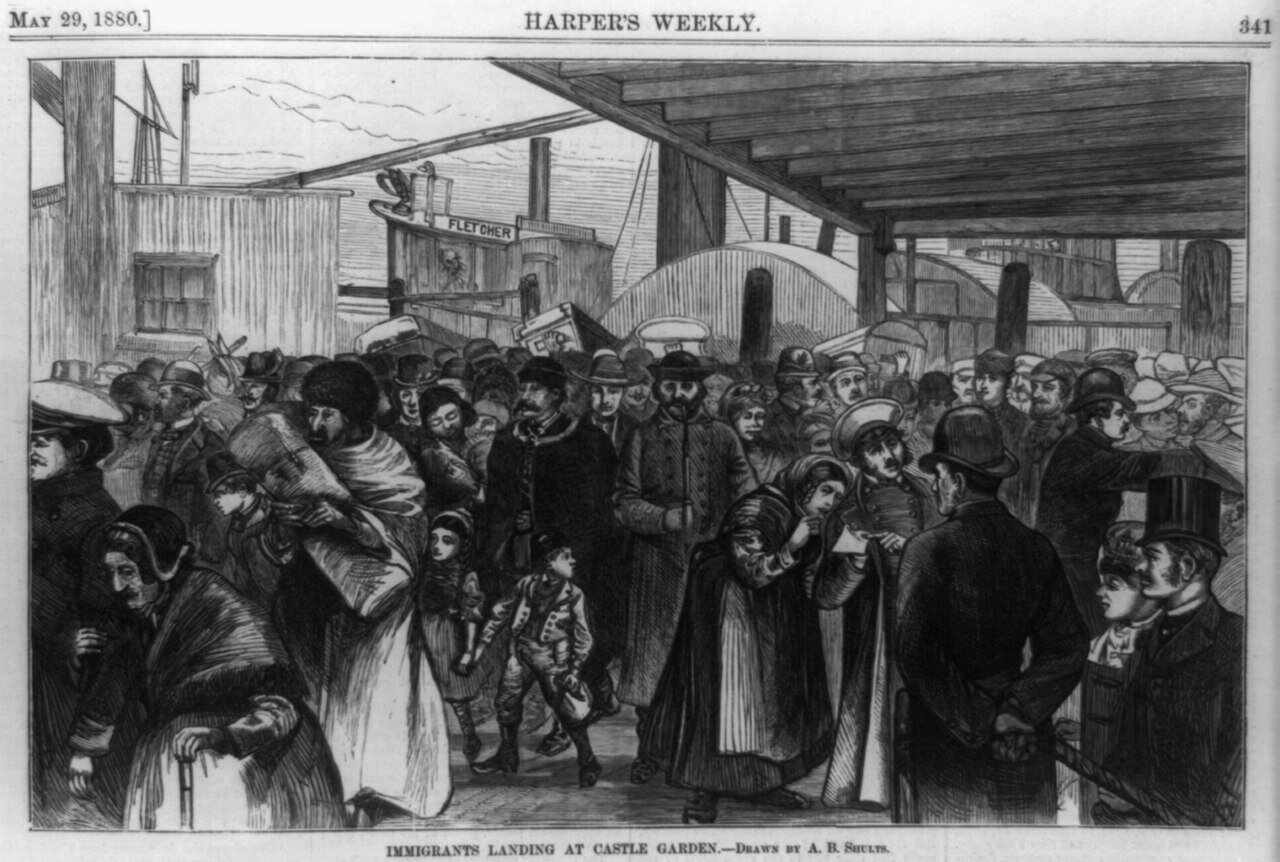
In the mass-migration era from 1880 to 1924, more than twenty-five million immigrants came to the United States. The first postwar wave still came largely from Ireland, Germany, Britain, and Scandinavia; after 1880 the balance shifted to southern and eastern Europe: Italians, Poles, Greeks, Hungarians, and some two million Jews fleeing the Russian Empire's pogroms. They came for wages a European farm could never pay, for land, for family members who had gone before, and to escape conscription and persecution. Steamships cut the Atlantic crossing to about two weeks, and labor agents and letters home guided the stream.
From 1892 the federal government funneled the flood through Ellis Island in New York Harbor, where over twelve million arrivals were processed between 1892 and 1924 alone. First- and second-class passengers were waved through aboard ship; steerage passengers faced the registry hall, where inspectors checked for disease, disability, and signs of contract labor, and where about a fifth were set aside for further inspection while roughly two percent were excluded outright and sent back, sometimes splitting families. On the Pacific coast, Chinese arrivals faced a different regime entirely, described on the Chinese Exclusion page, and from 1910 the Angel Island station detained Asian immigrants for weeks of interrogation.
Most immigrants settled in cities, and the cities strained to hold them. New York's Lower East Side became the emblem of that crowding, its families packed into dumbbell tenements where tuberculosis and fire were constant companions. Immigrants dug the subways, sewed the garments, and manned the steel mills and stockyards, and their neighborhoods built an infrastructure of mutual aid: synagogues and parishes, foreign-language newspapers, fraternal societies, and political machines like Tammany Hall that traded services for votes. Nativism grew with the numbers: the American Protective Association attacked Catholics in the 1880s, and the Immigration Restriction League campaigned for a literacy test, enacted over vetoes in 1917.
The newcomers remade American labor, cities, food, music, and politics, and their children filled the common schools and the armies of 1917. But restriction won the argument of the era: the Emergency Quota Act of 1921 and the Immigration Act of 1924 slammed the gates with national-origins quotas designed to favor northwestern Europe, ending the great age of immigration.
 Britannica: Ellis Island
 National Park Service: Ellis Island
 OpenStax U.S. History: The Growing Pains of Urbanization