 Go Back

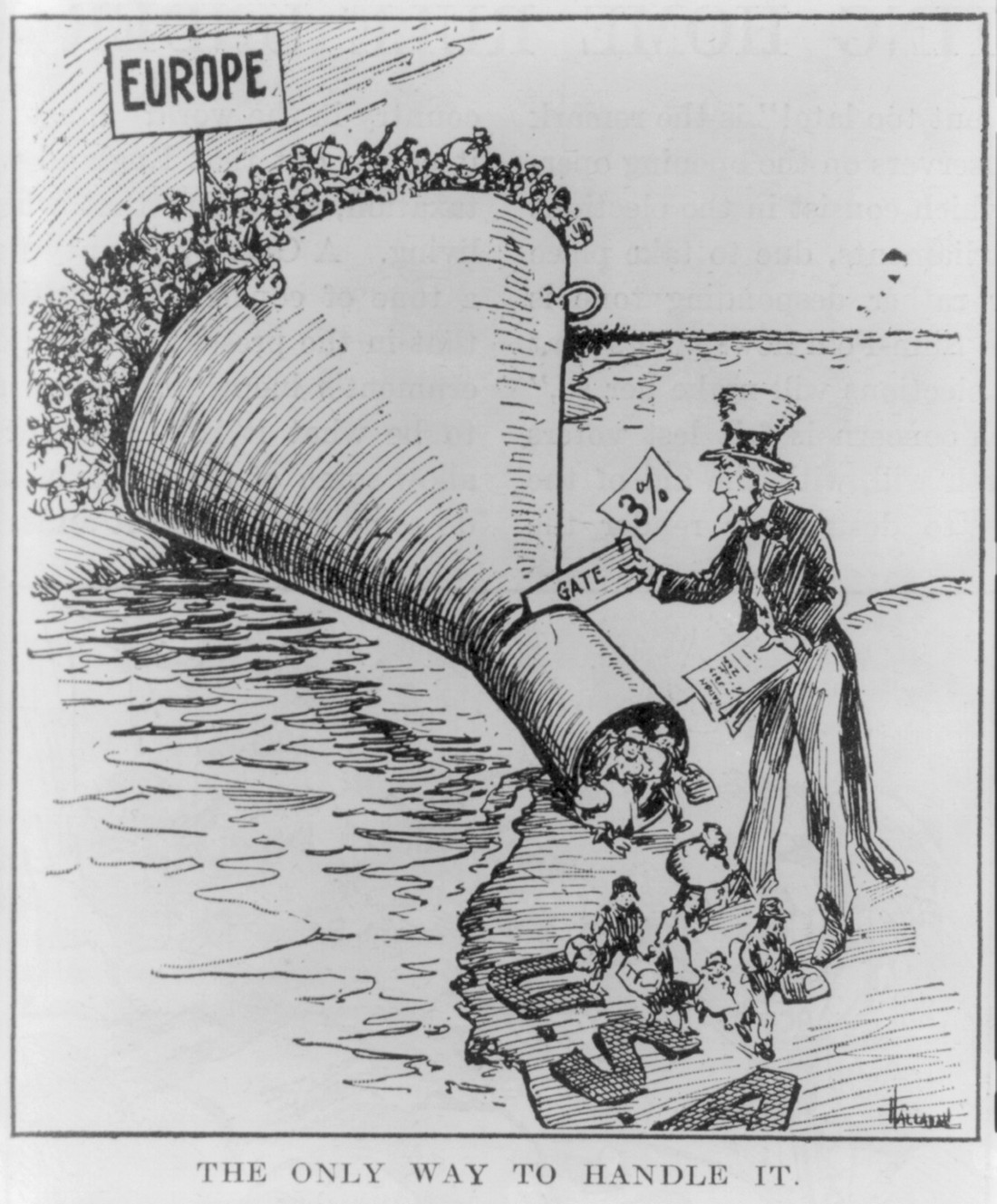
Between 1880 and 1914, more than twenty million immigrants came to the United States, most of them now from southern and eastern Europe: Italians, Poles, Jews, Greeks, and Slavs. The newcomers filled the factories and cities, but they also met rising nativism. Old-stock Americans, influenced by pseudoscientific theories of race, argued that the new immigrants could never be assimilated, and organized labor complained of competition for jobs. Congress responded first with a literacy test in 1917 and with an 'Asiatic Barred Zone' excluding most Asian immigrants.
The First World War and the Red Scare turned restriction into a landslide cause. In 1921 Congress passed the Emergency Quota Act, capping annual immigration at about 350,000 and limiting each nationality to three percent of its foreign-born population in the 1910 census. President Harding signed it, but restrictionists wanted a sharper and more permanent cut.
The Immigration Act of 1924, known as the Johnson-Reed Act, delivered it. The law lowered each nationality's quota to two percent and, crucially, moved the base year back from 1910 to 1890, before the great wave of southern and eastern European migration, so that the vast majority of visas went to northern and western Europeans. It banned virtually all immigration from Asia, provoking anger in Japan. Immigration from Canada and Latin America, however, was left outside the quota system.
The effect was dramatic: immigration fell to a fraction of its prewar level, and the doors that had stood open for generations swung shut. The 1924 act became the cornerstone of American immigration policy as the era closed, and its national-origins logic marked the high point of the nativism that the war years and the Red Scare had unleashed.
 Office of the Historian: The Immigration Act of 1924 (The Johnson-Reed Act)
 Wikipedia: Immigration Act of 1924