 Go Back

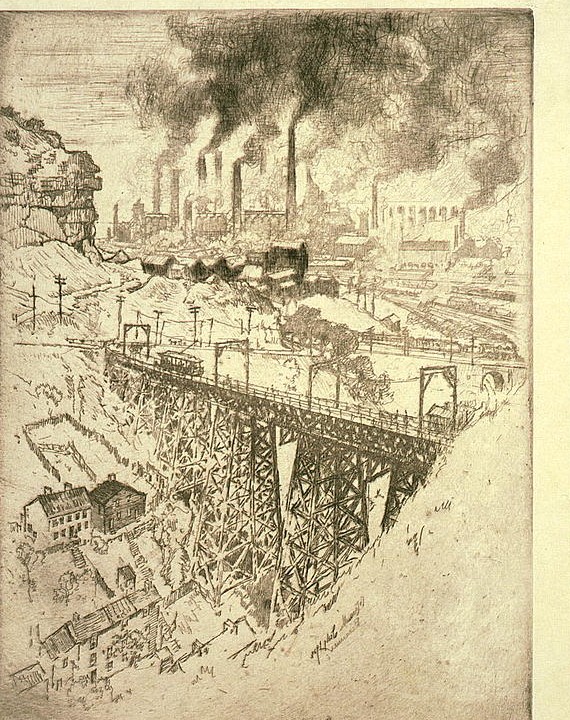
In the four decades after the Civil War, the United States became the world's leading industrial nation. The raw materials were there: coal, iron ore, oil, timber, and the farm output of a continent. So were the people, millions of immigrants and farm youth flowing into factory cities, and the capital, supplied by banks and by the profits of war. Railroads, covered on their own page, tied it all into the largest free-trade market on earth, while protective tariffs, cheap public land, and a government friendly to enterprise kept the conditions favorable. Between 1860 and 1900 American manufacturing output multiplied many times over, and by 1900 it surpassed Britain's.
New technologies made new industries. The Bessemer process made steel cheap, and Andrew Carnegie built an empire on it, controlling every stage from ore to rail before selling out to J. P. Morgan's United States Steel in 1901, the first billion-dollar corporation. John D. Rockefeller's Standard Oil refined and distributed most of the nation's kerosene, organizing competitors into a trust that the courts eventually ordered dissolved in 1911. Electricity lit the cities through Edison's and Westinghouse's systems, the telephone and typewriter remade business, and meatpacking, milling, and machinery became industries on a continental scale. Business leaders defended their power with the language of Social Darwinism and Carnegie's own Gospel of Wealth, which argued the rich should give away their fortunes for the public good.
Mark Twain and Charles Dudley Warner named the era in their 1873 novel The Gilded Age: a surface of glitter over base metal. Industrial fortunes built mansions on Fifth Avenue while tenement families, described on the Immigration and Urban America page, crowded a few blocks away. Corruption reached from Tammany Hall's Tweed Ring in New York to the Credit Mobilier scandal in Congress. Workers labored ten or twelve hours a day, six days a week, in mines and mills where death and injury were routine, and their answer, organization and strikes, is told on the Labor Movement page.
The pressures of industrial capitalism produced the first efforts at national regulation: the Interstate Commerce Commission of 1887 and the Sherman Antitrust Act of 1890 were weak beginnings, but beginnings. After 1900 the Progressive movement, drawing on the agrarian protest covered on the Populism page, pushed regulation much further, breaking up trusts, pure food and drug laws, and new protections for workers and consumers. By 1924 the United States was an industrial colossus whose factories produced nearly half the world's manufactures, a transformation unimaginable when the Civil War began.
 Britannica: Gilded Age
 OpenStax U.S. History: Industrialization and the Rise of Big Business
 Library of Congress: Inside an American Factory, Westinghouse Films 1904