 Go Back

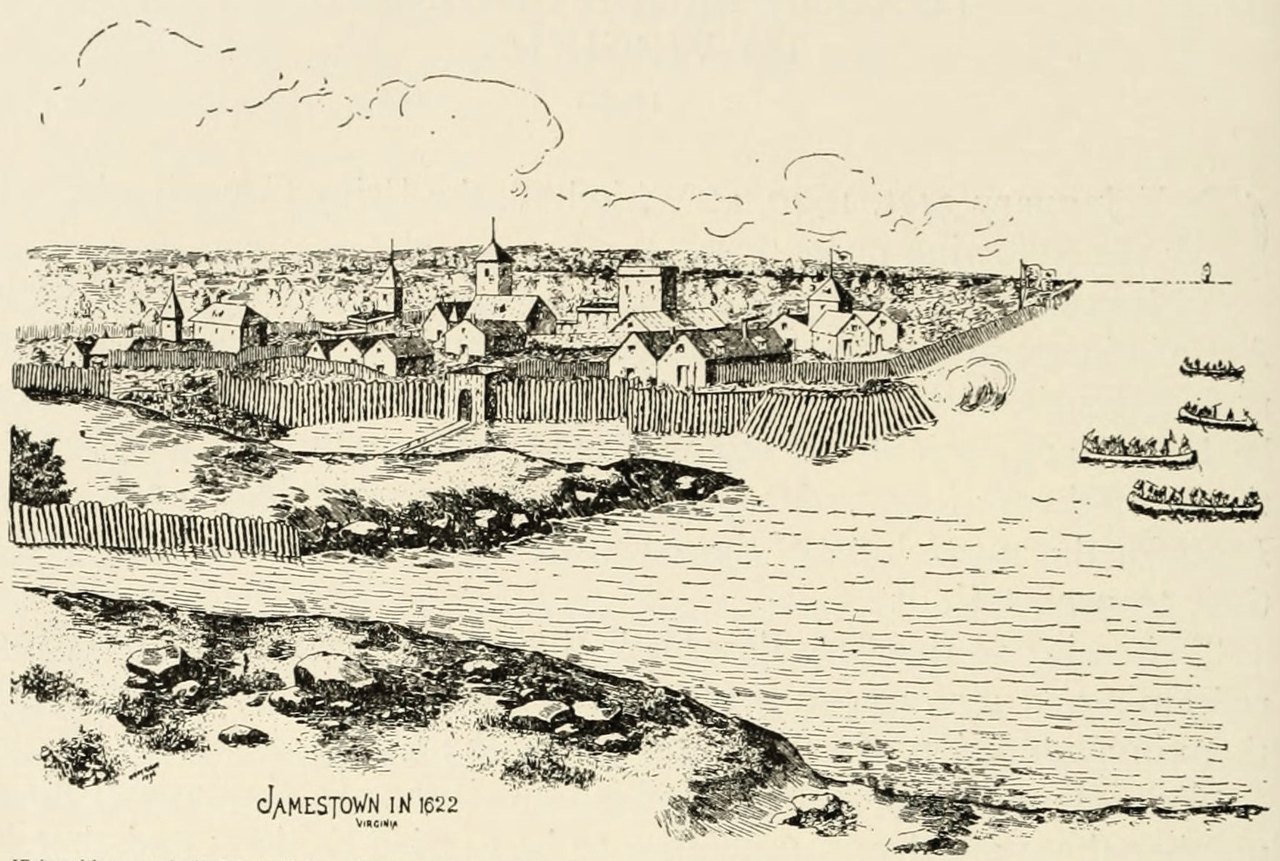
In 1606 King James I chartered the Virginia Company of London, a joint-stock enterprise of investors hoping for gold, a passage to Asia, and profit from North America. The next year three ships, the Susan Constant, Godspeed and Discovery, carried about 104 men and boys up a river they named for their king, where they built a triangular timber fort on a marshy peninsula: Jamestown, the first permanent English settlement in what became the United States. The site was defensible but unhealthy, and the gentlemen-heavy company was ill-prepared to feed itself.
The colony nearly died. Disease, brackish water and hunger killed most of the first settlers within a year, and the 'starving time' winter of 1609-1610 reduced several hundred colonists to sixty, with some resorting to cannibalism. Survival depended on the soldiers' discipline enforced by leaders like John Smith, on shiploads of new recruits, and on the food of the surrounding Powhatan people, who traded, and sometimes withheld, the corn that kept the colony alive. The Virginia Company poured in money and settlers and got almost nothing back.
Virginia's salvation was a weed. John Rolfe's experiments with West Indian tobacco produced a smooth, marketable leaf, and by the later 1610s tobacco exports were booming, turning the struggling outpost into a boomtown of plantations strung along the river. Rolfe's marriage to Pocahontas in 1614 sealed a temporary peace with Powhatan. To attract settlers the company granted private land through the headright system and, in 1619, summoned an elected House of Burgesses, the first representative assembly in English America. That same year a ship landed the first recorded Africans in the colony, 'twenty and odd' captives whose status was then still undefined.
In 1622 Powhatan's successor Opechancanough struck the colony in a coordinated assault that killed roughly a third of its people. The crown used the disaster, and the company's mounting failures, to revoke the charter in 1624, making Virginia a royal colony. Jamestown remained its capital until 1699, when the seat of government moved to Williamsburg, and the old town dwindled into farmland and pasture. Much of the site survived on land, and antiquarian and archaeological work there has recovered the story of England's precarious American beginning.
 Britannica: Jamestown Colony
 National Park Service: A Short History of Jamestown
 Library of Congress: Jamestown and Roanoke Primary Sources