 Go Back

In 1854 Senator Stephen A. Douglas of Illinois wanted to organize the territories of Kansas and Nebraska, partly to clear the way for a transcontinental railroad through his home state. To win southern votes, his Kansas-Nebraska Act declared that the settlers of each territory would decide the slavery question themselves, a formula he called popular sovereignty. Because both territories lay north of the 36-30 line, the act repealed the Missouri Compromise's thirty-four-year-old ban on slavery there. Northern reaction was ferocious: the act shattered the Whig Party, and opponents of slavery's extension founded the Republican Party that same year.
Popular sovereignty turned Kansas into a prize to be won by settlement. Northern emigrant aid societies sent free-state colonists with rifles and supplies, while proslavery Missourians, derided as border ruffians, crossed the line to vote illegally and intimidate their neighbors. Proslavery forces stole the territorial elections of 1854 and 1855, and Kansas soon had two rival governments: a proslavery legislature at Lecompton and a free-state government at Topeka. Both appealed to a divided Washington, where President Pierce recognized the proslavery regime.
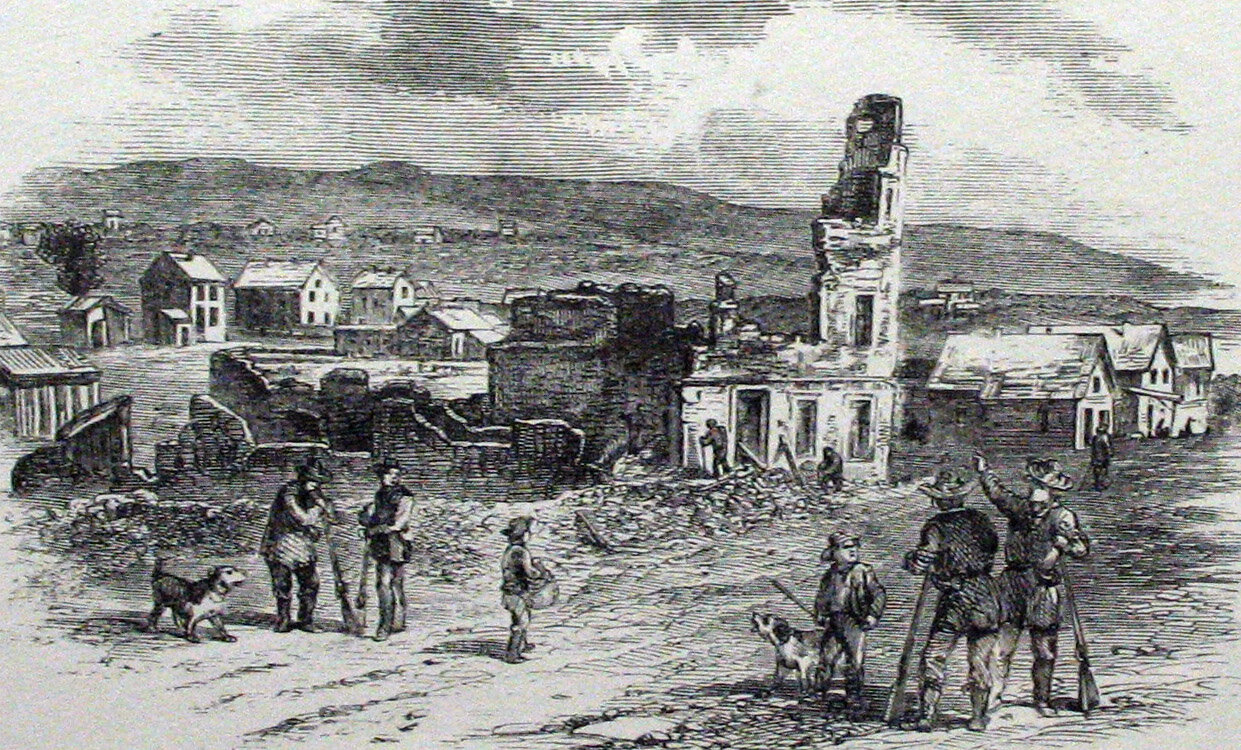
Politics gave way to war. In May 1856 a proslavery posse sacked the free-state town of Lawrence. Days later the abolitionist John Brown, convinced that only violence could answer violence, led a band that dragged five proslavery settlers from their cabins at Pottawatomie Creek and hacked them to death. Guerrilla raids, ambushes, and arson spread across the territory over the next two years, killing more than fifty people in all. In 1857 the proslavery convention at Lecompton drafted a constitution protecting slavery and rigged the referendum on it; Congress refused to accept it, and Kansas finally entered the Union as a free state in January 1861, as the South was already seceding.
Bleeding Kansas was a rehearsal for the Civil War, fought over the same question with the same passions. Its violence reached even the Senate floor, where in 1856 Representative Preston Brooks of South Carolina beat Senator Charles Sumner of Massachusetts nearly to death with a cane after an antislavery speech. The crisis proved that popular sovereignty could not settle the slavery question peacefully, destroyed the last national party capable of bridging the sections, and made the new Republican Party, and Abraham Lincoln, the vehicle of northern resolve.
 Britannica: Kansas-Nebraska Act
Britannica: Bleeding Kansas
Britannica: Popular Sovereignty